

On this page
If you love science but do not want to spend your life in a laboratory, science communication offers a direct path to turn technical curiosity into a career. Science writers and communicators translate complex research into accessible stories, videos, exhibits, and public campaigns. Rather than choosing between humanities and STEM, this field lets you combine analytical thinking with storytelling.
What career paths exist in science communication?
Science communication spans four main professional tracks, each requiring a distinct mix of technical literacy and narrative skill:
Science journalism and editorial writing: Reporting new discoveries for magazines, newspapers, and digital outlets. In India, publications like Science Reporter, published by CSIR-NIScPR, have introduced popular science to readers since 1964.
Institutional communication: Writing press releases, research summaries, and annual reports for universities, research institutes, and hospital systems. Public information officers (PIOs) help faculty present their peer-reviewed work accurately to the media.
Multimedia and video production: Scripting, animating, and presenting science explainers on digital channels, podcasts, and documentary platforms.
Museum curation and interactive outreach: Designing experiential galleries, conducting live demonstrations, and guiding visitors. The National Council of Science Museums administers 26 science centres and museums across India under the Ministry of Culture, regularly hiring education assistants and curators to run science demonstration lectures and mobile exhibitions.
For students exploring options outside conventional engineering or clinical degrees, talking about STEM careers beyond traditional tracks helps parents and teachers understand that public engagement is an established, growing profession.
Why is modern science communication shifting toward dialogue?
Historically, science outreach relied on the "deficit model." As documented by Bauer, Allum, and Miller (2007) in Public Understanding of Science, earlier decades operated on the assumption that public skepticism stemmed solely from a lack of scientific literacy, meaning scientists simply needed to deliver lectures to fill knowledge gaps. Over the past three decades, research has demonstrated that communication works best as a two-way dialogue that builds institutional trust.
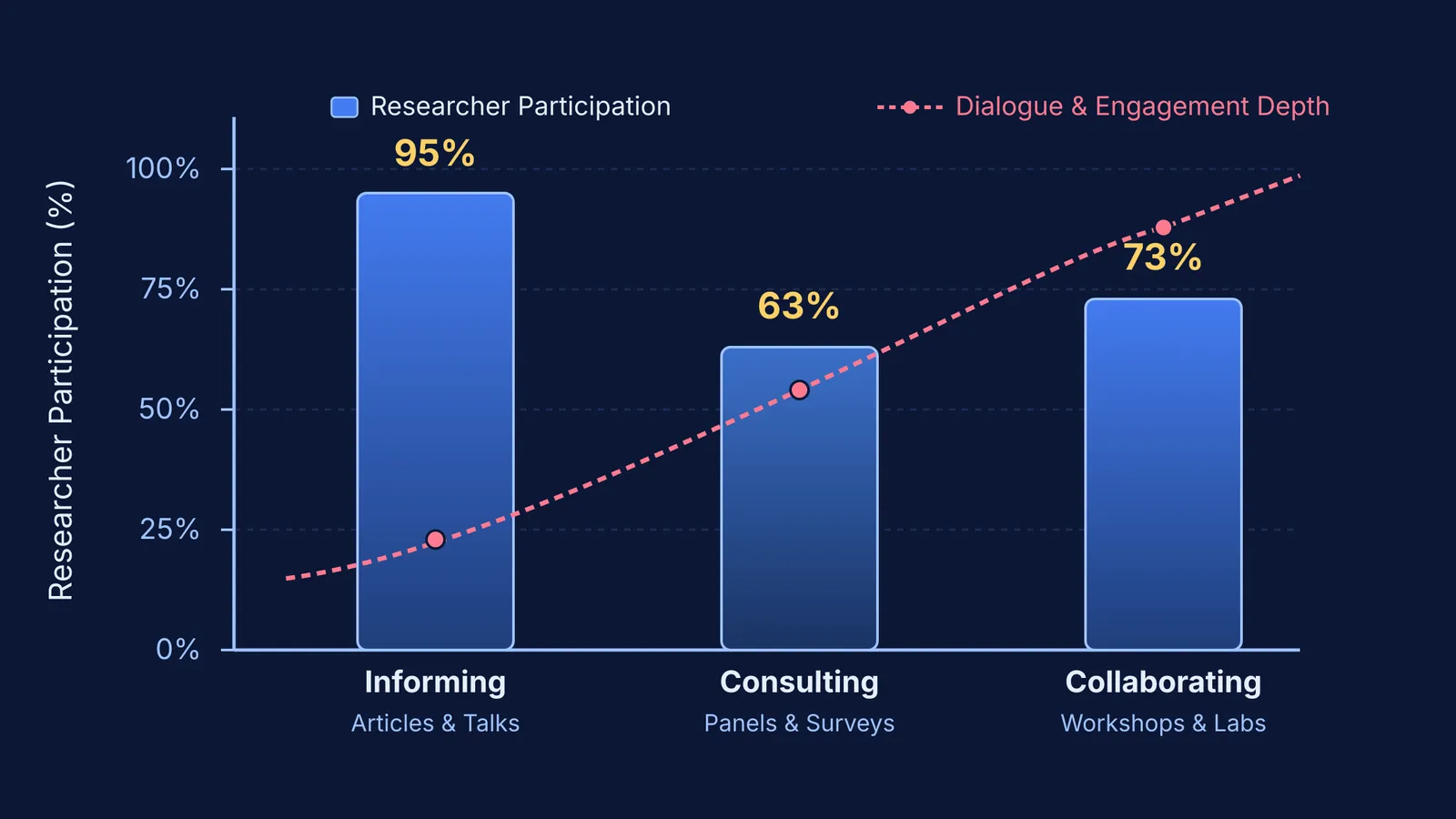
Today, active researchers are eager to participate in public discussions, but they frequently lack the time to craft lay narratives. A 2025 survey by the Royal Society on factors affecting public engagement found that 96% of surveyed researchers had participated in at least one public engagement activity in the prior 12 months. Specifically, 95% participated in informing activities, 73% in collaborative projects, and 63% in public consultations. Professional communicators provide the critical structure that makes these interactions meaningful.
Before explaining a mechanism to others, you have to grasp its causal structure yourself. When untangling complex topics across disciplines, the Fermi Concept Library offers dedicated lessons for every concept in physics, chemistry, biology, mathematics, and computing, helping you confirm technical foundations before translating them for an audience.
How can you build a portfolio while studying?
You do not need to wait for a degree or a press pass to start building credentials. In an empirical study on science writing pedagogy published in Frontiers in Environmental Science, Harrington and colleagues (2021) showed that writing quality across genres depends on "higher-order" rhetorical skills—audience awareness, purpose, and context—rather than passive mastery of technical jargon.
To prove those skills, build a four-piece portfolio while in school or college:
A short research explainer (500–700 words): Pick a recent open-access paper, decode the findings using our guide on how to read a scientific paper, and explain why the result matters to an everyday reader.
A multimedia storyboard or video script: Write a 2-minute script explaining a counterintuitive physical or chemical phenomenon, complete with visual cues for animation.
An interactive demonstration plan: Design a 15-minute hands-on activity or experiment worksheet for younger learners. Designing activities that help children learn without adding pressure shows that you can make abstract ideas tangible and engaging.
A researcher profile (800–1,000 words): Interview a professor or doctoral scholar on your campus about their experimental journey, focusing on obstacles they overcame rather than just their resume.
For visual and interactive communicators, static text often falls short when explaining dynamic mechanisms. Exploring the Fermi Simulation Lab shows how interactive simulations help make abstract ideas easier to see than to read, providing inspiration for video storyboards and museum demonstrations.
How do you pitch an editor or outreach coordinator?
Editors and outreach managers rarely hire based on a generic resume; they hire based on specific story ideas. The National Association of Science Writers, founded in 1934, recommends studying professional pitch structures to understand what editors need before sending an email. Resources like The Open Notebook pitch database host over 300 successful pitches across major global science publications.
Every strong pitch follows a 4-part framework:
The Hook: One sentence on what happened or what makes this story urgent right now.
The Science: Two sentences explaining the key finding, avoiding jargon.
The Stakes: Why the publication's specific audience will care.
The Fit: Why you are qualified to write it, linking to your portfolio samples.
Use this short template when emailing a department editor or campus magazine:
"Dear [Editor Name], I am pitching a 700-word piece on [Topic]. While most coverage focuses on [Common View], a new study in [Journal] shows that [Specific Insight]. This matters to your readers because [Everyday Impact]. I am an undergraduate studying [Subject] and have previously covered science for [College Publication/Blog]. You can see two relevant clips at [Portfolio Link]. Thank you for your time."


