On this page
Development Communication and Journalism is Chapter 13 of the NCERT Human Ecology and Family Sciences Part II textbook for Class 12 (reprint 2026-27). It shows how news, radio, campaigns and technology help communities develop, and what careers follow.
How many marks is Development Communication and Journalism worth?
The CBSE Home Science (064) curriculum for 2026-27 gives Unit VI, Communication and Extension, 5 of the 70 theory marks. This is the only chapter the curriculum lists under Unit VI.
The curriculum keeps every section: introduction, significance, three basic concepts, four methods, skills, and scope and careers. It does not list NCERT Chapter 14, Corporate Communication and Public Relations, or the book's radio public service announcement practical. One project option fits here: planning five nutrition, health and life-skills messages through different modes of communication.
What is development communication?
NCERT builds the chapter on three ideas (NCERT Chapter 13):
Development: lasting positive change in the social, economic and cultural lives of most people, achieved without exploitation or violence.
Development journalism: reporting that grew after the colonial era. It covers success stories of people who try new methods or technologies and the people working in new projects.
Development communication: using communication on purpose, with planned strategies, to bring positive social change. NCERT says Nora Quebral first coined the term in 1972.
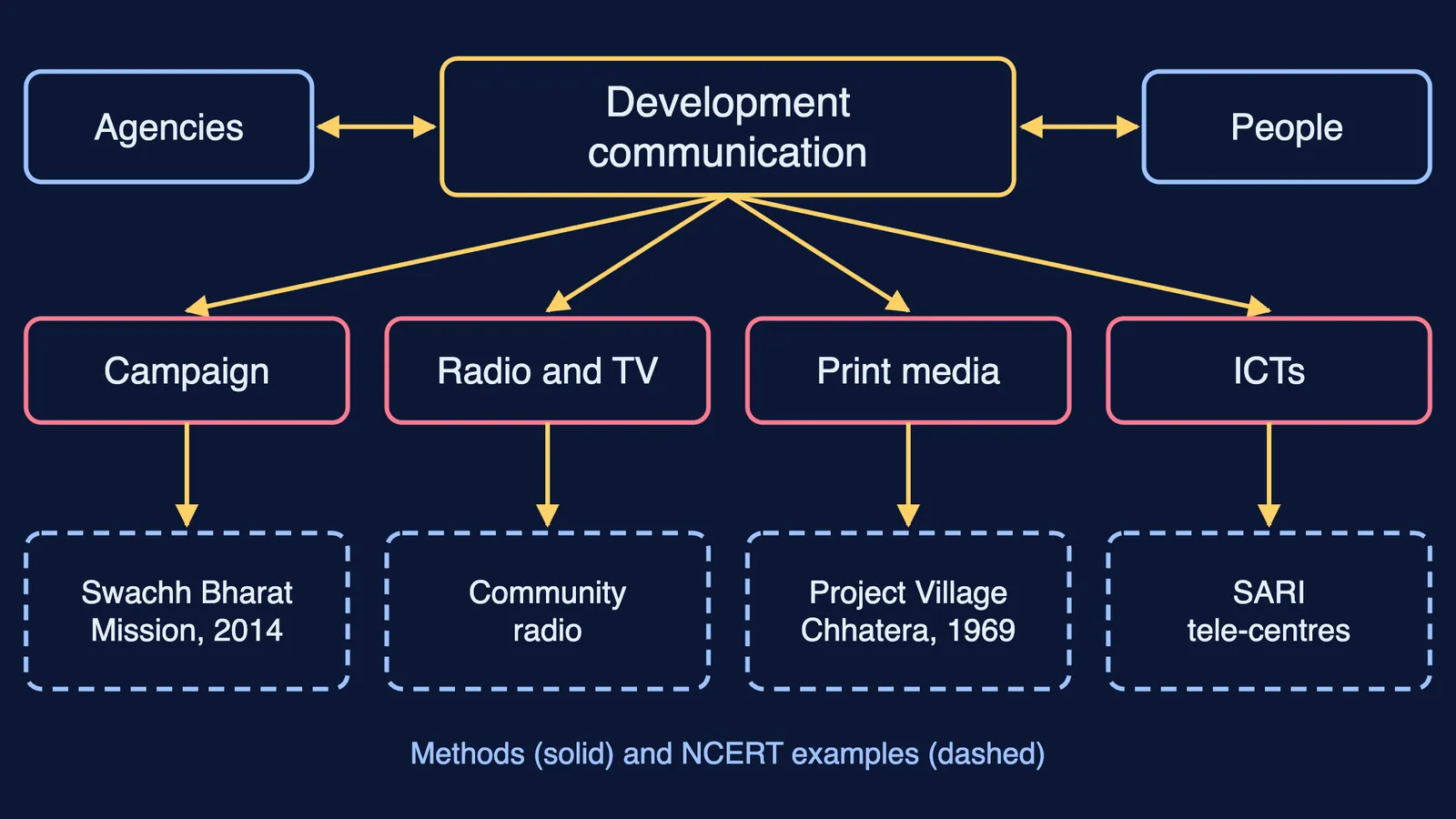
Its four features: it aims at people's socio-economic progress and well-being, informs and educates, mixes mass media with face-to-face channels, and is shaped around the audience. It is two-way, treating people facing a problem as able to solve it and building dialogue between communities and agencies.
NCERT's example is the Red Ribbon Express, an HIV/AIDS awareness train that travelled over 9,000 km a year, stopped at 180 stations and held activities in 43,200 villages.
What are the methods of development communication?
NCERT gives an Indian example of each method.
Campaign: meetings, leaflets, articles and exhibitions used intensively on one theme for a fixed period. NCERT's example is the Swachh Bharat Mission, launched on 2 October 2014 as a nationwide campaign that aimed to end open defecation in rural areas between 2014 and 2019.
Radio and television: NCERT calls radio the most accessible mass medium: cheap, portable and useful where literacy is low. Public service announcements last 10 to 60 seconds and carry a message for the public good, often as a jingle. Community radio is run by local people in their own dialect for a small area, as at Vanasthali Vidyapeeth, SEWA and Delhi University. EDUSAT (September 2004) was India's first satellite built only for education.
Print media: rural topics get little space. In Project Village Chhatera, started in 1969, the Hindustan Times ran a fortnightly column on one Northwest Delhi village, and the coverage brought roads, bridges and banks.
ICTs: computers, digital broadcasting and telecom, such as about 80 tele-centre kiosks in Tamil Nadu's SARI project and SEWA's IT training centres for its women members.
What skills and careers does the chapter list?
NCERT's skills, in our words:
Cognitive and creative: understand an issue, then present it in a way that catches attention.
Technical: camera work, video and radio production, editing, equipment handling, and the rules that govern media work.
People skills: listening, interviewing, leadership, and the social work principle of helping people help themselves.
Language and computers: command of one language for reports, plus word processing, spreadsheets and slides.
Curiosity: interest in current affairs, probing questions, and willingness to travel.
Where you can work: media houses, government departments and NGOs, as a development journalist, radio jockey or anchor, research scholar, trainer of field workers, or freelance consultant.
Practice questions for Development Communication and Journalism
The CBSE 2026-27 sample paper tests this chapter with one 1-mark MCQ and two 2-mark questions, one with an internal choice, matching the unit's 5 marks. These questions are ours.
(1 mark, MCQ) NCERT dates the term development communication to (a) 1962 (b) 1969 (c) 1972 (d) 2004.
(1 mark, MCQ) A 30-second jingle asking listeners to wear a helmet is a (a) documentary (b) public service announcement (c) talk show (d) tele-centre.
(1 mark, MCQ) Which mass medium does NCERT call the most accessible? (a) Newspaper (b) Radio (c) Television (d) Internet
(2 marks) A women's group in a hill village wants to share crop prices and weather alerts in their dialect. Suggest a suitable medium and give two reasons.
(2 marks) State two ways development journalism differs from reporting before independence.
(2 marks) Name two technical skills a development filmmaker needs and say why each matters.
(2 marks) Using one chapter example, explain how ICTs can help low-income communities.
Answers: Q1 (c). Q2 (b). Q3 (b).
Next, revise Consumer Education and Protection Class 12, or explore journalism and mass communication after 12th and BSc Home Science career options.
Not sure where to start revising? Fermi's AI tutor works out what you already know and builds a plan for the session.