On this page
The CBSE curriculum for 2026-27 gives Unit 1 Judiciary 08 of the 80 theory marks and lists five topics: courts and legal officers; roles and impartiality; appointment, retirement and removal of judges; tribunals; and judicial review. The prescribed text is the CBSE Legal Studies Class XII book, second edition 2023. Our Class 11 Political Science Judiciary guide covers independence and PIL.
How are courts in India arranged?
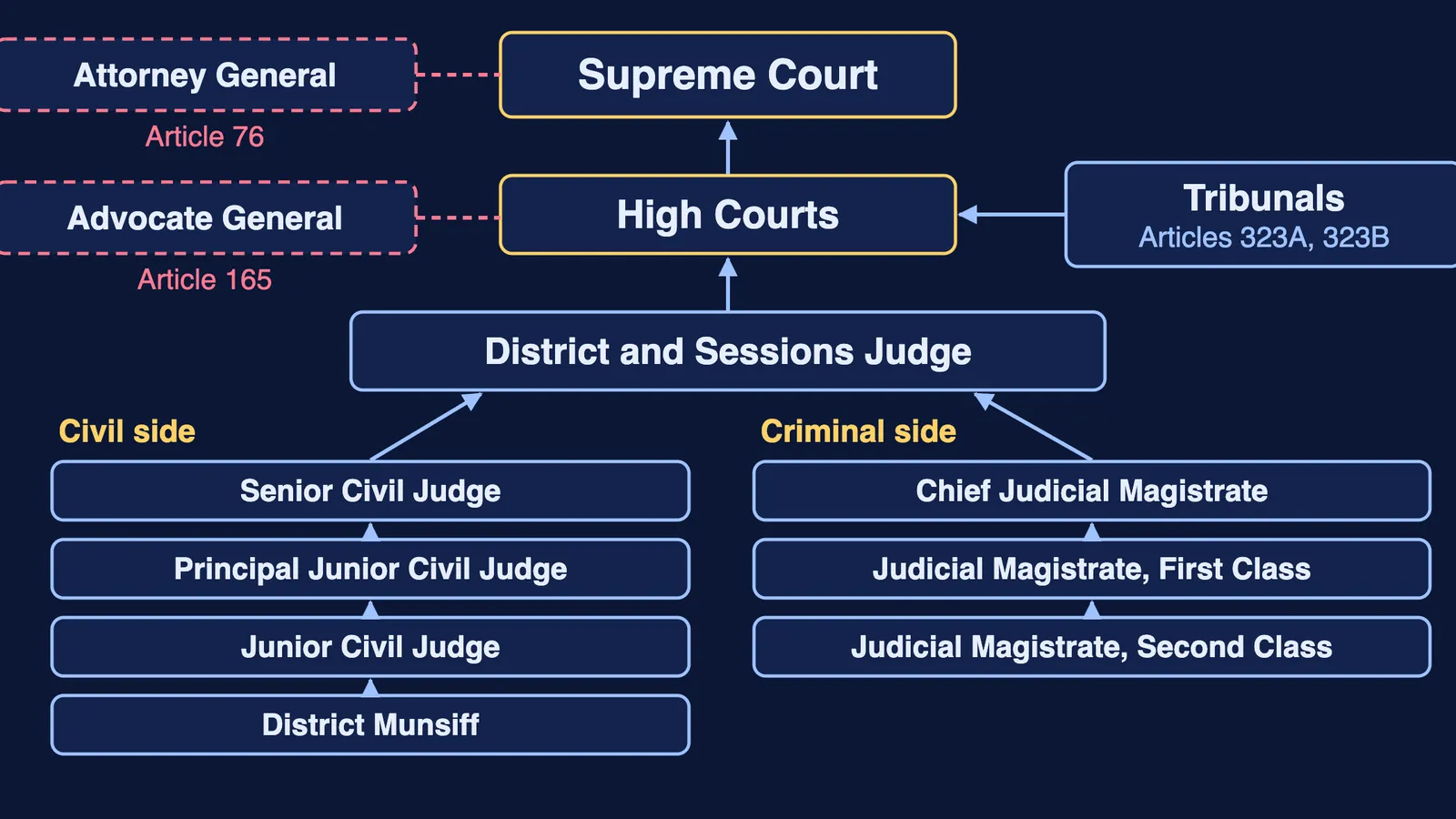
The Legal Studies XII book describes one integrated system for both Central and State laws. Arrows in the diagram show the direction of appeal.
Supreme Court: the apex court, in existence since 28 January 1950.
High Courts: each covers one or more states or union territories and supervises the courts below.
District and Sessions Judge: called District Judge in civil cases and Sessions Judge in criminal ones.
Civil ladder (lowest first): District Munsiff, Junior Civil Judge, Principal Junior Civil Judge, Senior Civil Judge.
Criminal ladder (lowest first): Judicial Magistrate Second Class, Judicial Magistrate First Class, Chief Judicial Magistrate.
Also note: India follows common law, so higher courts' judgments bind lower ones, and its trials are adversarial.
Sources: Gazette S.O. 848(E) and a PIB release.
Who are the legal officers in India?
Legal officers advise the government; they are not judges. Per the book:
Attorney General of India: appointed by the President under Article 76, serving at the President's pleasure. Needs a Supreme Court judge's qualifications. May speak in Parliament but not vote.
Advocate General: the State's chief legal adviser, appointed by the Governor under Article 165.
How are judges appointed, and when do they retire?
The book links each level to an Article: 124 for the Supreme Court, 217 for High Courts, 233 for district judges. In practice, higher-court appointments follow the collegium model, shaped by the Three Judges Cases:
First Judges case (1981): primacy went to the executive.
Second Judges case (1993): the Chief Justice of India's opinion gained primacy.
Presidential reference (1998): the CJI forms an opinion after consulting a plurality of judges.
For the Supreme Court, the CJI consults the four senior-most judges. For a High Court, its Chief Justice and two senior-most judges begin the proposal. The book gives retirement ages of 65 for Supreme Court judges and 62 for High Court judges.
How can a Supreme Court or High Court judge be removed?
The only grounds are proven misbehaviour and incapacity. Article 124(4) and the Judges (Inquiry) Act, 1968 govern the process, and Article 218 applies it to High Court judges. The book lays out four steps:
Notice: signed by at least 100 Lok Sabha members or at least 50 Rajya Sabha members.
Inquiry committee: one Supreme Court judge, one Chief Justice of a High Court and one distinguished jurist.
Report and vote: if the committee finds the judge guilty, each House must pass the motion by a majority of its total membership and by two-thirds of the members present and voting.
Order: the President orders the removal.
A district judge is removed by the State Government after consulting the High Court.
What do tribunals and judicial review add?
The 42nd Amendment of 1976 added Articles 323A and 323B. Article 323A tribunals handle public service matters and only Parliament creates them; Article 323B tribunals cover matters such as taxation or rent, created by Parliament or a State legislature. The book notes that in L. Chandra Kumar, High Courts kept the power to review tribunal decisions.
Judicial review lets courts test laws and actions against the Constitution; the book traces it to Marbury v. Madison. In India it covers fundamental rights (Articles 13, 32 and 226), Centre-State powers (Article 246), and fair executive action, as in Maneka Gandhi v. Union of India. Kesavananda Bharati (1973) is the landmark case for the basic structure doctrine.
Practice questions in the 2026-27 pattern
The 2026-27 sample paper has 1-mark MCQs and assertion-reason items, plus 2, 3 and 5-mark answers. Our own questions:
(1 mark) A legal-right dispute between the Union and a State goes straight to the Supreme Court. Which jurisdiction? (a) appellate (b) advisory (c) original (d) special leave
(1 mark) Assertion: a tribunal's order can be challenged in a High Court. Reason: tribunals do not take away the courts' power of review.
(2 marks) Can a State legislature create a rent tribunal under Article 323A or Article 323B? Give a reason.
(3 marks) Name three safeguards that protect a sitting judge's pay, tenure or conduct.
(5 marks) Compare how Supreme Court, High Court and district judges are appointed: Article, appointing authority and who is consulted.
Answers: 1 is (c); in 2, both are true and the reason explains the assertion; in 3, only Article 323B, since only Parliament creates Article 323A tribunals.
New to the subject? Read what Legal Studies covers or how to become a judge after LLB.
This is a study summary, not legal advice.
Not sure where to begin tonight's session? Fermi's AI tutor works out what you already know and builds a plan for the session.