On this page
Chapter 4(B), Forms of Legal Entities, is in Unit 4 of the CBSE Legal Studies Class XII textbook (2023). Its question: which legal shape should a business take, and who pays when it fails?
What does Forms of Legal Entities cover in 2026-27?
The CBSE Legal Studies curriculum for 2026-27 lists six types: sole proprietorship, partnership, limited liability partnership (LLP), private limited company, public limited company and one person company (OPC). Unit 4, the General Laws unit (Topics in Law II), carries 10 marks shared by three chapters (Law and Sustainable Development, Forms of Legal Entities, Criminal Laws in India), so this chapter has no separate figure. The curriculum does not list trusts or cooperatives.
The 2026-27 sample paper uses 1-mark multiple choice (including assertion-reason) and 2-, 3- and 5-mark answers capped at 40, 100 and 140 words.
How do the six legal entities compare?
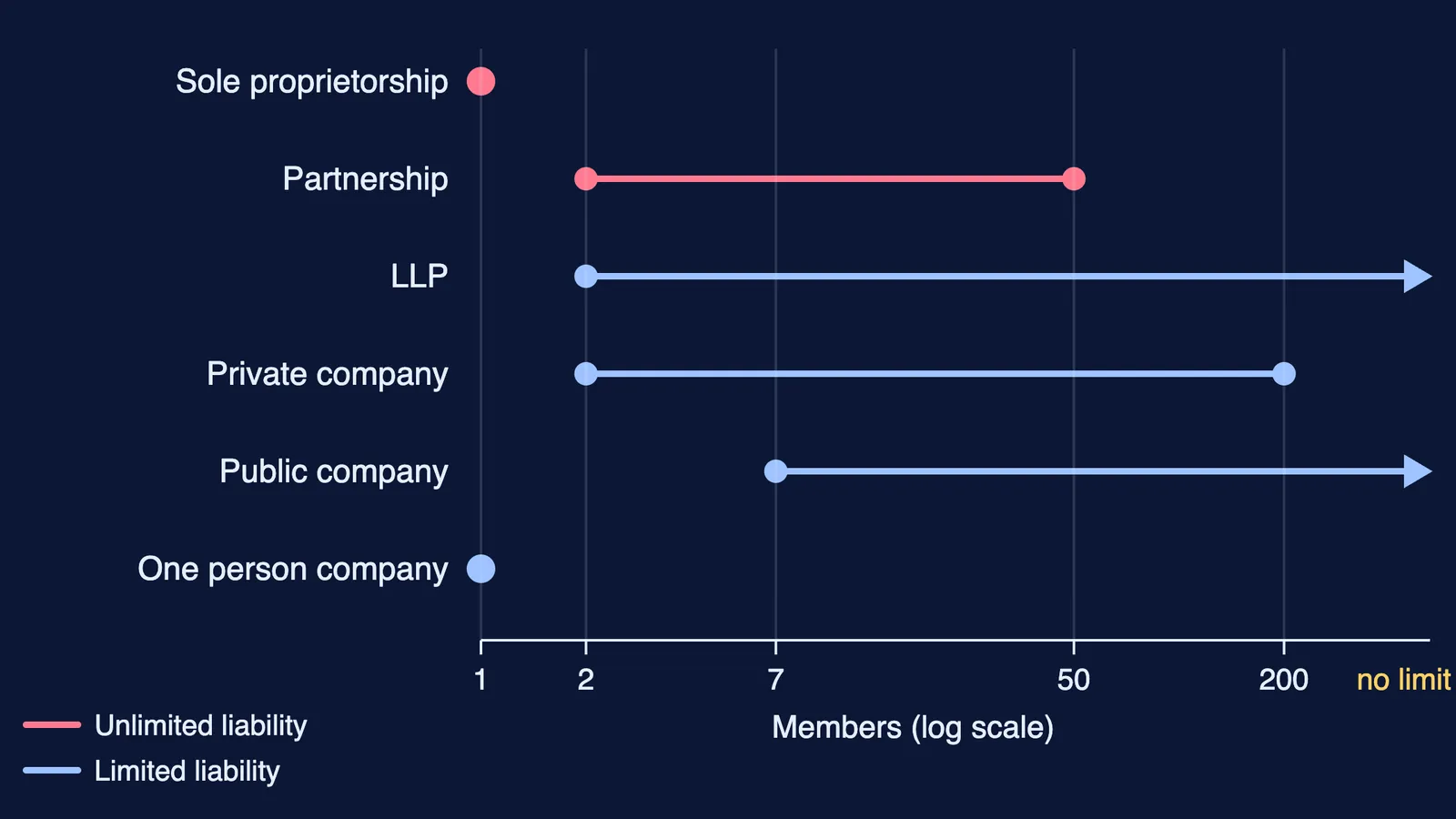
Sole proprietorship. One owner, no specific law, no formal registration. Owner and business are one in law, so liability is unlimited and the owner's death or insolvency can close it.
Partnership. Governed by the Indian Partnership Act, 1932; registration with the Registrar of Firms is optional, though the book calls a written Partnership Deed essential. The book gives 2 to 50 partners, no separate legal existence, and unlimited liability that is joint and several.
LLP. A body corporate under the Limited Liability Partnership Act, 2008, run by an LLP agreement. It is a separate entity with perpetual succession and 2 or more partners, no upper limit. Each partner's liability is limited to the agreed contribution, with no minimum capital.
Private limited company. Registered under the Companies Act, 2013, with a Memorandum and Articles of Association. Members range from 2 to 200; liability is limited and the company continues despite a member's death.
Public limited company. Section 2(71) defines it as a company that is not a private company. It needs at least 7 members, no maximum, may be listed or unlisted, and faces strict regulation and disclosure.
One person company. Section 2(62): a company with only one member. Liability is limited, a nominee keeps it running if the member dies, and the Act prescribes no minimum paid-up capital.
What is the difference between a private and a public company?
The book compares them on three bases:
Members: 2 to 200 (private) against 7 to unlimited (public).
Share transfer: restricted (private) against unrestricted (public).
Public subscription: only a public company may invite the public to buy its shares.
How do you choose the right entity in a case question?
Ask:
How many owners are there, now and later?
Should personal assets be protected from business debts?
Does the business need to raise money from the public?
How much registration cost and compliance can the owners handle?
Worked example. Kavya runs a home bakery alone and wants a bank loan for a proper kitchen. She will stay the sole owner but wants her family flat kept safe.
Owners: one, which rules out partnership, LLP and the multi-member companies.
Protection: a sole proprietorship gives none, since she and the business are one in law.
Answer: a one person company, with one member, limited liability and a separate legal identity; she names a nominee to run it after her death.
Practice questions (written by us)
Mark labels follow the 2026-27 sample paper.
(1 mark) Which form needs at least seven members? (A) LLP (B) Partnership (C) Public limited company (D) Private limited company.
(1 mark, assertion-reason) A: A creditor of an unpaid partnership firm can recover the debt from one partner's personal savings. R: Each partner is jointly and severally liable for debts of the firm.
(2 marks) State two differences between an LLP and a partnership firm.
(3 marks) A furniture workshop run by 12 partners plans to admit 45 craftspeople as partners and wants each partner's risk capped at what they put in. Can it stay a partnership? Suggest a form and give reasons.
(5 marks) Meera's one person company designs mobile games. Two friends want to join as owners, each risking only what they invest. Why must the form change? Compare a private limited company and an LLP for the three on members, liability and registration cost.
Answer key: 1 (C). 2 Both true; R explains A. 3 Any two: separate entity (LLP) or not (partnership); liability limited to contribution or unlimited; no partner cap or a cap of 50. 4 No: 57 partners exceed 50 and liability would be unlimited; an LLP fits. 5 An OPC has exactly one member. Private company: 2 to 200 members, liability limited to shares, Memorandum and Articles required. LLP: 2 or more partners, liability limited to agreed contribution, cheaper registration than a company.
Related reading: Legal Studies in Class 11, Class 11 forms of business organisation and Class 12 Intellectual Property Law.
This is a study summary, not legal advice.
Short on time this week? Fermi's AI tutor works out what you already know and builds a plan for the session.