On this page
Intellectual Property Law is Chapter 3(D) of the Class XII Legal Studies textbook revised in 2023-24.
This is a study summary, not legal advice.
What does Intellectual Property Law cover in Class 12 Legal Studies?
In the CBSE Legal Studies curriculum for 2026-27, Unit 3 (Business Laws) carries 20 marks. Four chapters share those 20 marks (Contract, Torts, Property and Intellectual Property Law), so this chapter has no separate figure.
The curriculum lists eight topics: meaning of IP, international obligations, WIPO, copyright, patent, trademark, geographical indication and design. The CBSE Class XII Legal Studies textbook also covers trade names and trade secrets, which the curriculum does not list separately.
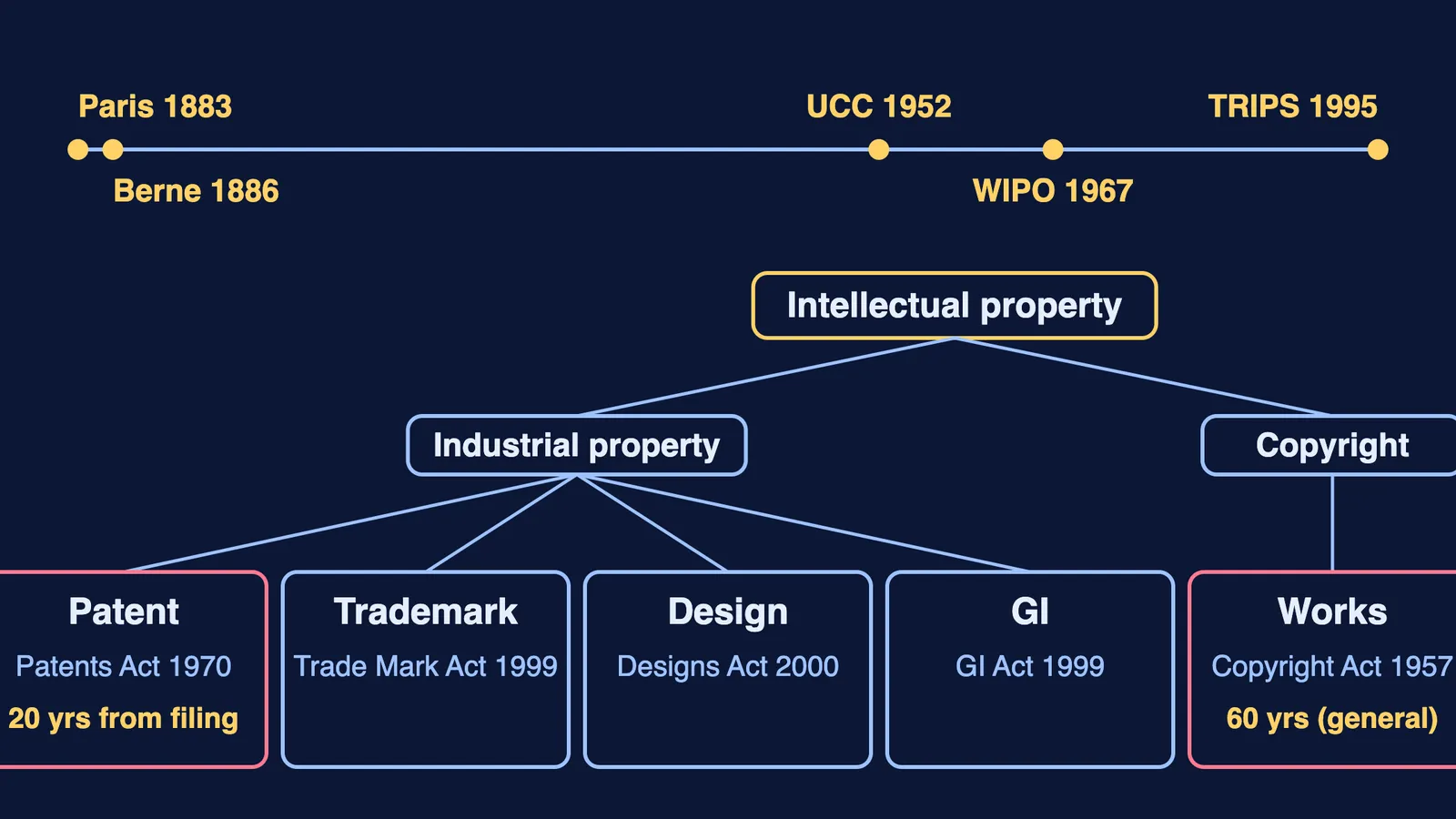
The book defines intellectual property as intangible property that comes from human intellect, and splits it into two groups: industrial property (patents, trademarks, designs, GIs) and copyright (literary and artistic works).
Which international treaties shaped Indian IP law?
The textbook traces five milestones:
Paris Convention (adopted 1883): national treatment for industrial property, plus a priority framework for protecting an invention in several countries at once.
Berne Convention (adopted 1886): national treatment, automatic protection without formalities, and independence of protection.
Universal Copyright Convention (1952): national treatment without automatic protection, a copyright notice, and a term of the author's life plus 25 years.
WIPO Convention (signed 1967, in force 1970): created WIPO, a UN specialised agency since 1974.
TRIPS Agreement (in force 1 January 1995): the WTO's agreement covering all forms of IP. As a signatory, India passed several IP laws to meet its obligations, and amended the Patents Act in 2005 to comply.
How do copyright, patents, trademarks, GIs and designs differ?
Each right with its Act, as the textbook gives them:
Copyright (Copyright Act, 1957): protects original expression fixed in a material form, not bare ideas. Protection is automatic; registration is only prima facie evidence of ownership. The general term is 60 years, counted from the year after the author's death for literary, dramatic, musical and artistic works, and from the date of publication for films, sound recordings and photographs, among others. Owners hold economic rights (reproduce, distribute, communicate to the public, adapt, translate) and moral rights (paternity, integrity, retraction).
Patent (Patents Act, 1970, as amended in 2005): granted for an invention in return for full disclosure, for 20 years from the date of filing. The three tests are novelty, non-obviousness and industrial application.
Trademark (Trade Mark Act, 1999): a word, logo, shape, packaging or colour combination that distinguishes one trader's goods or services.
Geographical indication (GI Act, 1999): links a product's qualities or reputation to its place of origin.
Design (Designs Act, 2000): protects the new, non-obvious appearance of an article (shape, pattern, colour, line), never its function.
Two cases from the book: in Amarnath Sehgal v. Union of India, the government removed a sculptor's Vigyan Bhavan mural without consent, damaging it; the Delhi High Court said moral rights stay with the author even after a sale, and destroying or altering the work violated them. In Eastern Book Company v. D.B. Modak, the Supreme Court held that the publisher's SCC inputs (splitting and numbering paragraphs, marking concurring or dissenting judges) needed skill and judgment and carried copyright.
How do you decide which right applies?
A made-up pottery cooperative invents a faster kiln process, gives its lamps a curved shape, sells them under a new name and logo, and publishes a photo booklet. Ask:
New technical solution? The kiln process can be patented if novel, non-obvious and industrially useful.
Only about looks? The curved shape is a design, unless function dictates it.
Identifies the seller? The name and logo are trademarks.
Original creative work? The booklet is under copyright from creation.
A GI would need the lamps' qualities to come from their place.
What practice questions can you try?
Our own questions, in the formats of the CBSE 2026-27 sample paper and its marking scheme.
MCQ (1 mark): A handloom cluster wants to stop outsiders selling shawls under its district's name. Which right fits? (a) Patent (b) Design (c) Geographical indication (d) Copyright.
Assertion-reason (1 mark): A: An Indian patent holder must reveal how the invention works. R: A patent is granted in exchange for full disclosure of the invention.
Short answer (2 marks): Name two moral rights of a copyright owner.
Case-based (3 marks): A student composes and uploads a tune; a music app streams it to listeners without asking. Is registration needed? Which economic right is affected? When does the tune's 60-year term start?
Long answer (5 marks): A folding bicycle has a new hinge, a striking frame shape and a catchy name. Match each feature to a right and Act, and explain why design law cannot cover the hinge.
Pointers: 1 (c); 2 both true, R explains A; 4 no, communication to the public (webcasting), 60 years counted from the year after her death.
Finding it hard to plan your revision week? Fermi's AI tutor works out what you already know and builds a plan for the session. See our Legal Studies Class 11 subject guide, or read how to become a patent agent with a science degree.