On this page
Financial Management and Planning is Chapter 10 of the NCERT book Human Ecology and Family Sciences Part II (Reprint 2026-27). It covers how a family earns, plans, saves, invests and borrows money. This is a study summary, not financial advice; every rupee figure in our example is made up for practice.
What does Financial Management and Planning cover in Class 11?
The CBSE Home Science curriculum 2026-27 (code 064) places this chapter in Unit V, Adulthood, alongside Care and Maintenance of Fabrics. Unit V carries 15 of the 70 theory marks, shared by both chapters. NCERT numbers Adulthood as Unit IV.
The curriculum topic list runs through every numbered section of the chapter, from 10.1 Introduction to 10.9 Credit. The practical exam also has a budget-planning task for a given situation, worth 3 of the 30 practical marks.
What are the three types of family income?
NCERT defines family income as all income, of every type, from all members over a set period; for official purposes this is the financial year, 1 April to 31 March.
Money income: rupees coming in as salary, wages, rent, interest, dividends, pension and similar.
Real income: the flow of goods and services the family enjoys. Direct income needs no money (home cooking, a kitchen garden, a house fully paid for, public parks). Indirect income needs exchange, usually money.
Psychic income: the satisfaction a family gets from its real income. It cannot be counted in rupees, yet NCERT calls it the most important for quality of living.
How do you make a family budget?
NCERT gives five steps: list needed goods and services in groups; estimate the cost of each group; estimate income, split into assured and possible; balance income and spending; then check the plan (needs, emergencies, solvency, economic conditions, long-term goals).
Worked example (our numbers). A family's assured monthly income is a salary of ₹38,000 plus a grandparent's pension of ₹7,000, so ₹45,000. Possible income is ₹4,000 from irregular tuition.
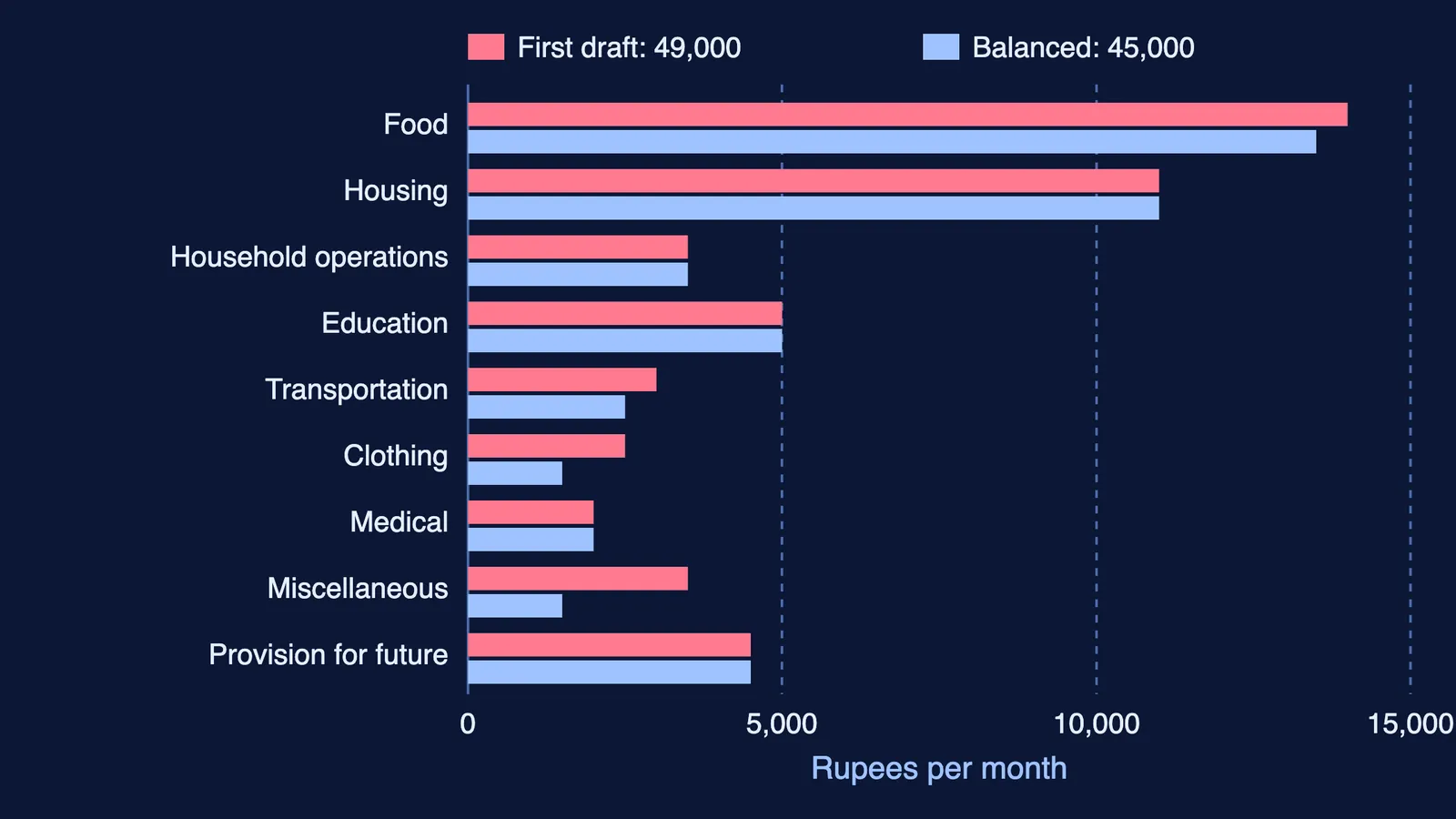
First draft, using nine of NCERT's eleven suggested groups (we leave out income tax and personal allowances): food ₹14,000, housing ₹11,000, household operations ₹3,500, education ₹5,000, transportation ₹3,000, clothing ₹2,500, medical ₹2,000, miscellaneous ₹3,500, provision for future ₹4,500.
Total: ₹49,000. That is ₹4,000 more than assured income.
Balance by cutting: food ₹500, transportation ₹500, clothing ₹1,000, miscellaneous ₹2,000. Cuts add up to ₹4,000, so the plan now totals exactly ₹45,000.
Check: necessities come from assured income only. Provision for future stays at ₹4,500 (₹2,500 savings, ₹2,000 emergency fund), which is 10% of assured income. If the ₹4,000 tuition money arrives, it pays for "nice but not necessary" items such as festival clothes.
We checked every sum by hand and in Python. To control the plan, the family can record allocated against spent amounts on a single sheet.
What makes savings and investment sound?
Saving means setting money aside for later; investment means putting it to productive use. NCERT notes that physical assets such as gold or land do not form capital in the economic sense, though they usually give long-term returns, while bank deposits, post office schemes, shares, insurance and similar form financial assets.
The chapter lists ten principles of sound investment: safety of principal, reasonable return, liquidity, effect of world conditions, ease and convenience, matching maturity to a known need, tax efficiency, after-investment service, time period (lock-in) and capacity. Two trade-offs: higher return usually means higher risk, and more liquidity usually means lower return. Avenues listed range from post office and bank schemes to mutual funds, insurance, gold and land.
What are the 4 Cs of credit?
Credit means getting money, goods or services now and paying later. Lenders judge four things:
Character: the will to repay as agreed.
Capacity: the margin left after necessary spending. In our example, spending other than provision for future is ₹40,500, leaving a ₹4,500 monthly margin.
Capital: net worth, what is owned minus what is owed. A family owning ₹6,00,000 of assets and owing ₹1,50,000 has ₹4,50,000.
Collateral: specific assets pledged as security.
NCERT also mentions self-help groups, where members pool money and lend to one another without collateral. Our Class 10 guide to money and credit covers formal and informal loans, and the Class 12 consumer education and protection guide builds on these ideas next year.
Practice questions for Financial Management and Planning
The mark labels are our suggestion.
(1 mark) A grandmother's home-grown vegetables used in the family kitchen are which type of income?
(2 marks) Give one difference between assured and possible income, with an example of each.
(3 marks) A family earns ₹30,000 a month and its first-draft budget is ₹33,000. Suggest two ways to balance it, using the NCERT steps.
(3 marks) Explain why safety and rate of return pull in opposite directions.
(4 marks) A family owns assets worth ₹2,40,000 and owes ₹90,000. Find its capital, then explain how capacity differs from capital.
Answer for 5: capital is ₹1,50,000.
Not sure where to start tonight? Fermi's AI tutor works out what you already know and builds a plan for the session.