On this page
Law and Sustainable Development is Chapter 4(A) of CBSE Class 12 Legal Studies. This guide covers the 2026-27 syllabus, the book's treaties and laws, and original practice questions. It is a study summary, not legal advice.
What does Law and Sustainable Development cover in 2026-27?
The CBSE Legal Studies curriculum for 2026-27 lists five topics: introduction, international initiatives, constitutional provisions, the Environment Protection Act, 1986 and the Pollution Control Boards. Unit 4, Topics in Law II (General Laws), carries 10 marks shared with Chapter 4(B) Forms of Legal Entities and Chapter 4(C) Criminal Laws in India, with no separate figure for this chapter.
The prescribed text is the CBSE Legal Studies Class XII textbook, second edition 2023, pages 95 to 100. See also what Legal Studies covers in Class 11 and our Unit 3 Law of Torts Class 12 guide.
What is sustainable development in law?
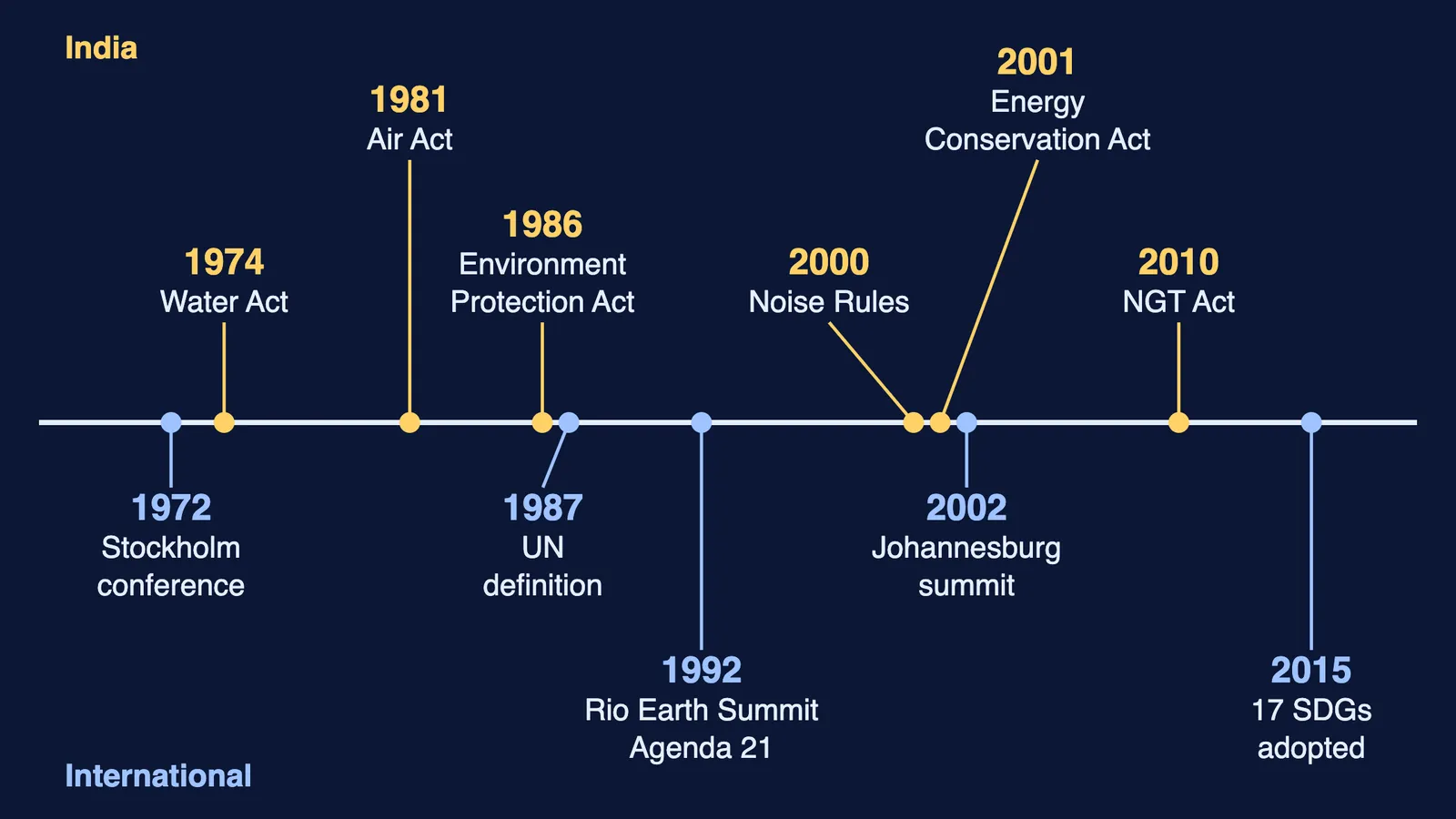
The book gives the 1987 United Nations General Assembly definition: development that meets present needs without harming the ability of future generations to meet theirs. In law, it means planning growth that keeps the environment fit for later generations. Book examples: solar power, crop rotation.
The textbook says the UN adopted the 17 Sustainable Development Goals, or Global Goals, in 2015 to protect the planet, end poverty and secure peace and prosperity by 2030.
Which international steps does the book name?
Stockholm, 1972: Stockholm hosted the UN Conference on the Human Environment, the first global conference on the environment. The book says the Environment Protection Act, 1986 was meant to carry out its decisions.
Rio de Janeiro, 1992: the UN Conference on Environment and Development, or Earth Summit, attended by 179 countries. Outcomes included Agenda 21, the UNFCCC, the Convention on Biological Diversity and the forest principles.
Agenda 21: an action programme that treats community participation as a key requirement, reaffirmed at the Johannesburg summit in 2002.
For the Political Science view, see the Environment and natural resources Class 12 guide.
Which articles of the Constitution protect the environment?
The book links four provisions:
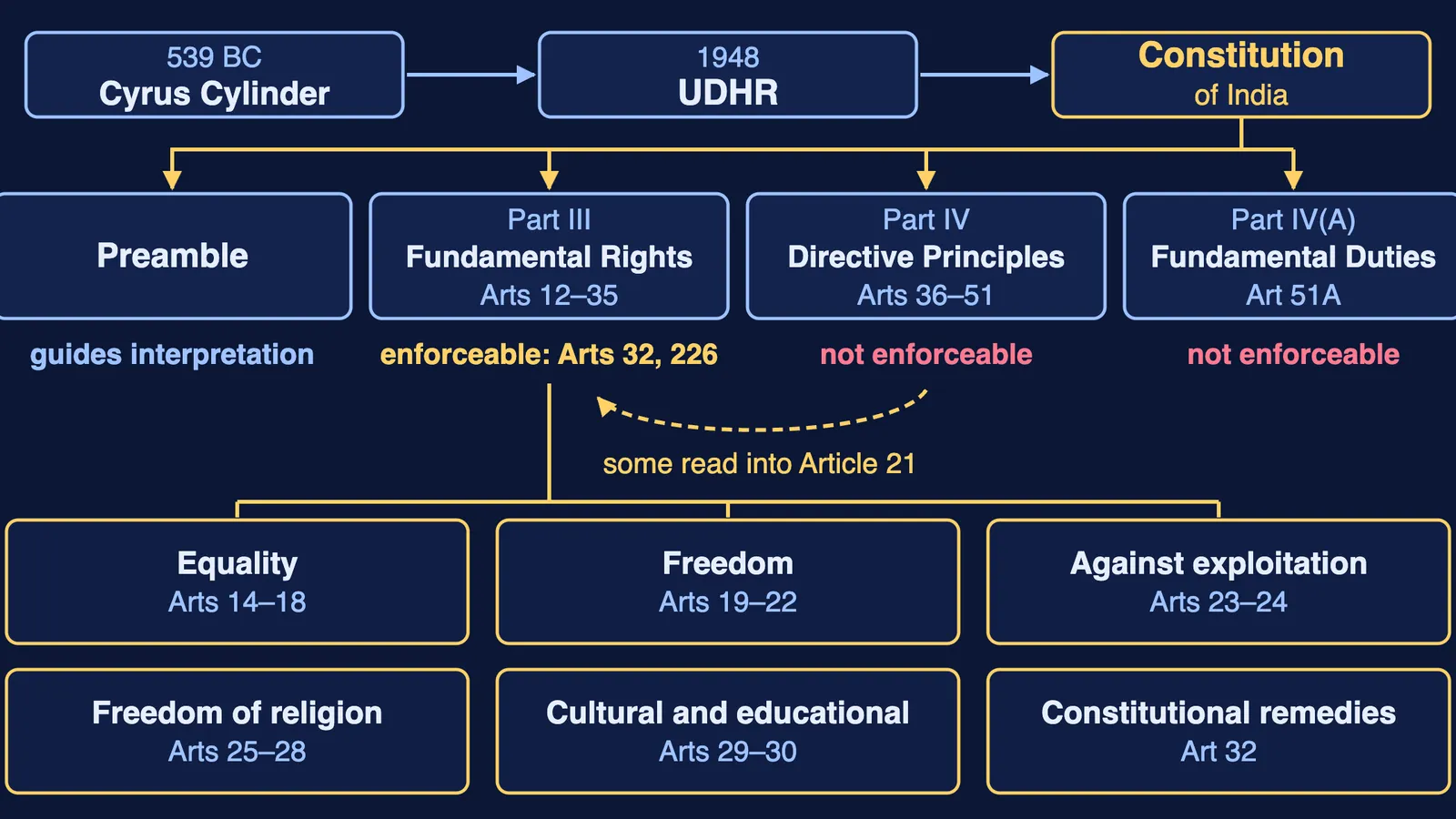
Article 21 (Fundamental Right): the right to life, read widely to include a right to a clean environment.
Article 38 (Directive Principle): a welfare-state social order, which the book ties to a pollution-free environment.
Article 48A (Directive Principle): added by the 42nd Amendment, it directs the State to safeguard forests and wildlife and to protect and better the environment.
Article 51A(g) (Fundamental Duty): every citizen must care for forests, lakes, rivers, wildlife and the wider environment, and show compassion for living creatures.
Under Article 48A the book divides the State's role into a protectionist policy (bans, such as on leaded petrol) and an "improvinistic" policy (alternatives, such as CNG or tree planting). Its one case is K. M. Chinnappa v. Union of India, where the Supreme Court defined environmental law as a means of protecting and improving the environment and of controlling or preventing pollution.
How do the Environment Protection Act and Pollution Control Boards work?
The book's legal framework has six parts: the Environment Protection Act, 1986, Air Act, 1981, Water Act, 1974, Noise Pollution Rules, 2000, National Green Tribunal Act, 2010 and Energy Conservation Act, 2001. The NGT Act appears only in this list; the curriculum does not list it as a topic.
The Environment Protection Act, 1986 was passed under Article 253 after the Bhopal tragedy. The book calls it an umbrella law letting the Centre coordinate authorities set up under earlier laws such as the Water and Air Acts.
The Central Pollution Control Board, a statutory body set up under the Water Act, 1974, draws its functions from the Water and Air Acts. It advises the Centre, guides State Boards, settles their disputes and sets air and water standards.
Each State Board works under the Central Board's supervision, and every business in the State needs its authorisation. Functions include NOCs, consent under Section 21 of the Air Act and Sections 25/26 of the Water Act, collecting water cess, notifying emission and effluent standards, and legal action against defaulters.
Practice questions in the 2026-27 sample paper formats
The 2026-27 sample paper uses 1-mark MCQ and assertion-reason items plus 2-, 3- and 5-mark answers. These questions are ours.
(1 mark, MCQ) Under which Act is the Central Pollution Control Board constituted? (a) Air Act, 1981 (b) Water Act, 1974 (c) Energy Conservation Act, 2001 (d) NGT Act, 2010
(1 mark, assertion-reason) A: A citizen who dumps waste in a lake fails a constitutional duty. R: Article 51A(g) asks every citizen to protect lakes and rivers.
(2 marks) Give one protectionist and one improvinistic measure under Article 48A.
(3 marks) Explain why the book calls the Environment Protection Act, 1986 an umbrella law.
(5 marks) Residents near a new brick kiln complain about its smoke. Using five State Board functions, explain how the Board can deal with the kiln before and after it starts work.
Answers: 1 is (b); in 2 both are true and R explains A.
Planning a revision evening? Fermi's AI tutor works out what you already know and builds a plan for the session.