On this page
This chapter asks who causes environmental damage, who pays, who should fix it and who uses how much of the Earth's resources. In the CBSE Political Science (028) curriculum for 2026-27, Environment and Natural Resources is Chapter 6 of Part A, Contemporary World Politics, and is allotted 6 of the 40 marks for Part A (the full paper is out of 80). This guide follows the NCERT chapter, Reprint 2026-27.
What does the 2026-27 syllabus cover in this chapter?
The curriculum lists seven topics: environmental concerns, global commons, common but differentiated responsibilities, India's stand, environmental movements, resource geopolitics and the rights of indigenous peoples. NCERT also covers common property resources. The list does not name them, but the 2026-27 sample paper asks a 2-mark question on why such resources decline, so learn them too.
It also sets a 4-mark choice between oil geopolitics and indigenous peoples, with word limits of 50-60 words for 2 marks, 100-120 for 4 and 170-180 for 6.
Why did the 1992 Rio Earth Summit matter?
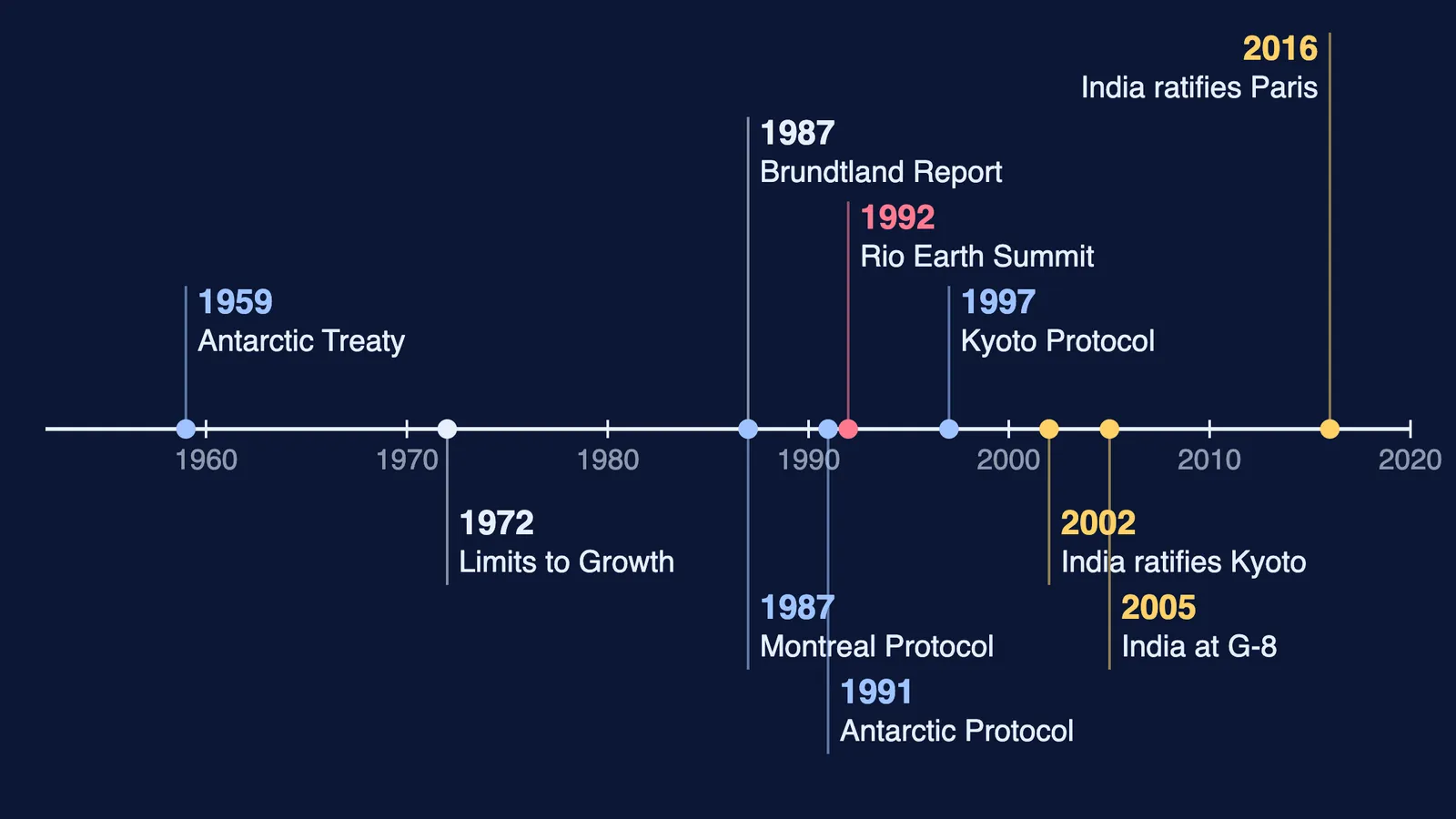
Before Rio came the Club of Rome's 1972 book Limits to Growth and the 1987 Brundtland Report, Our Common Future, which said old patterns of growth could not last.
The NCERT text says the UN Conference on Environment and Development in Rio de Janeiro in June 1992, the Earth Summit, drew 170 states along with thousands of NGOs and many multinational firms. It produced conventions on climate change, biodiversity and forestry, plus Agenda 21. Its agreed idea was sustainable development: growth combined with ecological responsibility.
Rio also exposed a split: the global North worried about ozone depletion and global warming, the global South about linking development with environmental management.
What are the global commons?
Global commons lie beyond the sovereign control of any single state, so they need shared governance: the Earth's atmosphere, Antarctica, the ocean floor and outer space. NCERT names three landmark agreements: the Antarctic Treaty (1959), the Montreal Protocol (1987) and the Antarctic Environmental Protocol (1991).
Common property resources are different: a group owns them, and its members have both rights and duties over use and upkeep. NCERT's example is the sacred groves that village communities manage along the forest belt of South India. Four causes of their decline: privatisation, more intensive farming, a growing population and damage to ecosystems.
What is common but differentiated responsibilities?
The North wants equal responsibility now. The South argues that developed countries caused most degradation while industrialising, so they should do more.
According to NCERT, the 1992 Rio Declaration accepted this argument, and it became the principle of common but differentiated responsibilities (CBDR). The 1992 UN Framework Convention on Climate Change (UNFCCC) adds equity and respective capabilities. The Kyoto Protocol, agreed in Japan in 1997, set emission-cut targets for industrialised countries, while developing countries such as India and China were exempt.
What is India's stand on environmental issues?
In August 2002, India signed and ratified Kyoto. At the June 2005 G-8 meeting, it argued that developing countries emit only a small share per person of what developed countries emit.
Worked example: turning NCERT's numbers into an argument. The chapter projects India's per capita emissions growing from 0.9 tonnes (2000) to 1.6 tonnes (2030), against a 2000 world average of 3.8 tonnes.
Divide: 1.6 ÷ 3.8 is about 0.42.
So India's projected 2030 figure is about 42% of the 2000 world average, less than half.
Link it to the principle: binding cuts on India would, in India's view, go against the spirit of the UNFCCC.
Then add what India does: the National Auto-fuel Policy, the Energy Conservation Act of 2001, the Electricity Act of 2003 and India's ratification, on 2 October 2016, of the Paris Climate Agreement. India also asks developed countries for finance and clean technology.
How do you answer questions on resource geopolitics and movements?
Resource geopolitics is who gets what, when, where and how. NCERT says the Gulf produces about 30 per cent of the world's oil yet holds about 64 per cent of known reserves, with Saudi Arabia holding a quarter. For water, it cites the Jordan and Yarmuk rivers and dams on the Euphrates.
For movements, contrast the South's peopled forests with the North's empty wilderness, and cite the Narmada Bachao Andolan, whose shared idea is non-violence. For indigenous peoples, learn the UN definition and that the World Council of Indigenous Peoples formed in 1975.
Practice questions we wrote:
Distinguish global commons from common property resources, with one example each. (2 marks)
Explain two reasons why the North and the South disagreed at the Rio Summit. (4 marks)
Using per capita emission data, examine India's position on binding emission cuts. (6 marks)
Why is oil central to resource geopolitics? Give four points. (4 marks)
For the economics side, read our environment and sustainable development guide; for context, revise the Cold War era and the end of bipolarity.
If you are unsure where to begin, Fermi's AI tutor can work out what you already know, build a plan for the session and check your understanding as it goes.