

On this page
The Berlin Wall fell on 9 November 1989, and just over two years later the Soviet Union no longer existed. Chapter 1 of NCERT's Class 12 Contemporary World Politics, The End of Bipolarity, centres on three questions: why the USSR broke up, what shock therapy was, and where India stands with Russia. Each is answered below, with an exam answer plan.
What does the end of bipolarity mean?
During the Cold War, world politics had two poles: the US-led capitalist bloc and the Soviet-led "second world", held together by the Warsaw Pact. NCERT says the Cold War ended "not by military means but as a result of mass actions by ordinary men and women", after which the Soviet Union itself disintegrated (NCERT, The End of Bipolarity). With one pole gone, the same chapter notes, the US became the sole superpower. That is the end of bipolarity.
If the 1917 revolution that created the USSR feels hazy, revise it first with our Russian Revolution Class 9 summary.
Why did the Soviet Union disintegrate?
NCERT's core answer is that "the internal weaknesses of Soviet political and economic institutions, which failed to meet the aspirations of the people, were responsible for the collapse of the system" (NCERT). Learn it as four causes:
Economic stagnation. The economy spent much of its resources on a nuclear and military arsenal and on satellite states in eastern Europe. Consumer shortages followed, and citizens could see how far ahead the West was.
An unaccountable party. The Communist Party had ruled for over 70 years without answering to the people; NCERT lists slow administration, corruption and special privileges for party bureaucrats.
Gorbachev's reforms. Mikhail Gorbachev became General Secretary in 1985 and brought in perestroika (restructuring) and glasnost (openness). Loosening the system set off expectations that, in NCERT's words, became virtually impossible to control: some felt he should move much faster, while party members felt he was moving too quickly.
Nationalism. NCERT calls the rise of nationalism in Russia, the Baltic republics, Ukraine and Georgia "the final and most immediate cause".
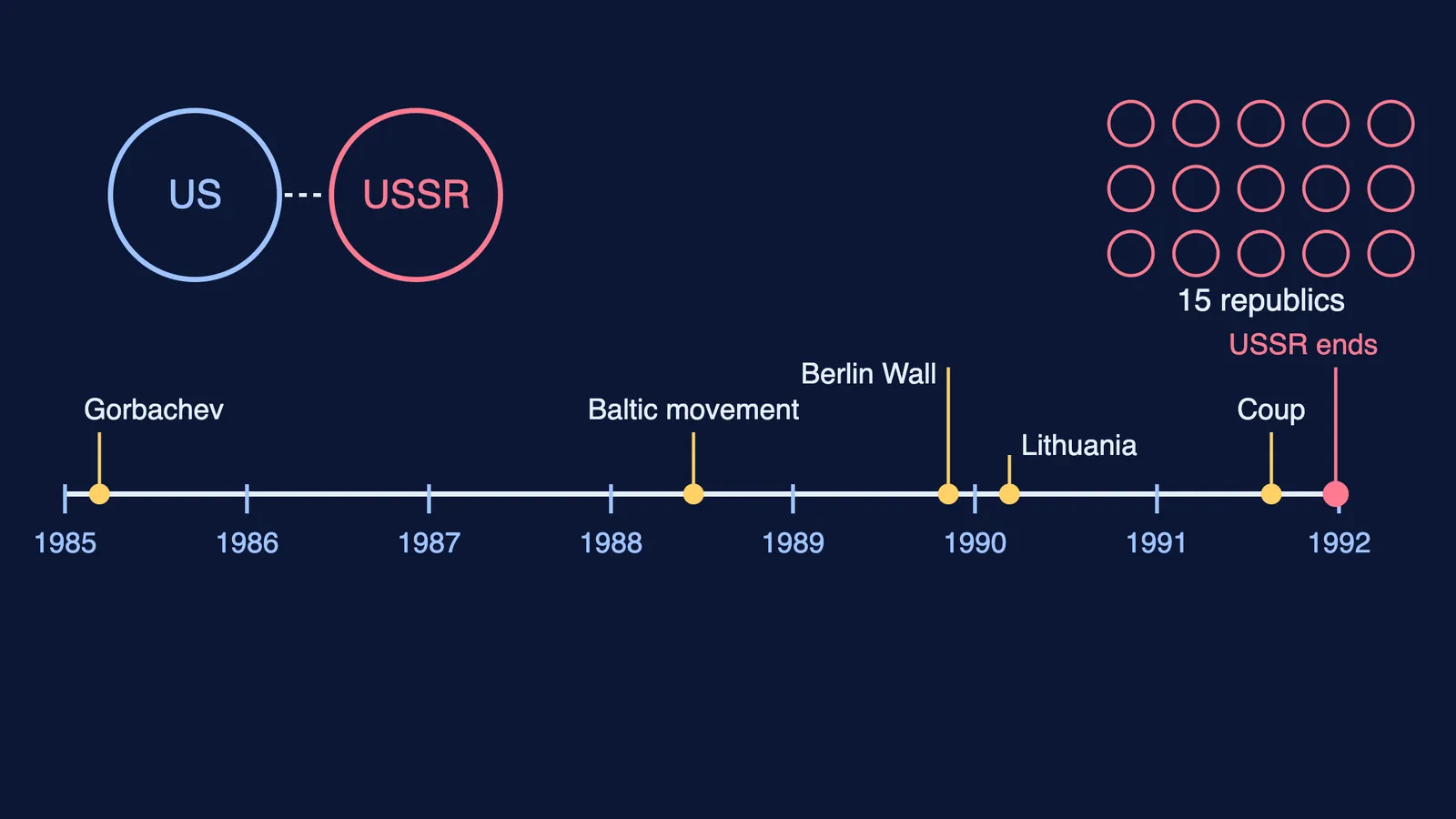
According to NCERT's timeline, Lithuania became the first of the 15 Soviet republics to declare independence in March 1990; hardliners staged a failed coup in August 1991; in December 1991 Russia, Belarus and Ukraine annulled the 1922 treaty that created the USSR and set up the Commonwealth of Independent States (CIS); and Gorbachev resigned on 25 December 1991. The State Department's historians say the failed August coup "sealed the fate of the Soviet Union" (Office of the Historian).
What was shock therapy, and what did it do to Russia?
Shock therapy is the name for the model of sudden transition from an authoritarian socialist system to a democratic capitalist one, influenced by the World Bank and the IMF, that Russia, Central Asia and eastern Europe followed (NCERT). It meant privatising state assets, replacing collective farms with private farming, and switching suddenly to free trade, foreign investment and currency convertibility.
The results NCERT records:
About 90 per cent of Russia's industries were put up for sale, in what was called "the largest garage sale in history".
The rouble fell sharply, and inflation was so high that people lost all their savings.
Russia's real GDP in 1999 was below its 1989 level.
About half of Russia's 1,500 banks and other financial institutions went bankrupt.
Most of these economies began reviving in 2000, mainly on exports of oil, gas and minerals.
India opened up its own economy in 1991, as the Soviet Union was breaking up; compare the two paths with our guide to LPG reforms of 1991 for Class 12.
How did India's ties with Russia change after 1991?
NCERT says India keeps good relations with all post-communist countries, but the strongest are still with Russia (NCERT). In the Cold War years the USSR gave aid and technical assistance for steel plants such as Bhilai, Bokaro and Visakhapatnam, backed India on Kashmir at the UN and supplied most of its military hardware.
After 1991, more than 80 bilateral agreements have been signed as part of the Indo-Russian Strategic Agreement of 2001, and both countries share a vision of a multipolar world order. India benefits on Kashmir, energy supplies, information on terrorism, access to Central Asia and balancing China. Russia benefits because India is its second largest arms market.
How do you write a long answer on this chapter?
Use this frame for "Why did the Soviet Union disintegrate?", taking every fact from the NCERT chapter:
One line of context. "The USSR, one of the two superpowers, disintegrated in December 1991."
Three or four points, each with a heading and one NCERT fact. For causes: stagnation (arms spending), the party (70 years without accountability), Gorbachev (1985 reforms), nationalism (Lithuania first).
One closing line on the result. "The bipolar world ended and the US became the sole superpower."
For dates, memorise one chain: 1985 Gorbachev, 1989 Wall falls, 1990 Lithuania, August 1991 coup, December 1991 CIS, 25 December 1991 USSR ends. Then turn it into a cause-and-effect chart for a history chapter.
If your timetable also has physics, chemistry or maths to cover, Fermi's AI tutor can work out what you already know and build a plan for the session, so the science half of your revision has a clear next step too.


