On this page
Russia's revolution came in three steps: a warning in 1905, the fall of the tsar in February 1917, and the Bolshevik takeover in October 1917. Here is each step, then a revision plan.
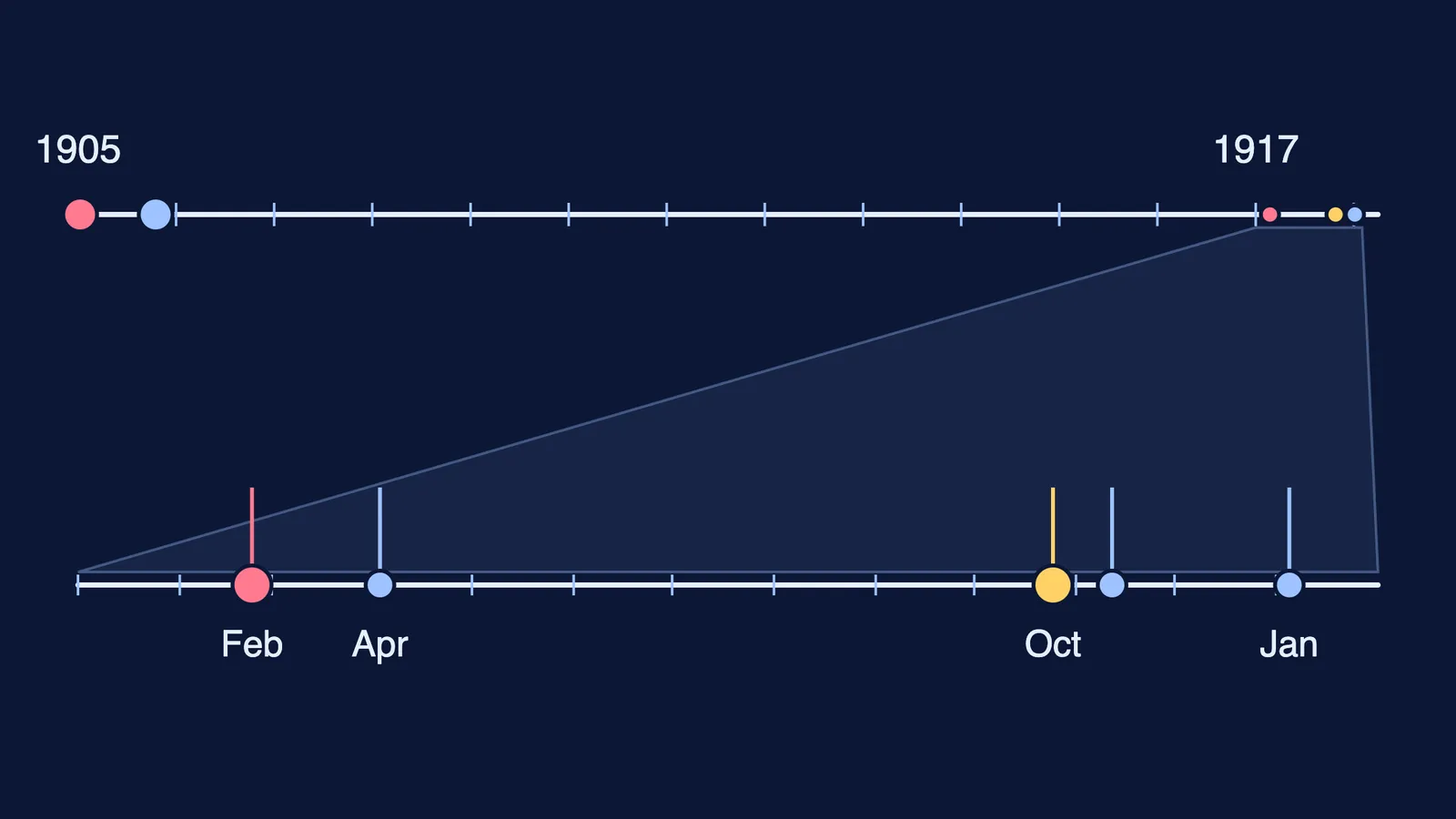
First, the dates. Russia then used the old Julian calendar, and when it switched to the Gregorian calendar (the one India uses) on 14 February 1918, thirteen days had to be skipped (Old Style and New Style dates). That is why the October Revolution fell on 7 November by our calendar. The revolutions are named by their Old Style months, so we give Old Style dates first, New Style in brackets.
Also check which book your school uses. The Wire reported in June 2026 that the new NCERT Class 9 book, Understanding Society: India and Beyond, leaves out the Russian Revolution, which moves to the Class 10 books due in 2027-28 (The Wire); Madhyamam, citing The Hindu, reported the same of the released book in September 2026 (Madhyamam).
What happened in Russia in 1905?
On 9 January 1905 (22 January), soldiers of the Imperial Guard fired on workers led by Father Georgy Gapon as they marched towards the Winter Palace in St Petersburg (Bloody Sunday). That day, Bloody Sunday, started the active phase of the 1905 Revolution. Estimates of the dead range from 143 to 234.
Strikes and protests followed. In October 1905 the tsar issued the October Manifesto, a pledge to create a legislative assembly, and was compelled to set up the State Duma (Russian Revolution of 1905). Remember 1905 as the first warning: the tsar survived it, but only by promising change.
What happened in the February Revolution of 1917?
Protests against food rationing broke out on 23 February 1917 (8 March) in Petrograd, then Russia's capital and now Saint Petersburg (February Revolution). Striking workers from the Putilov factory were joined by crowds marking International Women's Day. Troops in the capital deserted, and Nicholas II was forced to abdicate, which ended the rule of the Romanov dynasty.
Two bodies now spoke for Russia. A Provisional Government under Georgy Lvov replaced the tsar's ministers, while socialist parties revived the Petrograd Soviet, a council first created during 1905, to represent workers and soldiers. The Provisional Government had to share this dual power with the Soviet, and it was deeply unpopular.
What happened in the October Revolution of 1917?
Lenin, the Bolshevik leader, arrived in Petrograd by train on 3 April 1917 (16 April) and set out his April Theses in a speech the next day (April Theses). Under the slogan "all power to the soviets", they denounced the Provisional Government, led first by Lvov and later by Alexander Kerensky.
On 25 October 1917 (7 November), the Bolsheviks seized power in Petrograd. Red Guards captured the Winter Palace, seat of the Provisional Government, and its ministers were imprisoned (October Revolution).
What changed after October 1917?
Land: on 26 October 1917 (8 November), the Second All-Russian Congress of Soviets passed the Decree on Land, written by Lenin (Decree on Land).
Peace: the same day, Lenin signed the Decree on Peace; Soviet Russia then signed the Treaty of Brest-Litovsk with the Central Powers on 3 March 1918 (Treaty of Brest-Litovsk).
Elections: in the Constituent Assembly election of 12 November 1917 (25 November), the Bolsheviks received between 22% and 25% of the vote, and the Socialist Revolutionaries won the most seats, 324 to the Bolsheviks' 183 (Russian Constituent Assembly).
The Assembly closed: it met on 5-6 January 1918 (18-19 January) and was then dissolved by the Bolshevik-led All-Russian Central Executive Committee.
Civil war: the Civil War began in early 1918, as anti-Bolshevik forces inside Russia confronted the new Red Army (Russian Revolution).
How should you revise the Russian Revolution for an exam?
Use a date ladder: five rungs you can write from memory, each with one cause and one result.
Write the rungs on a blank page: January 1905, February 1917, April 1917, October 1917, January 1918.
Beside each, add a cause and a result, for example "February 1917: food rationing protests, tsar abdicates".
Turn the ladder into arrows with this guide to making a cause-and-effect chart for a history chapter.
Check every date against your textbook, especially one a chatbot gave you: how to check an AI-given history date in NCERT.
Write one answer a day in four parts: background, trigger, event, result.
Here is that frame for "Why did the tsar fall in February 1917?"
Background: 1905 had shown that the tsar would give way under pressure.
Trigger: protests against food rationing in Petrograd on 23 February, joined by strikers and International Women's Day crowds.
Event: troops in the capital deserted, and Nicholas II was forced to abdicate.
Result: a Provisional Government took over, sharing dual power with the Petrograd Soviet.
Not sure where to begin with a chapter? Fermi's AI tutor can work out what you already know and build a plan for the session.
Wondering how much this year counts? Read where Class 9 marks matter and where they don't, then build your ladder.