

On this page
For Class 12 economics, the 1991 story has three parts you must write in order: why the crisis came, what the reforms did, and whether they worked. This guide follows the NCERT chapter Liberalisation, Privatisation and Globalisation: An Appraisal in Indian Economic Development.
In the CBSE economics curriculum for 2025-26, the features and appraisal of the LPG policy sit in Unit 6 of Part B, which shares 12 of the 80 theory marks with the 1947-90 development story. Check your school's current syllabus for this year's split.
Why did India need economic reforms in 1991?
The 1991 crisis was an external debt crisis: according to NCERT, India could not repay its foreign borrowings, and its foreign exchange reserves fell to a level that could not finance imports for more than two weeks.
Write the build-up as a chain of four links:
In the late 1980s, government spending ran far ahead of revenue, and borrowing to fill the gap became unsustainable.
Public sector undertakings earned too little to help, and some borrowed foreign exchange went on consumption.
Imports grew fast while exports lagged, and prices of essential goods rose sharply.
Reserves ran down until no country or international lender was willing to lend.
India then approached the World Bank (IBRD) and the IMF and received a $7 billion loan, NCERT records. The conditions: liberalise, lift restrictions on the private sector, shrink the government's role and remove trade barriers. India agreed and announced the New Economic Policy (NEP).
What do liberalisation, privatisation and globalisation mean?
Liberalisation means removing the rules and restrictions that controlled economic activity, as the NCERT chapter explains it. Five areas changed:
Industry: licensing was abolished for all but a few categories, such as alcohol, cigarettes, hazardous chemicals and explosives. Only part of atomic energy generation and some core railway activities stay reserved for the public sector.
Finance: the RBI was to move from regulator to facilitator, private banks were allowed, and the foreign investment limit in banks rose to around 74 per cent.
Tax: income and corporation tax rates came down, and a 2016 constitutional amendment led to GST.
Foreign exchange: the rupee was devalued in 1991.
Trade: import licensing was abolished except for hazardous and environmentally sensitive industries.
Privatisation means shedding the government's ownership or management of an enterprise. Selling part of a public sector enterprise's equity to the public is called disinvestment. The government also gave some profitable PSEs Maharatna, Navratna or Miniratna status for more autonomy.
Globalisation means integrating the country's economy with the world economy. Outsourcing of services such as call centres and software to India is an important outcome. According to NCERT, the WTO was founded in 1995 as the successor to GATT, which began in 1948 with 23 countries.
Our Class 10 guide to globalisation and the Indian economy covers MNCs and who gained.
What does the appraisal of the LPG reforms say?
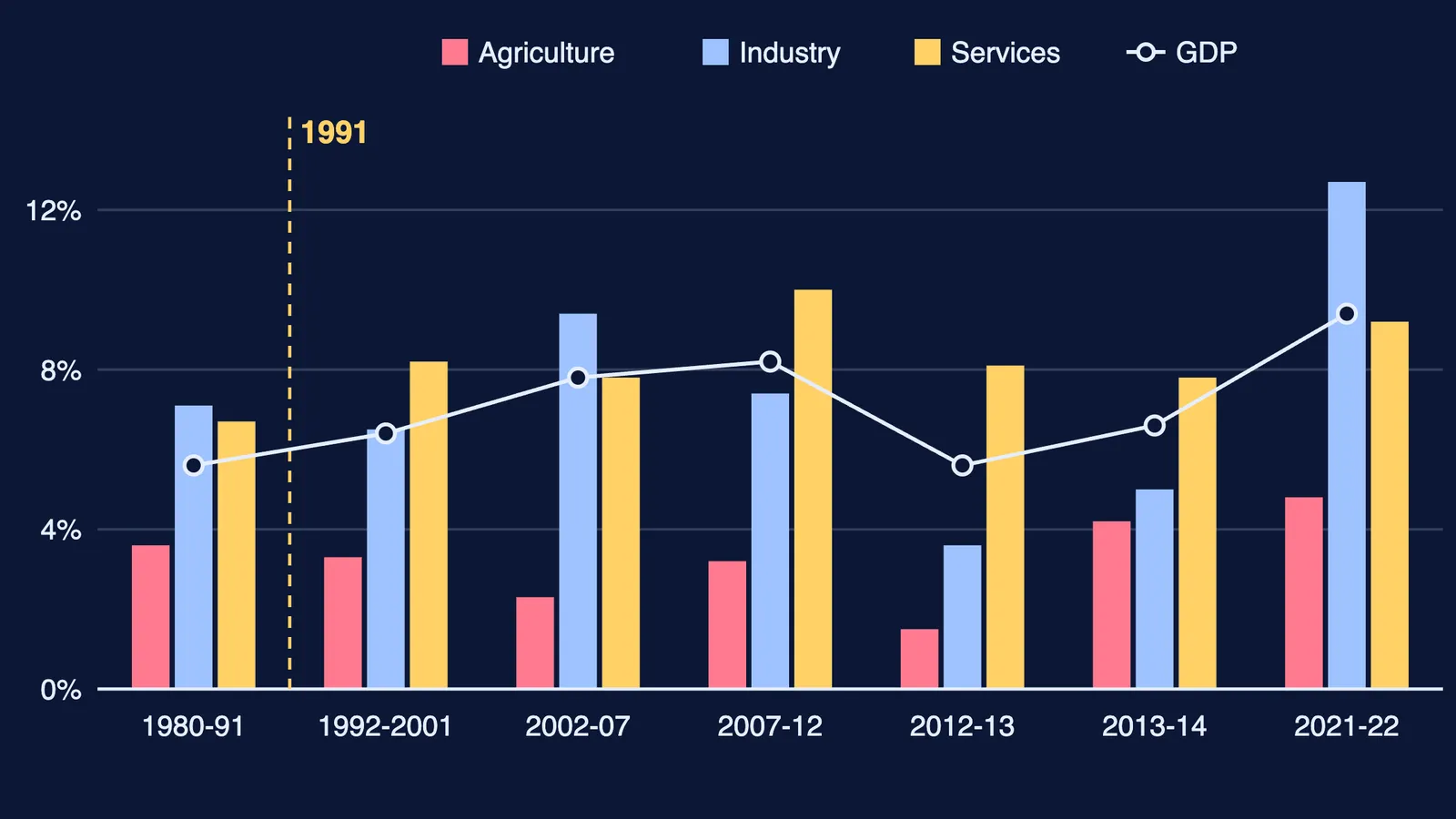
NCERT's assessment, using Economic Survey data in its Table 3.1, gives you both columns.
Gains:
GDP growth rose from 5.6 per cent a year in 1980-91 to 9.4 per cent in 2021-22.
Foreign investment (FDI plus FII) rose from about US$100 million in 1990-91 to US$23 billion in 2022-23.
Foreign exchange reserves rose from about US$6 billion in 1990-91 to about US$646 billion in 2023-24.
Criticisms:
Agriculture: growth slowed, public investment in irrigation, power, roads and research fell, and a partial cut in fertiliser subsidy raised costs.
Industry: growth slowed because of cheaper imports and weak infrastructure.
Jobs: scholars point out that growth did not create enough employment.
Disinvestment: critics say PSE assets were undervalued, and the money plugged revenue gaps. The 1991-92 target was Rs 2,500 crore; in 2022-23 the government raised about Rs 46,000 crore.
Fiscal policy: tax cuts did not raise revenue, and social spending was squeezed.
The pattern to remember: services drove growth while agriculture lagged. If GDP itself feels shaky, read what GDP means in simple words.
How do you write a 6-mark answer on the 1991 reforms?
Take the question: Critically appraise the economic reforms of 1991. Use a four-part plan, with every figure taken from NCERT:
Context (1 sentence): a balance of payments crisis, reserves worth under two weeks of imports, then the NEP.
What changed (2 lines): one example each of liberalisation, privatisation and globalisation.
Two gains with numbers: GDP growth, and reserves from US$6 billion to US$646 billion.
Two criticisms and a close: agriculture and jobs, then one line saying growth was real but uneven.
To practise the plan, Fermi's AI tutor works out what you already know about a topic you bring and builds a plan for the session, so revision starts at your gaps.
If this is the part of economics you enjoy, read how to become an economist in India.


