

On this page
Chapter 4 of the Class 10 economics book asks what happened when India opened its markets to the world, and who came out ahead. It answers through a handful of stories, and examiners expect you to use them.
What is globalisation in Class 10 economics?
The NCERT chapter Globalisation and the Indian Economy defines globalisation as the process of rapid integration or interconnection between countries. More goods, services, investments and technology now move between countries; the movement of people has not increased much, because of various restrictions.
Three more key terms, from the same NCERT chapter:
MNC: a company that owns or controls production in more than one nation.
Investment: money spent on assets such as land, buildings and machines; investment made by MNCs is called foreign investment.
Liberalisation: removing barriers or restrictions set by the government.
MNCs spread production in three ways: joint production with local companies; buying local companies, the most common route (Cargill Foods buying Parakh Foods); or placing orders with small producers of garments, footwear and sports goods.
How do foreign trade and MNCs connect markets?
Foreign trade lets producers sell beyond their own country and gives buyers more choice. In the textbook's Chinese toys example, cheaper Chinese toys arrive and, within a year, 70 to 80 per cent of toy shops replace Indian toys with them (NCERT, page 60). Buyers gain, Chinese makers gain, Indian toy makers lose. With trade, prices of similar goods in two markets tend to become equal and distant producers compete closely; the chapter calls this the integration of markets.
For foreign investment, the chapter uses Ford Motors, which came to India in 1995 and spent Rs 1,700 crore on a plant near Chennai in collaboration with Mahindra and Mahindra (NCERT, page 59).
For the contrast with colonial trade, see our post on the Age of Industrialisation chapter.
What changed in 1991, and what does the WTO do?
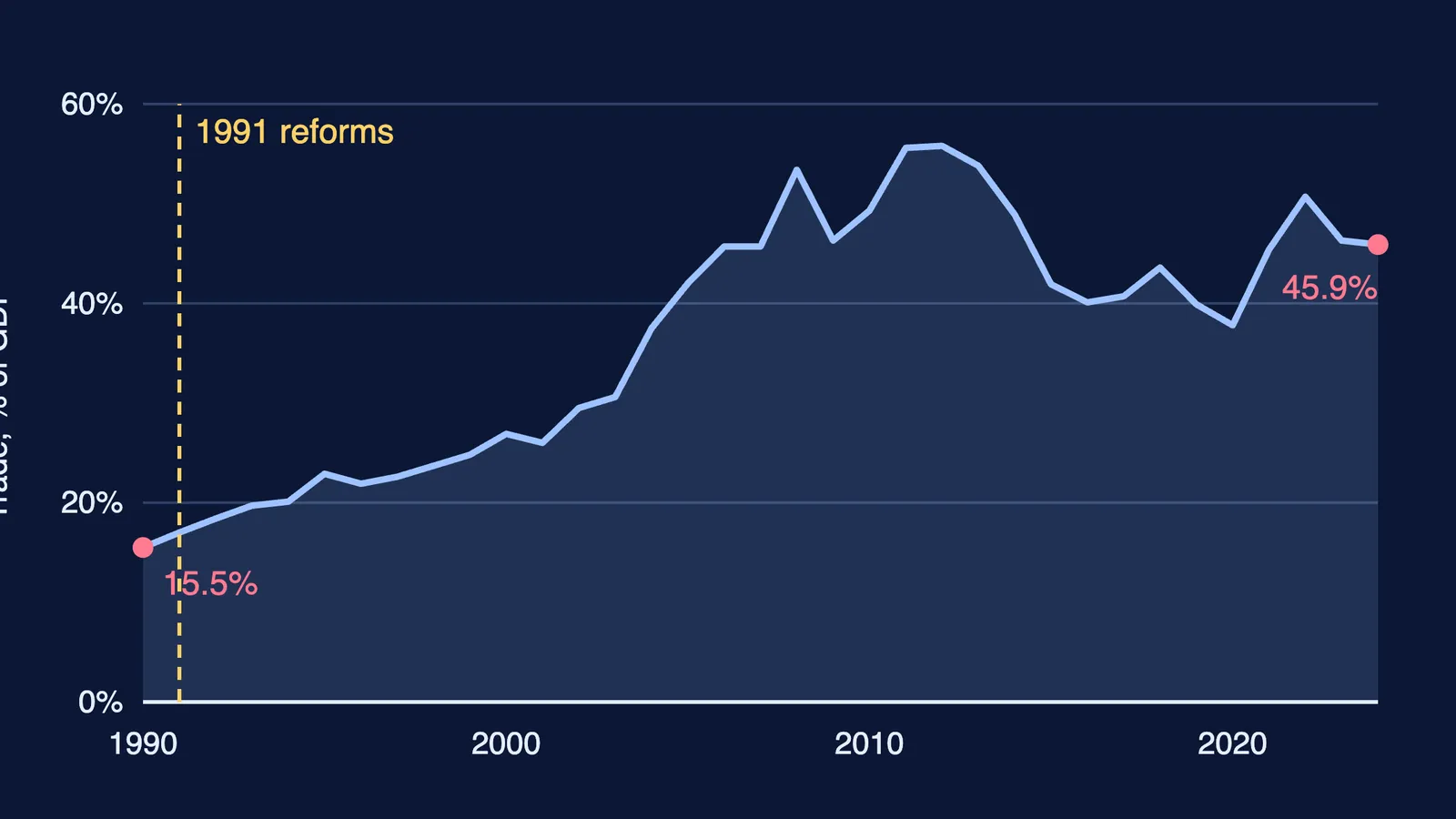
After Independence, India put barriers on foreign trade and investment, allowing imports of only essential items, to protect producers in industries that were just coming up. Starting around 1991, the NCERT chapter says, those barriers were removed to a large extent so Indian producers would compete with producers around the globe. It highlights three factors behind globalisation: rapid improvement in technology (containers, air transport, the internet), liberalisation of trade and investment, and pressure from the World Trade Organisation.
India has been a WTO member since 1 January 1995, according to the WTO's India page. The textbook's criticism of the WTO is a likely question: developed countries have unfairly retained trade barriers and pay their own farmers vast sums, while WTO rules have forced developing countries to remove theirs.
India's trade was 15.5% of GDP in 1990 and 45.9% in 2024, according to the World Bank's trade indicator.
Who gained and who lost from globalisation in India?
The chapter's verdict is that the impact has not been uniform. From the NCERT chapter:
Gained: well-off urban consumers (more choice, better quality, lower prices); MNCs, which raised their investment in India; top Indian companies that invested in newer technology, some becoming MNCs themselves, such as Tata Motors, Infosys and Asian Paints; service companies, particularly in IT, such as call centres.
Lost: small producers in batteries, capacitors, plastics, toys, tyres, dairy products and vegetable oil; workers whose permanent jobs became temporary.
Two stories make the loss concrete. Ravi started a capacitor company in Hosur in 1992 and grew to 20 workers. After the government removed restrictions on capacitor imports in 2001, television companies preferred imports at half his price, and he was left with seven workers (NCERT, page 68). Sushila, a garment worker in Delhi, lost a permanent job with health insurance and provident fund, and now works as a temporary worker for less than half her earlier pay (NCERT, page 69).
How do you write a 5-mark answer on globalisation?
Use this five-line frame, one line per mark:
Define globalisation in one sentence.
Name the mechanism: foreign trade, foreign investment by MNCs, or liberalisation.
Give one textbook example (Ford, Cargill, Chinese toys, Ravi or Sushila).
State one gain and one loss, naming who.
Close with one step towards fair globalisation.
Worked example, for NCERT's exercise "The impact of globalisation has not been uniform. Explain this statement": Globalisation is the rapid integration of countries through trade and foreign investment. After liberalisation from 1991, competition from MNCs and imports rose. Well-off urban consumers gained choice and lower prices, and firms such as Infosys grew into MNCs. Small producers like Ravi in Hosur lost buyers to imports at half his price, and workers like Sushila lost permanent jobs. So the government must enforce labour laws and support small producers.
To revise, turn each story into a cause-and-effect chain, as in our guide to making a cause-and-effect chart. For your science papers, the Fermi Concept Library covers every concept in physics, chemistry, biology, mathematics and computing, so you can patch a gap before the board exam.


