

On this page
The Age of Industrialisation is Chapter 4 of the NCERT Class 10 history book, India and the Contemporary World II. It looks first at Britain, "the first industrial nation", and then at India, "where the pattern of industrial change was conditioned by colonial rule" (NCERT, Chapter 4). Its main argument is that industrialisation meant much more than factories.
What is proto-industrialisation in Class 10 history?
Proto-industrialisation is NCERT's name for the phase when there was "large-scale industrial production for an international market" that "was not based on factories" (NCERT, Chapter 4).
In the seventeenth and eighteenth centuries, merchants from European towns went to the countryside because powerful urban crafts and trade guilds kept newcomers out of the towns. Poor peasants, losing access to common lands, took the merchants' advances and worked at home. NCERT says each merchant employed 20 to 25 workers at each stage of production, so one clothier controlled hundreds of workers (same source).
How did factories grow in Britain?
The earliest factories in England came up by the 1730s, but their numbers grew only in the late eighteenth century (NCERT, Chapter 4). Cotton led the way: Britain's raw cotton imports rose from 2.5 million pounds in 1760 to 22 million pounds in 1787. Richard Arkwright's cotton mill brought every process under one roof and one management.
The chapter then shows that change was slow. In NCERT's account:
At the beginning of the nineteenth century there were no more than 321 steam engines in all of England, even though James Watt had patented his improved engine in 1781.
Even at the end of the nineteenth century, less than 20 per cent of the workforce worked in technologically advanced industrial sectors.
With plenty of cheap labour, many industrialists preferred hand labour, especially in seasonal trades.
Demand for variety needed skill: mid-nineteenth-century Britain produced 500 varieties of hammers and 45 kinds of axes.
What happened to Indian textiles under colonial rule?
Before machine industries, fine cotton and silk from India led the world market (NCERT, Chapter 4). As European companies took control, old ports like Surat and Hoogly declined: trade through Surat fell from Rs 16 million in the late seventeenth century to Rs 3 million by the 1740s.
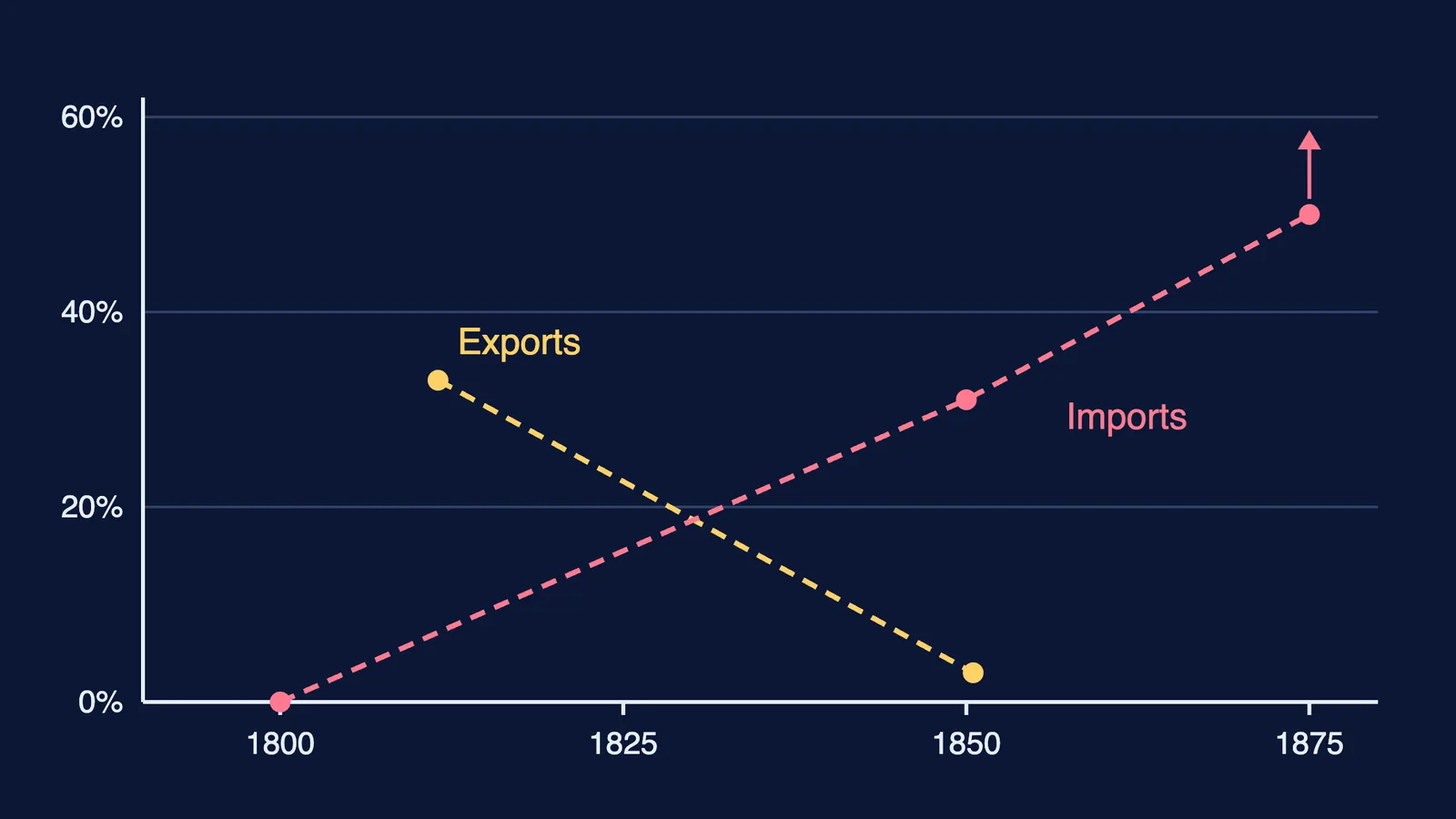
After the 1760s, the East India Company appointed paid supervisors called gomasthas and tied weavers to it through a system of advances, so they could not sell to other buyers. Then Manchester's machine-made cloth arrived. Piece-goods made up 33 per cent of India's exports in 1811-12 and no more than 3 per cent by 1850-51 (same source). Meanwhile, cotton piece-goods rose from virtually nothing at the end of the eighteenth century to over 31 per cent of the value of India's imports by 1850 and over 50 per cent by the 1870s. The American Civil War then pushed up the price of raw cotton, which hurt weavers again.
Factories came up in India too. The first cotton mill in Bombay came up in 1854, and Bengal's first jute mill in 1855. Workers in Indian factories rose from 584,000 in 1901 to over 2,436,000 by 1946 (NCERT, Chapter 4). Yet only 5 per cent of the industrial labour force worked in registered factories in 1911, and 10 per cent in 1931. Handloom cloth production almost trebled between 1900 and 1940, partly because weavers took up the fly shuttle.
How do you write an answer on why Indian weavers declined?
Here is a worked example built only from the textbook. Question: "Explain the problems faced by Indian cotton weavers in the nineteenth century."
Name the two-sided squeeze: the export market collapsed while the home market filled with Manchester imports.
Give one number for each side: exports fell from 33 to 3 per cent; imports rose past 50 per cent by the 1870s.
Explain why: machine-made goods were cheaper.
Add the 1860s raw cotton shortage after the American Civil War.
End with the twist: handloom production still grew in the twentieth century.
If you are drawing up the chapter's timeline, our guide to making a cause-and-effect chart for a history chapter turns these steps into one page. When an AI summary gives you a year, check it against NCERT before you learn it.
Is the chapter in this year's board syllabus?
Syllabus details change from year to year, so check the current CBSE curriculum rather than a guidebook. Our post on how to check the rationalised NCERT syllabus shows where to look.
History sits next to science and maths in the same board year. For those subjects, Fermi's AI tutor can work out what you already know and build a plan for the session, so you sit down to a clear next step.


