

On this page
CBSE's Economics syllabus for 2025-26 lists "Sustainable Economic Development" under Class 12, Part B, Unit 7, "Current Challenges facing Indian Economy", a unit worth 20 of the 80 theory marks. The chapter you actually read is Chapter 7 of NCERT's Indian Economic Development, a book printed for Class 11. Check your school's current syllabus for this year's marks.
What are the four functions of the environment?
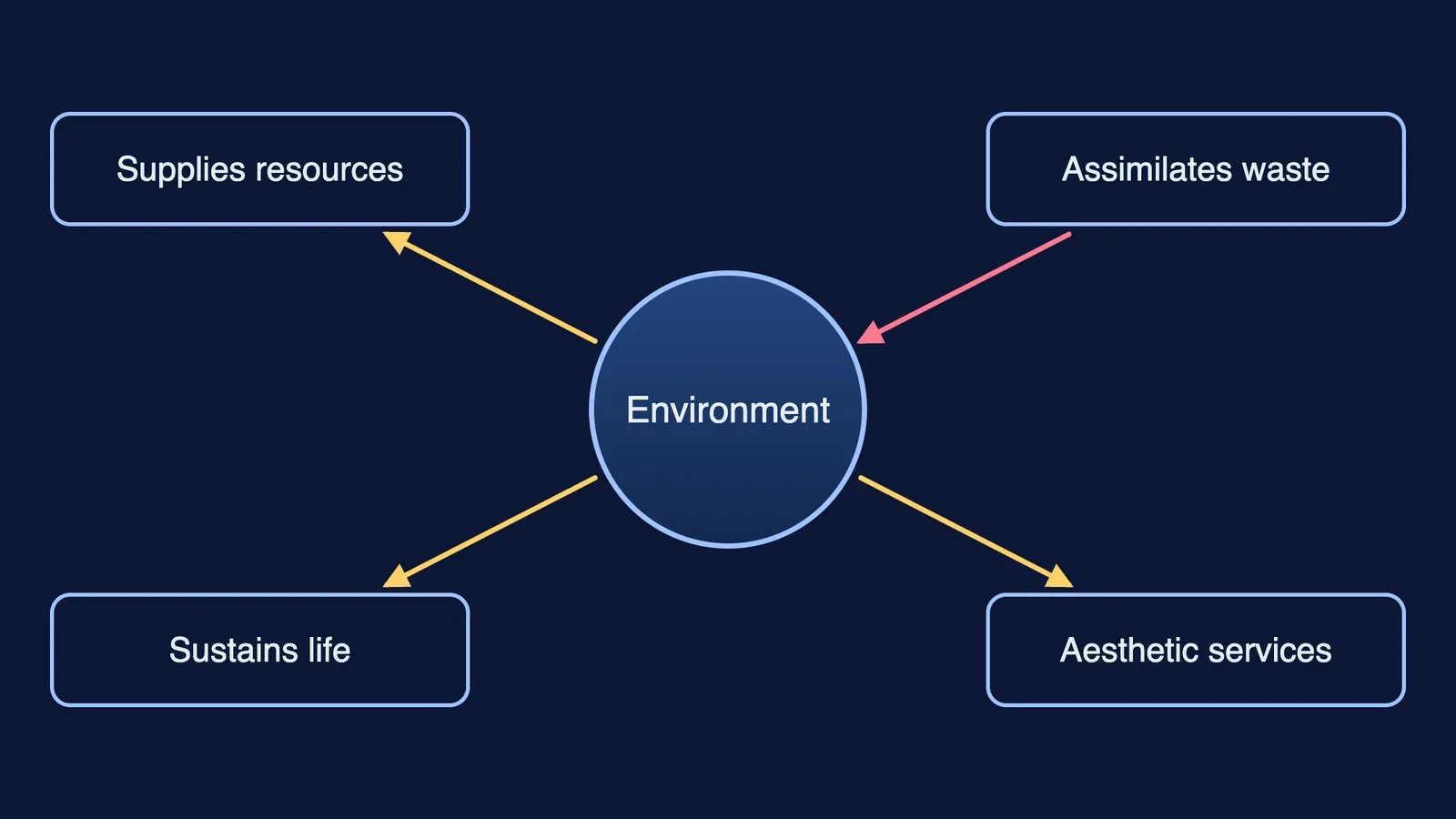
NCERT defines environment as "the total planetary inheritance and the totality of all resources", including all biotic and abiotic factors (NCERT, Chapter 7). It lists four functions:
It supplies resources, both renewable (trees, fish) and non-renewable (fossil fuels).
It assimilates waste.
It sustains life by providing genetic and biodiversity.
It provides aesthetic services, such as scenery.
The environment works within its carrying capacity when resource extraction stays below the rate of regeneration and wastes stay within its assimilating capacity. Absorptive capacity is the environment's ability to absorb degradation. Cross these limits and, NCERT says, the third function fails and an environmental crisis follows.
What are India's main environmental challenges?
NCERT's chapter names five priority issues: land degradation, biodiversity loss, air pollution (especially vehicular pollution in cities), management of fresh water, and solid waste management. It frames them as a dichotomy: poverty-induced degradation on one side, and pollution from affluence and a fast-growing industrial sector on the other.
The chapter's key numbers:
India supports about 17 per cent of the world's people and 20 per cent of its livestock on 2.5 per cent of its geographical area.
Per capita forest land is only 0.06 hectare, against 0.47 hectare needed to meet basic needs.
Soil is being eroded at about 5.3 billion tonnes a year.
Motor vehicles grew from about 3 lakh in 1951 to 35 crore in 2022.
For a current forest figure, the government's India State of Forest Report 2023 puts forest and tree cover at 25.17 per cent of India's geographical area.
What is sustainable development, and how does India pursue it?
The Brundtland Report, *Our Common Future* (1987), defined it this way: "Sustainable development is development that meets the needs of the present without compromising the ability of future generations to meet their own needs" (Swiss Federal Office for Spatial Development). NCERT gives nearly the same words, credited to the UN Conference on Environment and Development, and points to its two catch phrases: "need", which is about distributing resources, and "future generations".
NCERT also gives environmental economist Herman Daly's five conditions: keep population within the carrying capacity; make technology input-efficient; extract renewable resources no faster than they regenerate; deplete non-renewable resources no faster than renewable substitutes are created; and correct inefficiencies from pollution.
The chapter's strategies for India:
Non-conventional energy: wind power, solar power through photovoltaic cells, and mini-hydel plants.
LPG and gobar gas in rural areas; CNG in urban areas.
Traditional knowledge and practices: India has about 15,000 plant species with medicinal properties, of which about 8,000 are in regular use.
Biocomposting, including composting with earthworms.
Biopest control: neem-based pesticides, mixed cropping, and protecting snakes, owls and peacocks that eat pests.
How do you write a 4- or 6-mark answer on this chapter?
Use a three-step frame we call function, failure, fix:
Function: name which of the four functions is at stake.
Failure: show which limit is crossed (carrying or absorptive capacity), with one number from the chapter.
Fix: give the matching strategy and say why it works.
Worked example. "Air pollution in Indian cities is a threat to sustainable development. Explain." (4 marks)
Function: the environment assimilates waste, and vehicle exhaust is waste.
Failure: vehicles rose from about 3 lakh in 1951 to 35 crore in 2022 (NCERT), so emissions exceed the air's absorptive capacity and health costs rise.
Fix: CNG in public transport, which NCERT says lowered air pollution in Delhi; wind and solar power to cut emissions from thermal plants.
For 6 marks, add the dichotomy: rural households burn wood and dung cake, while affluence adds cars, so the fix needs both LPG or gobar gas and CNG.
The chapter also has boxes on global warming and ozone depletion, and the syllabus names global warming. If greenhouse gases or how CFCs thin the ozone layer feel fuzzy, the Fermi Concept Library covers every concept in chemistry and biology, each with its own lesson.
A three-day revision plan
Day 1: from memory, write the four functions, the two capacities, the Brundtland definition and the five priority issues.
Day 2: learn Daly's five conditions and the strategies; match each strategy to the function it protects.
Day 3: answer NCERT exercises 8, 16 and 18 with function, failure, fix, timed.
If you are not sure where to begin, Fermi's AI tutor can work out what you already know and build a plan for the session.
Related reading: income and HDI in Class 10 development, how India measures its poverty line, and the biotic and abiotic basics in environment and its components from Class 7.


