

On this page
Ravi's playground is dug up for a block of flats, and his class asks: what is environment? That story opens the first chapter of NCERT's Class 7 geography book. Here is the chapter in plain words, with a sorting drill and a model exam answer.
What is environment in Class 7 geography?
NCERT's definition: "the place, people, things and nature that surround any living organism is called environment" (NCERT Class 7, Our Environment, Chapter 1). The chapter calls it a combination of natural and human-made phenomena. The word comes from the French *environner*, meaning "neighbourhood".
Biotic means the world of living things, such as plants and animals. Abiotic means the world of non-living things, such as land. The natural environment includes both.
What are the three components of environment?
The chapter's diagram (Fig. 1.1 in the NCERT chapter) splits the environment into three groups:
Natural: land, water, air and living things.
Human-made: buildings, parks, bridges, roads, industries and monuments.
Human: the individual, family, community, religion, education, the economy and the political situation.
A quick test: did nature make it, did people build it, or is it about how people live together? A river is natural, a dam on it is human-made, and the panchayat that decides how its water is shared belongs to the human environment.
What are the four domains of the environment?
The natural environment is studied as four domains. Each definition follows the NCERT chapter:
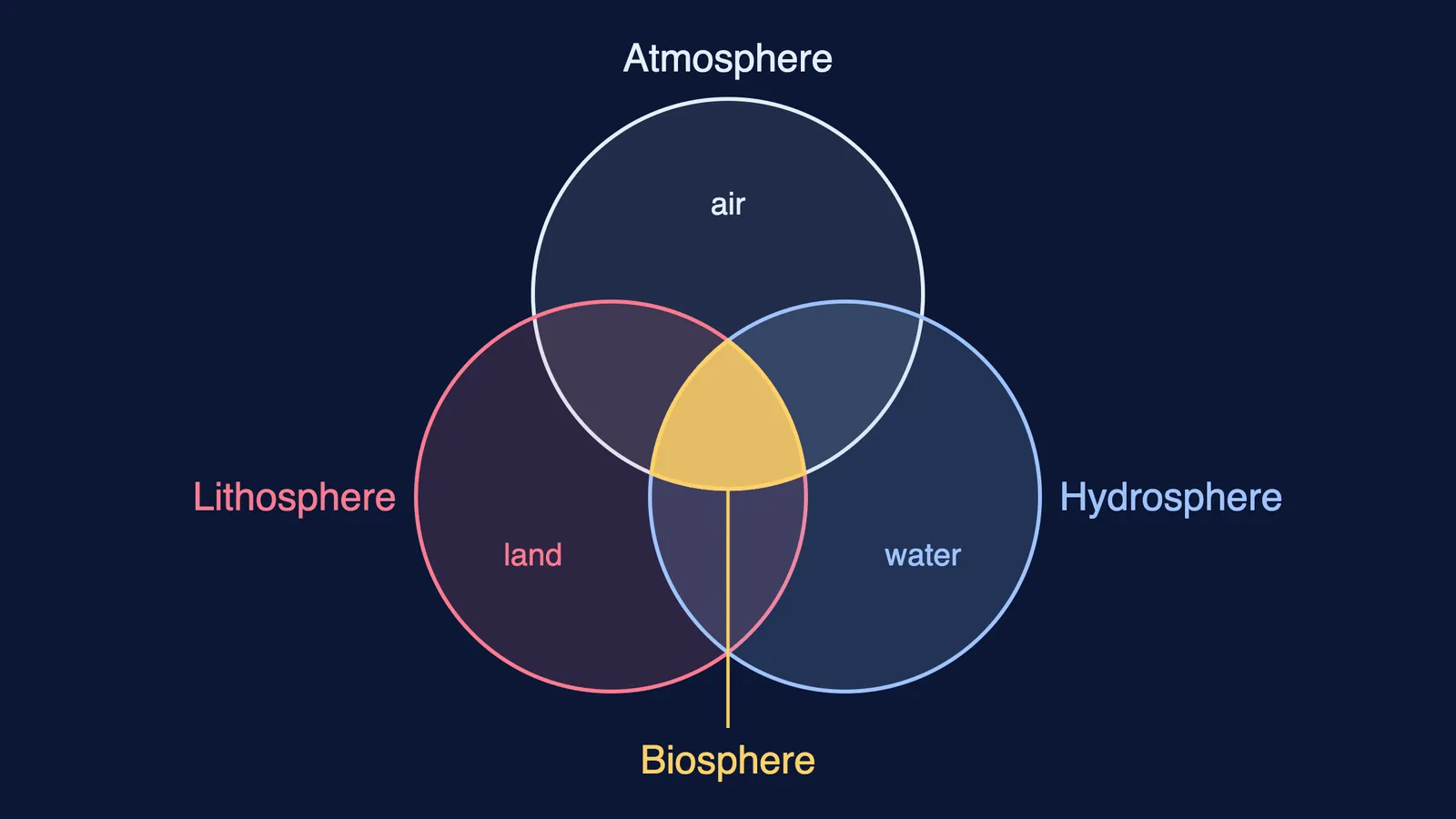
Lithosphere: the solid crust or hard top layer of the earth, made of rocks and minerals and covered by a thin layer of soil. It gives us forests, grasslands, farmland, land for settlements and minerals.
Hydrosphere: the domain of water, including rivers, lakes, seas and oceans. It is essential for all living organisms.
Atmosphere: the thin layer of air around the earth, held in place by the earth's gravity. It protects us from the sun's harmful rays and heat, and its changes bring changes in weather and climate.
Biosphere: plants and animals together, the living world. It is a narrow zone where land, water and air interact to support life.
That last line is the picture at the top of this post: the biosphere is where the other three meet.
What is an ecosystem, with examples?
NCERT defines an ecosystem as a system formed by living organisms interacting with each other and with the physical and chemical factors around them, all linked by a transfer of energy and material (NCERT Chapter 1). Its examples run from a rainforest, grassland, desert, mountain, lake, river and ocean down to a small pond.
The chapter's story shows why ecosystems differ. Jessy from Kerala describes heavy rain and coconut plantations; Heera from Jaisalmer describes sand and kikar trees, and then camels, snakes and lizards. Ravi asks whether the animals, the plants and the way people live are all related to each other, and the teacher says they are, very much so. To see one ecosystem traced link by link, read our guide to the grassland ecosystem and its food chain.
How do I revise this chapter quickly?
Do this on your way home.
Note ten things you see: a neem tree, the road, a crow, the school building, a puddle, clouds, a temple, your friends, a shop, the soil in a flowerpot.
Sort each one. Neem, crow, puddle, clouds and soil are natural; road, school building and shop are human-made; your friends belong to the human group.
Put each natural item in a domain: soil in the lithosphere, the puddle in the hydrosphere, clouds in the atmosphere, neem and crow in the biosphere.
Pick one place, such as a park, and say in two sentences whether it is an ecosystem. The chapter asks exactly this about Ravi's park.
Some items fit two groups: the temple is a human-made building and also part of religion in the human environment. Say so and give the reason; it shows you understand the groups rather than having memorised them.
For the "Give reasons" question "Man modifies his environment", follow the chapter's sequence: early humans adapted to nature; as needs grew, they learned to grow crops, domesticate animals and settle; then came the wheel, the barter system and trade, the industrial revolution, faster transport and the information revolution. End with the chapter's point that the natural and human environment need to stay in balance.
If "ecosystem" or "biosphere" is still fuzzy, the Fermi Concept Library covers every concept in biology, each with its own lesson and its place in the map.
Is this chapter in the new NCERT book?
NCERT rolled out a new Class 7 social science book, Exploring Society: India and Beyond, for 2025-26; it replaces the three earlier books for history, geography and social and political life, as Scroll reported. The definitions here come from the older Our Environment book, so check which book your school follows.
They also return in high-school biology, where the one-way flow of energy and cycling of nutrients in an ecosystem becomes a full topic, and Ernst Haeckel's 1866 definition of ecology shows where the subject's name began.


