On this page
If a biology test asks who coined the word ecology, the answer is the German zoologist Ernst Haeckel, in 1866. He spelled it Oecologie, in the second volume of his book Generelle Morphologie der Organismen (“General Morphology of Organisms”), and the page survives in the digitised 1866 volume on the Internet Archive. Here is what he wrote, the example he used, and how to turn it into an exam answer.
Who coined the word ecology?
Ernst Haeckel (1834–1919) was a German zoologist and a follower of Charles Darwin, and he coined “oecologia” to deal with how organisms relate to their “external world”, according to the Environment & Society Portal’s entry on the term. He taught zoology at the University of Jena from 1862 to 1909 and also coined phylum, phylogeny and ontogeny, as his Wikipedia biography notes.
Chapter XI of volume 2 starts on page 286 and is titled “Oecologie und Chorologie”: ecology, plus chorology, the study of how organisms are spread over the Earth (Generelle Morphologie, vol. 2).
What did Haeckel mean by ecology in 1866?
Here is his definition from page 286 of volume 2: “Unter Oecologie verstehen wir die gesammte Wissenschaft von den Beziehungen des Organismus zur umgebenden Aussenwelt, wohin wir im weiteren Sinne alle ‘Existenz-Bedingungen’ rechnen können.”
In our translation: by ecology we mean the whole science of the relations of the organism to the outside world around it, in which, in a wider sense, we can include all its “conditions of existence”.
On the same page he splits those conditions into two kinds:
Inorganic conditions: the physical and chemical properties of the place where the organism lives, the climate (light, warmth, moisture and the electrical state of the air), inorganic food, and the nature of the water and soil.
Organic conditions: all its relations with the other organisms it meets, most of which either help it or harm it. Every organism has “friends and enemies” among the others, and the organisms it eats and the parasites living on it count here too.
That split is the abiotic and biotic factors of your school textbook, written down in 1866.
Earlier in the volume (pp. 235–236) he calls ecology “die Lehre vom Naturhaushalte”, the study of nature’s economy, and notes that textbooks did not yet treat it as a subject (vol. 2).
What example did Haeckel use to explain ecology?
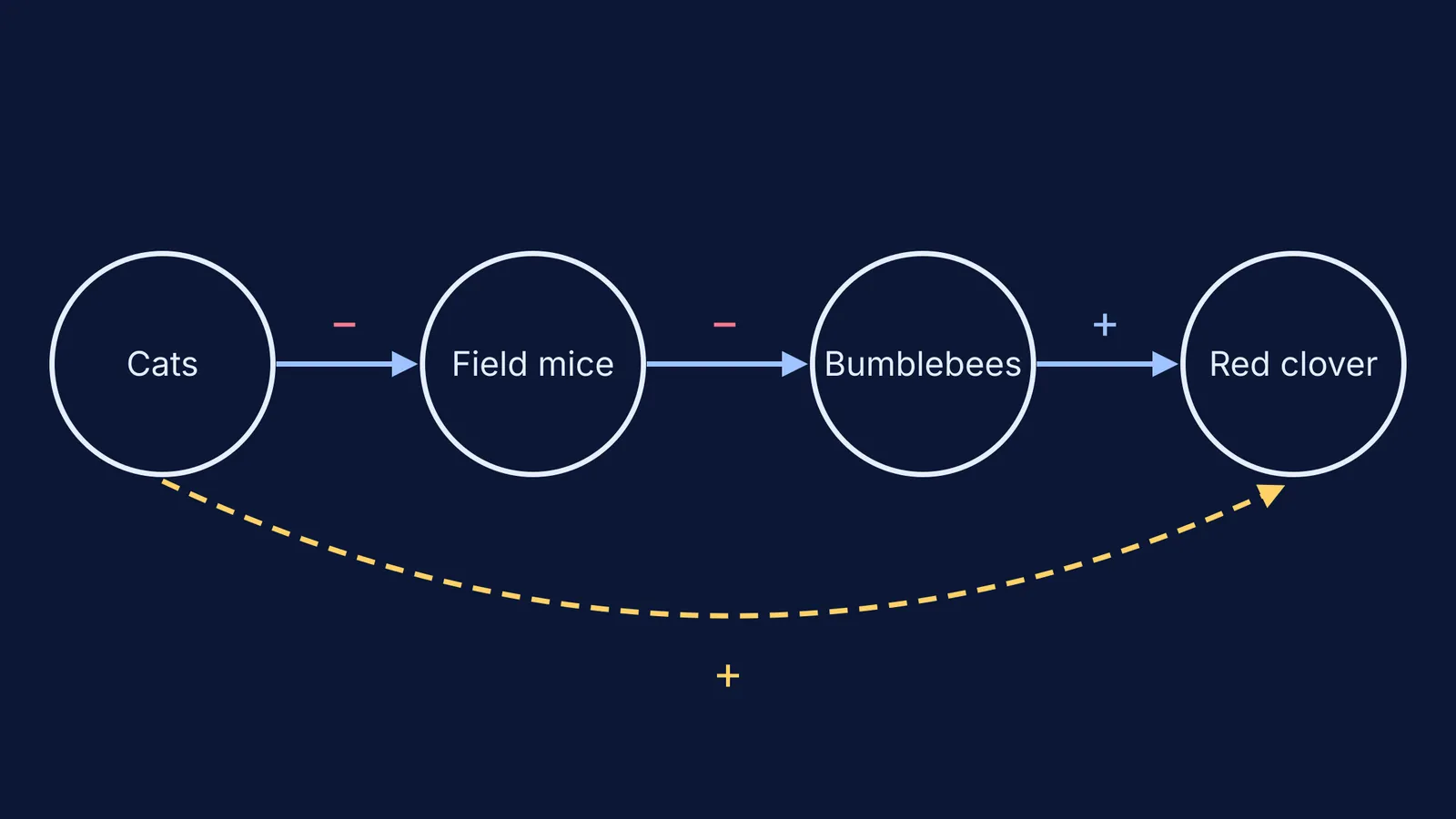
He borrowed one from Darwin. In a footnote on page 235 of volume 2, Haeckel retells a chain of cats, field mice, bumblebees and red clover. Darwin’s own version in On the Origin of Species goes like this: only humble-bees (bumblebees) visit red clover, because other bees cannot reach the nectar; field mice destroy bumblebee combs and nests; and the number of mice depends largely on the number of cats. So, Darwin argued, the number of cats in a district might help decide how common certain flowers are there.
Haeckel then stretched the chain, crediting Carl Vogt, into a half-joke about clover, English beef and English culture. The serious point: in ecology, a change in one species travels along the links to others.
To watch a ripple like this happen, try our post on what happens when you remove a species from a food web. The Fermi Simulation Lab has interactive simulations for ideas that are easier to see than to read.
How do you use Haeckel’s definition in a biology answer?
Use his two lists as a checklist for any “factors affecting an organism” question.
Name the organism and where it lives.
List the inorganic conditions, roughly in Haeckel’s order: light, temperature, moisture, water, soil, inorganic nutrients.
List the organic conditions: what it eats, what eats it, what competes with it, what lives on it, what helps it.
Pick one link and write it as a chain, the way Haeckel did in his footnote: more cats, fewer mice, more bumblebees, more clover.
Worked example: a frog in a paddy field. Inorganic: water depth, temperature, sunlight, soil. Organic: insects it eats (food), snakes and birds that eat it (enemies), other frogs (competitors), its parasites. One chain: fewer insects, fewer frogs, less food for the snakes.
A two-mark answer you can write: “Ecology is the study of the relationships of organisms with their surroundings, both living (biotic) and non-living (abiotic). The term was coined by the German zoologist Ernst Haeckel in 1866.”
Tansley’s paper, The Use and Abuse of Vegetational Concepts and Terms, appeared in the journal Ecology; Charles H. Smith’s notes on Tansley record that it introduced the term. Our post on Arthur Tansley and the ecosystem idea tells that story, and our explainer on habitat vs niche sorts out two more words students mix up. If terms like these keep blurring together, the Fermi Concept Library gives every biology concept its own lesson and its place in the map.