

On this page
If you are studying biology, one of the most common points of confusion in ecology is the difference between a habitat and a niche. They sound similar, but they describe entirely different dimensions of how an organism survives.
The simplest way to separate them comes from the American ecologist Eugene Odum. In the 1959 edition of his textbook *Fundamentals of Ecology*, he gave students a memorable rule: the habitat is the organism's "address", while the niche is its "profession" (Source).
What is a habitat?
A habitat is the physical environment where a species lives. It is the geographic space you would go to if you wanted to find that organism in the wild.
A habitat provides the baseline conditions required for life, such as shelter, water, and an acceptable temperature range. Crucially, a habitat is a shared space. A single tropical rainforest is the habitat for many different species, from canopy-dwelling monkeys to fungi growing on the forest floor. They all have the same "address".
What is an ecological niche?
An ecological niche is much more specific. It is the functional role an organism plays within its community. If the habitat is *where* an organism lives, the niche is *how* it makes a living.
A niche includes everything a species does to survive and reproduce. It covers its diet, its behaviour (such as whether it is active day or night), and its trophic level. Just as biological magnification shows how toxins concentrate as they move up a food chain, niche theory explains how energy itself flows through those specific feeding roles. Because a niche defines a highly specific role, no two species can occupy the exact same niche in the same habitat for long.
If you struggle to remember the difference between these definitions, the Fermi Concept Library covers every concept in physics, chemistry, biology, mathematics and computing, each with its own lesson and its place in the map.
What is the competitive exclusion principle?
When two species try to do the same "job" in the same place, they compete. In 1934, the Russian biologist G. F. Gause proved what happens when this competition is absolute.
Gause set up a laboratory experiment using two closely related single-celled organisms, *Paramecium aurelia* and *Paramecium caudatum*. When grown in separate test tubes with a constant food supply, both species thrived. However, when he put them in the same tube, forcing them to occupy the exact same niche, they competed intensely. *P. aurelia* had a slightly faster growth rate. The *P. caudatum* population began to collapse, and *P. aurelia* drove *P. caudatum* to complete extinction (Source).
This experiment led to Gause's Law, or the competitive exclusion principle: two species competing for the identical limited resource cannot stably coexist. One will always be slightly more efficient and outcompete the other.
What is the difference between a fundamental and realized niche?
In nature, environments are not as simple as a single test tube. In 1957, the ecologist G. Evelyn Hutchinson expanded the idea of a niche into a mathematical model. He called it an "*n*-dimensional hypervolume"—a shape drawn across many different axes, such as temperature, humidity, and food size (Source).
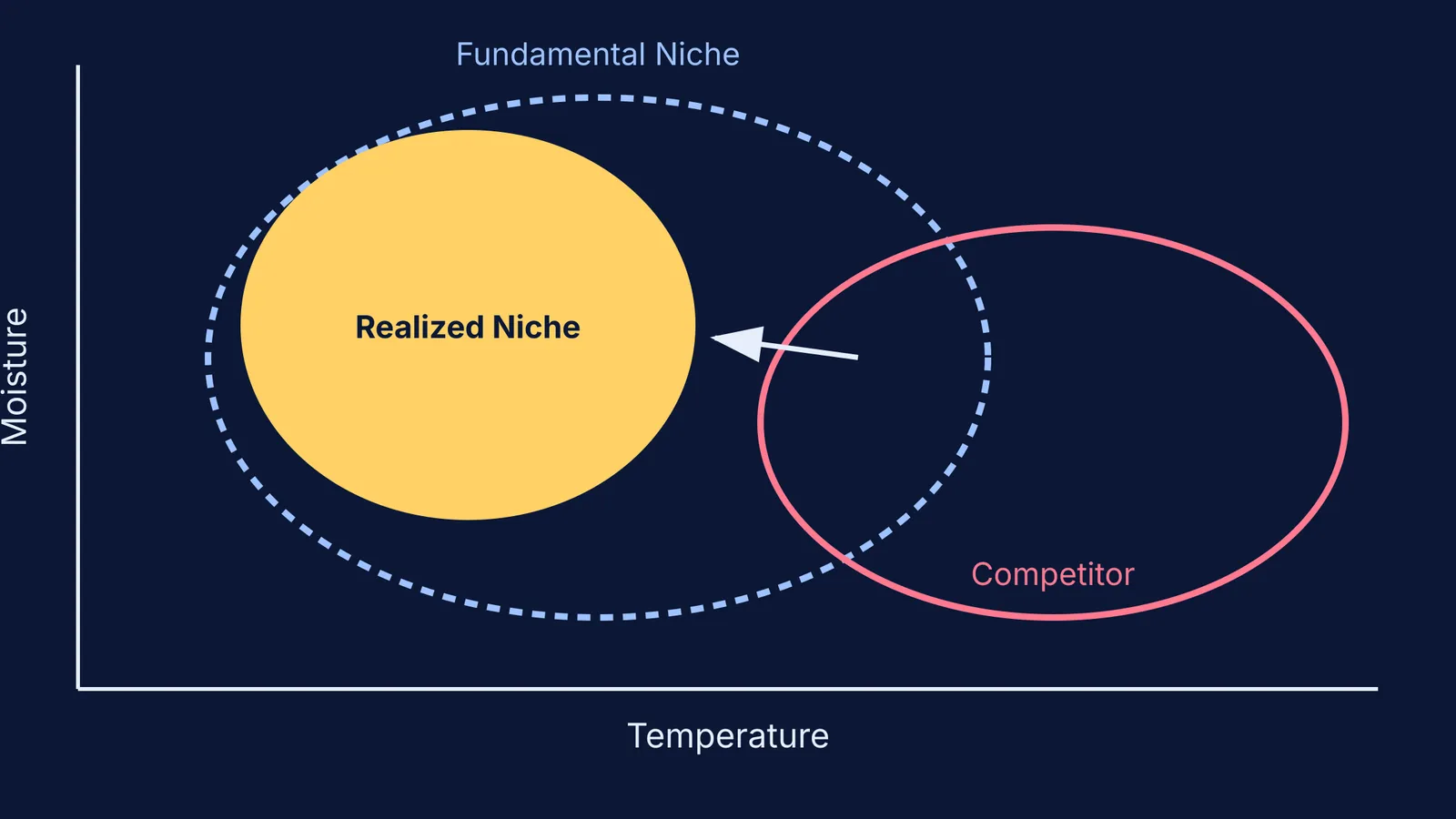
Hutchinson pointed out a critical difference between what an organism *can* do and what it *actually* does:
Fundamental niche: The full, theoretical range of conditions an organism could survive in if there were no competitors or predators to stop it.
Realized niche: The smaller, actual space the organism is forced into because of competition and predation.
When a stronger competitor moves into a habitat, a species usually shrinks its activity to avoid direct conflict, abandoning parts of its fundamental niche to survive in a narrower realized niche. This shift to avoid overlap is an example of evolutionary pressure at work, shaping the species' behaviour much like stabilising, directional and disruptive selection shapes its physical traits over generations.
Learning to separate these concepts is a matter of practice. The Fermi Problem Library has worked problems with a step-by-step solver that explains the reasoning rather than printing an answer, helping you map theoretical rules to practical questions.


