On this page
International Organisations is chapter 4 of NCERT's Contemporary World Politics. The current NCERT text (reprint 2026-27) asks why countries need the UN, how the Security Council decides, why reform stalls and what India wants. The CBSE Political Science curriculum for 2026-27 gives it 6 marks out of the 40 for Contemporary World Politics and keeps every sub-topic, including the key agencies and two human rights NGOs.
Why do we need international organisations like the UN?
States create international organisations and stay in charge of them; such a body has no power above its members. It helps countries settle disputes without war and tackle what none can solve alone, such as a disease or global warming (NCERT). Its rules and bureaucracy help members trust that costs and benefits will be shared fairly.
The UN replaced the League of Nations, which failed to stop the Second World War. Learn these dates:
26 June 1945: 50 nations sign the UN Charter; Poland signs later, making 51 founding members.
24 October 1945: the UN is founded, so this is UN Day.
30 October 1945: India joins.
By 2011 the UN had 193 members, each with one vote in the General Assembly.
How does the UN Security Council work?
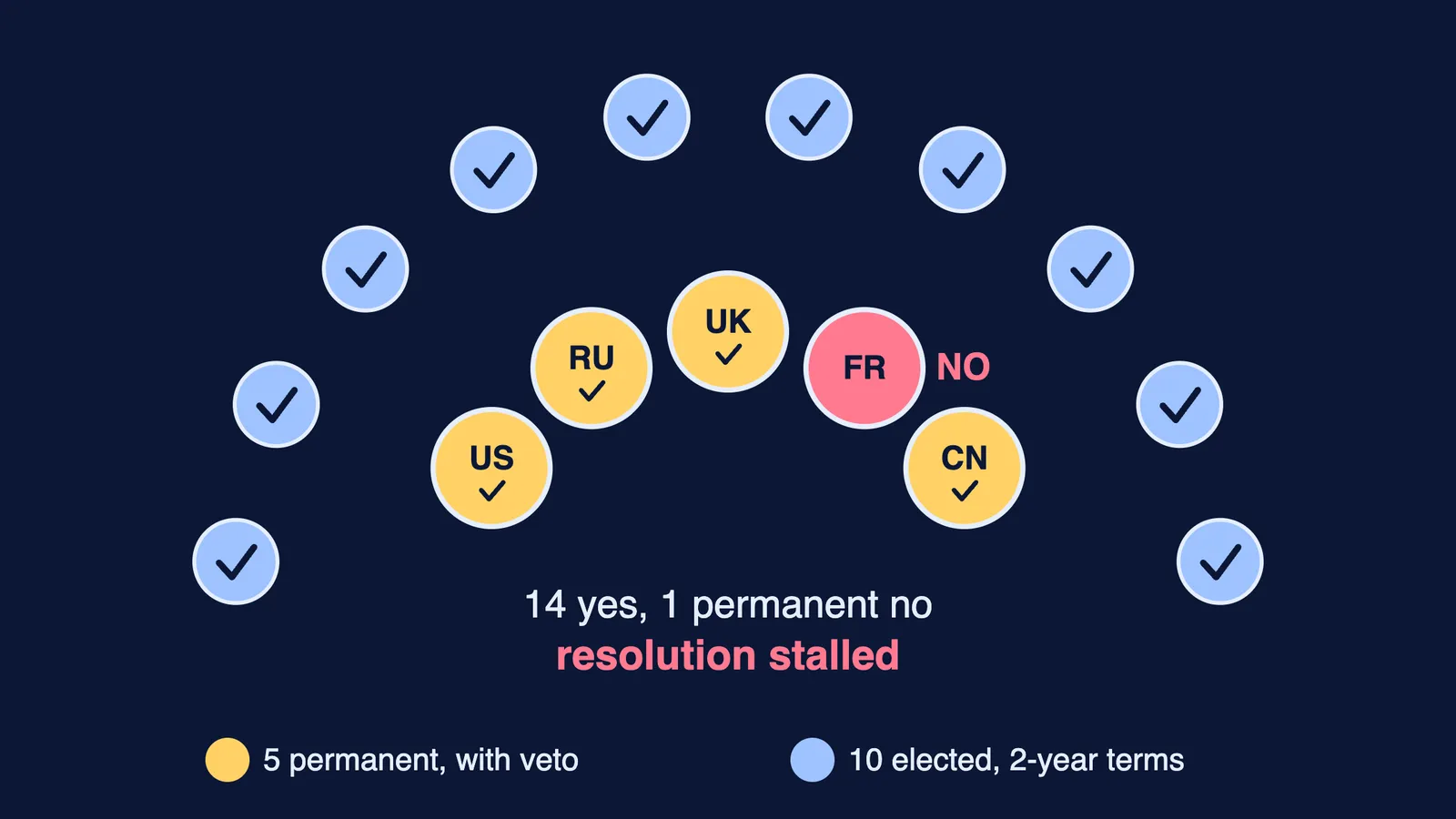
The Security Council has 15 members (NCERT):
5 permanent members: the US, Russia, the UK, France and China, the most powerful states and the victors after the Second World War.
10 non-permanent members, elected for two years so all continents are represented. None can be re-elected straight away, and none has a veto.
Every member has one vote, but a negative vote from any permanent member stalls a decision. That is the veto.
Many see the veto as clashing with democracy and sovereign equality, yet NCERT notes that without it the great powers might lose interest in the UN and act outside it.
Why is UN reform so hard, and what does India want?
A 1992 General Assembly resolution reflected three complaints: the Council no longer matched political realities, it served only Western values and interests, with a few powers in control, and it lacked equitable representation (NCERT). Proposed tests for new members include economic and military power, budget contributions, population, respect for democracy and human rights, and wider representation. Each favours some countries, so agreement stalls.
India's core point is that the Council grew from 11 to 15 in 1965 with no new permanent members, while the General Assembly, now mostly developing countries, kept growing. India backs more seats of both kinds. For its own claim, the text lists:
The most populous country, with almost one-fifth of the world's people.
The world's largest democracy.
A long record in UN peacekeeping.
Regular financial contributions, never missed.
Its economic emergence.
The objections NCERT lists are Pakistan's reluctance, concern over India's nuclear weapons, a fear that adding India means adding Brazil, Germany, Japan or South Africa, and calls to represent Africa and South America first.
The CBSE 2026-27 sample paper caps 6-mark answers at 170-180 words, so plan first.
Which agencies and NGOs should you know?
Each needs one line of purpose (NCERT; ILO from the curriculum's reference material):
IMF: oversees international finance; votes are unequal, and the G-7 hold 41.29%.
World Bank: set up in 1944; loans and grants to developing countries.
WTO: set up in 1995 to succeed GATT; sets global trade rules.
ILO: founded in October 1919 in Geneva; sets international labour standards.
IAEA: set up in 1957 from Eisenhower's Atoms for Peace proposal; inspects nuclear facilities.
Amnesty International and Human Rights Watch: NGOs that research and campaign on human rights.
The 2026-27 sample paper has two 1-mark WTO questions and a 4-mark question on the chapter's cartoon about the 2006 Lebanon crisis.
What questions should you practise?
These are our own questions in the board pattern:
(1 mark) In which year did the Security Council grow from 11 to 15 members?
(2 marks) Give two privileges of a permanent Security Council member.
(4 marks) Explain two criteria proposed for new Council members and one problem with each.
(6 marks) "India's claim to a permanent seat is strong, but the path is hard." Examine both halves.
If you are not sure where to start revising, Fermi's AI tutor can work out what you already know and build a plan for the session, so you sit down to a clear next step. Before long answers, read our guide to writing Political Science answers in boards. Revise chapter 1 with the end of bipolarity and the Soviet break-up, and the Cold War era guide for veto-era background.