

On this page
Dry cleaning is not dry. Your clothes are washed in a liquid, just not in water. As the PBS science series Reactions says in its explainer on why clothes shrink, "dry cleaning isn't dry at all": instead of water, the cleaners use a chemical such as perchloroethylene, or "perc" for short. The chemistry behind it is the same polarity rule you meet in Class 11, and it explains both why grease comes out and why your woollen sweater keeps its size.
Why is it called dry cleaning?
It is called dry because the clothes are washed in a solvent, not in water. The US Environmental Protection Agency's 2024 fact sheet on perc dry cleaning describes dry-to-dry machines that "wash, extract, and dry the articles in a single machine." In the EPA's words, "The articles enter and exit the machine dry."
How does a nonpolar solvent lift an oily stain?
The rule is "like dissolves like". A polar liquid dissolves polar and ionic substances; a nonpolar liquid dissolves nonpolar ones. Water is polar. Oil, ghee, hair oil and the grease from skin are mostly long hydrocarbon chains, which are nonpolar. That is why water alone does little to an oily stain on a silk kurta.
Perc is the opposite of water. PBS describes perc as "an oil loving, nonpolar solvent" that "does a great job of lifting non-polar stains from fabric" (PBS Reactions). PubChem's record for tetrachloroethylene notes that it dissolves in most fixed and volatile oils, so the grease dissolves and drains away with the solvent.
The weak spot is the reverse: sugar and salt are water-soluble, and perc cannot dissolve them. The same PBS explainer says a detergent is added that "helps lift any water soluble stains that the perc can't interact with." It is the mirror image of why ionic compounds dissolve in water but not in kerosene.
Why does dry cleaning not shrink wool?
Wool is made of protein fibres, and water gets inside them. PBS explains that water molecules "cause the interior of the fiber structure to swell", and to make room for that swelling "the exterior of the fiber has to contract lengthwise" (PBS Reactions). Perc behaves differently: it "can't penetrate protein based fibers, so it doesn't cause any shrinkage." For heat and felting, read why woollens shrink in hot water.
Worked example: why is perc nonpolar if its C–Cl bonds are polar?
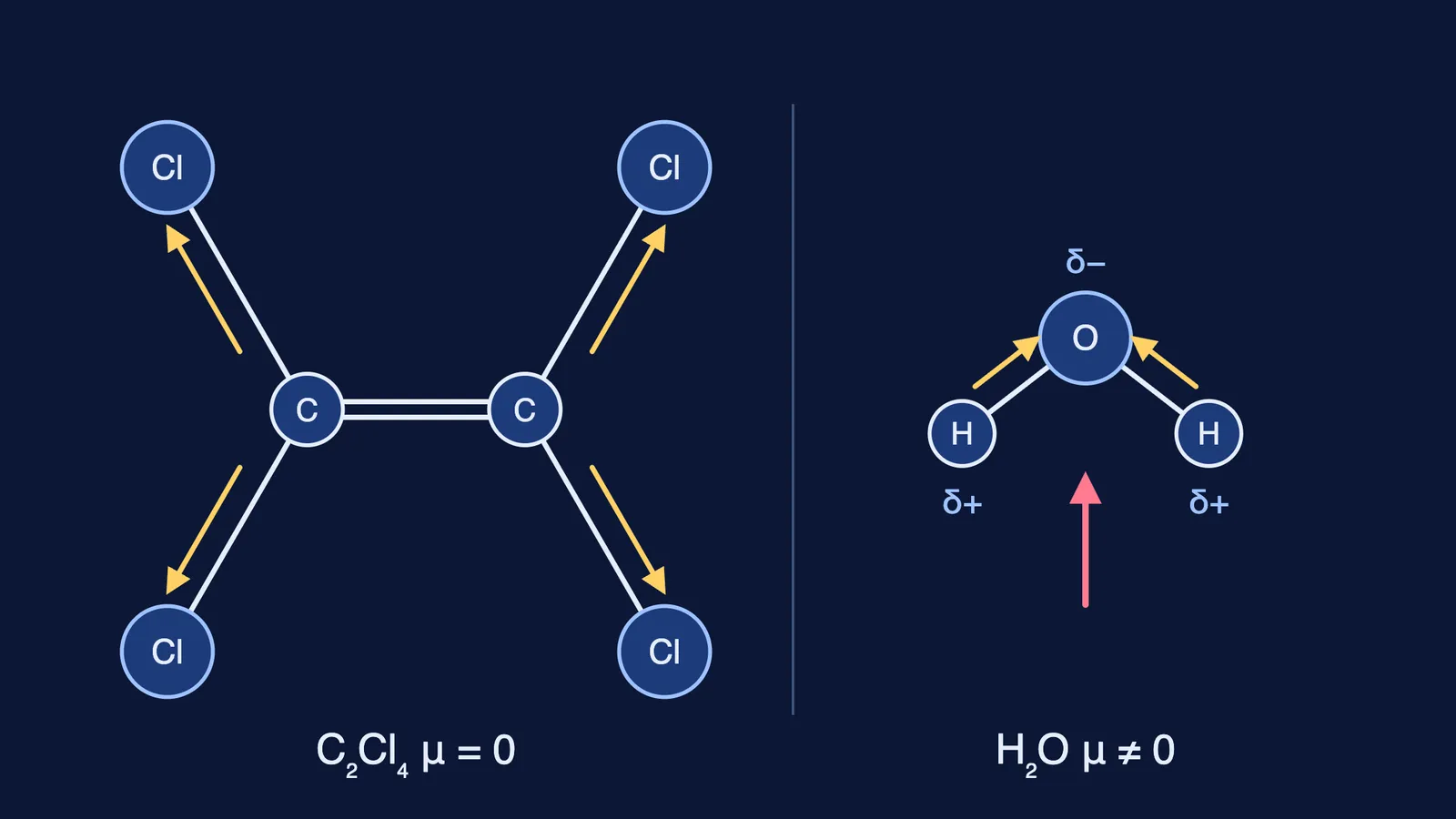
This is a standard Class 11 reasoning question. Perc is tetrachloroethylene, Cl2C=CCl2.
Each C–Cl bond is polar. Chlorine is more electronegative than carbon, so each bond dipole points from carbon towards chlorine.
Draw the shape. Both carbons are trigonal planar, so the whole molecule is flat, with two chlorines on each carbon.
Pair the arrows. Every C–Cl bond dipole has a partner of equal size pointing the opposite way across the centre of the molecule.
Add them as vectors. The four bond dipoles cancel, so the net dipole moment is zero and the molecule is nonpolar.
Contrast with water. Its two O–H dipoles sit in a bent shape, so they add, and water is polar.
The same reasoning separates CCl4 from CHCl3, and it sits behind why haloalkanes are insoluble in water.
If adding dipoles as vectors still feels shaky, the Fermi Concept Library has a lesson for every concept in chemistry, each with its place in the map. And Fermi's AI tutor can draw the figure on a board and check your understanding as it goes.
What makes perc useful, and why is it being phased out?
PubChem's record for tetrachloroethylene gives the numbers that suit a cleaning fluid. Perc boils at 121.2 °C. Its density is 1.623 g/cm3 at 20 °C, so it is denser than water and sinks. Only about 206 mg of perc dissolves in a litre of water at 25 °C. The fire-safety listing reports no flash point in a conventional closed tester, so unlike petrol it does not readily catch fire.
The catch is health. The EPA's risk management page for PCE says the agency "determined that PCE presents an unreasonable risk of injury to human health." Its December 2024 rule sets a 10-year phaseout of perc in US dry cleaning and bars perc in newly acquired machines after 6 months. In July 2025 the EPA opened a public comment period as a first step to reconsider the rule, so check that page for its current status. This is a US rule; other countries set their own.
A stain sorter you can use today
Before you hand over a stained garment, sort the stain by polarity:
Oily (ghee, hair oil, lipstick, engine grease): nonpolar, so it is the solvent's job.
Water-based (sugar syrup, salty food): polar, so it needs water or detergent.
Mixed (gravy, sweat, oily snacks with spices): both, so name each part.
Wool marked "dry clean only": PBS notes these are the clothes prone to shrinkage, so keep it out of the washing machine.
Next time you see a "dry clean only" label, you will know what it means: like dissolves like, and water stays out.


