On this page
Haloalkanes puzzle a lot of Class 12 students. The carbon–halogen bond is polar, and chloromethane's dipole moment is 1.87 D, almost the same as water's 1.85 D, according to the LibreTexts table of dipole moments/Physical_Properties_of_Matter/Atomic_and_Molecular_Properties/Intermolecular_Forces/Specific_Interactions/Dipole_moments). "Like dissolves like" seems to say chloromethane should mix with water. It barely does. The reason is an energy balance, and once you see it, the exam answer writes itself.
Why are haloalkanes insoluble in water though they are polar?
Dissolving is a trade. Some attractions must break before new ones can form, and the trade only goes ahead if the new attractions pay back what the broken ones cost. Chemguide's page on haloalkanes sets out the steps:
Pull the haloalkane molecules apart. This costs energy, because they hold each other by dispersion forces and dipole–dipole attractions.
Push water molecules apart to make room. This costs energy too, because hydrogen bonds between water molecules have to break.
Let haloalkane and water molecules attract each other. This releases energy, through dispersion forces and dipole–dipole attractions.
The new haloalkane–water attractions are not as strong as the hydrogen bonds they replace, so less energy is released in step 3 than steps 1 and 2 cost, as Chemguide explains. With nothing to pay for that gap, most of the haloalkane stays out of the water and the liquids sit in two layers.
So the polarity is real, it is just not the deciding factor. If you want to see why the dipole order among the methyl halides is not what most students guess, read our post on the dipole moment order of CH3F, CH3Cl, CH3Br and CH3I.
How insoluble are haloalkanes, in real numbers?
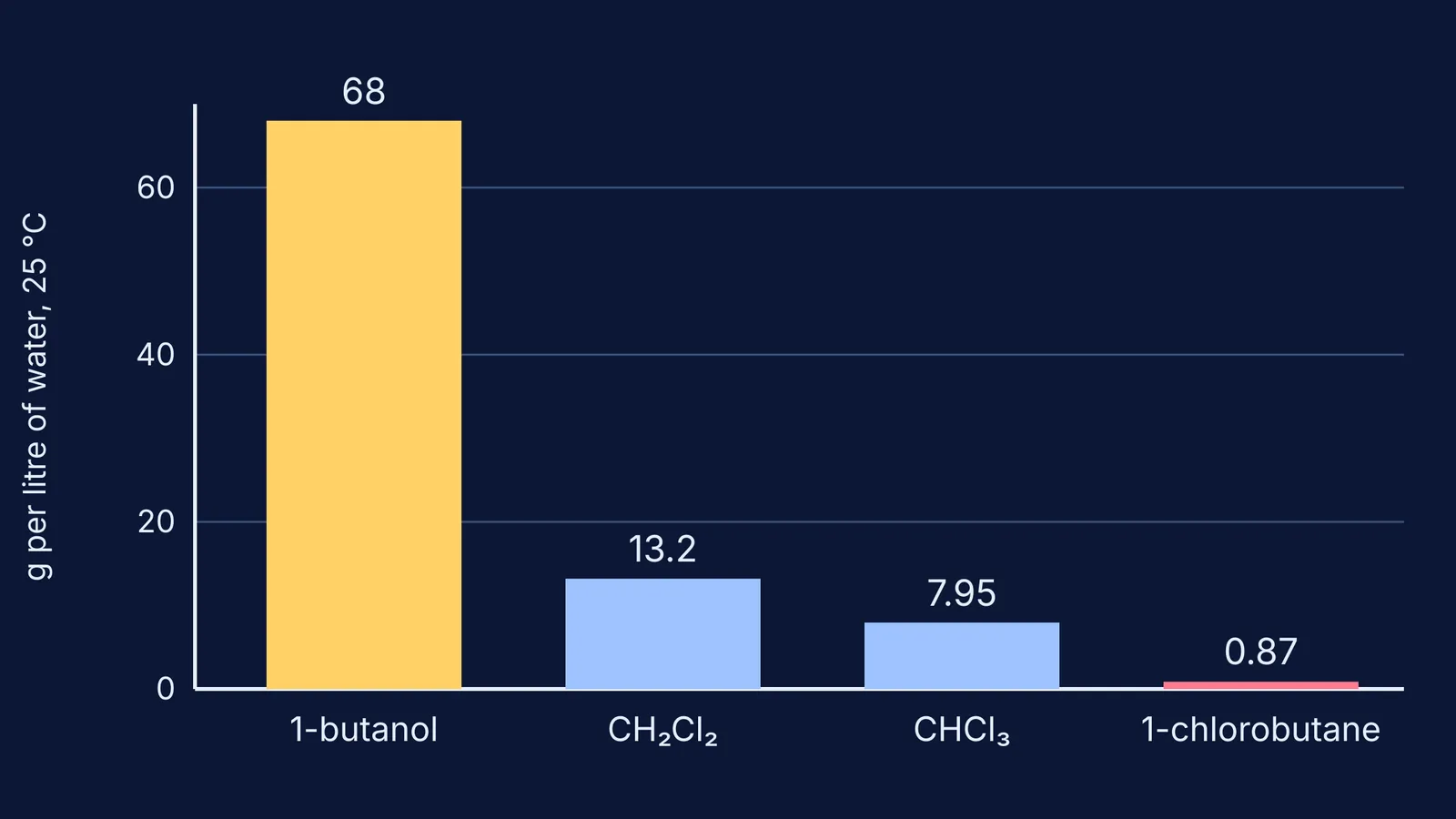
"Insoluble" here really means "very slightly soluble". Measured values collected on PubChem show the size of the effect.
1-butanol: about 68 g per litre of water at 25 °C, per the Handbook of Aqueous Solubility Data cited on PubChem's 1-butanol record.
1-chlorobutane: about 0.87 g per litre at 25 °C, per the ILO-WHO International Chemical Safety Card cited on PubChem's 1-chlorobutane record.
Dichloromethane: about 13.2 g per litre at 25 °C, per the same handbook cited on PubChem's dichloromethane record.
Chloroform: about 7.95 g per litre at 25 °C, per a 1980 Chemosphere study cited on PubChem's chloroform record.
The fair comparison is the first pair. Both have the same four-carbon chain. Swapping the –OH for –Cl cuts solubility by a factor of about 78 (68 ÷ 0.87), because the –OH group can hydrogen bond with water and the –Cl cannot.
Why do haloalkanes dissolve in organic solvents, then?
The same energy trade explains it. When a haloalkane mixes with another organic liquid, the new attractions have much the same strength as the ones being broken in each liquid, so the trade roughly balances, as Chemguide notes. Ethers make a useful contrast with haloalkanes, and our post on why ethers dissolve like alcohols but boil like alkanes explains.
How do you write this in a CBSE board or JEE Main answer?
Here is a worked example you can copy the shape of.
Question: Haloalkanes are polar, yet only very slightly soluble in water. Explain. (3 marks)
Answer:
To dissolve a haloalkane, energy is needed to overcome the attractions between haloalkane molecules and to break the hydrogen bonds between water molecules.
The new attractions between haloalkane and water molecules are only dipole–dipole and dispersion forces, which are weaker than the hydrogen bonds in water.
So less energy is released than is absorbed, and the haloalkane does not dissolve to any great extent.
Before you hand it in, check it against three common slips:
Do not write "haloalkanes are non-polar". The C–X bond is polar; that is the whole puzzle.
Do not write "haloalkanes form no attractions with water". They do, just weaker ones.
Do not skip the cost of breaking water's hydrogen bonds. That step decides the answer.
If intermolecular forces never quite settled for you, go back one step. The Fermi Concept Library has a lesson for every concept in chemistry, each with its place in the map, so you can revisit hydrogen bonding before returning to haloalkanes. For practice, the Fermi Problem Library has worked problems with a step-by-step solver that explains the reasoning rather than printing an answer.
Next, see how bond strength shapes this family's reactions in our post on why the C–I bond is the weakest carbon–halogen bond.