On this page
Light an agarbatti, leave it alone, and you often come back to a grey ghost of the stick still standing in the holder: the same width, the same straight line, sometimes several centimetres long. Touch it and it crumbles. That fragile column is not unburnt incense. It is the part of the stick that could not burn.
What is incense ash actually made of?
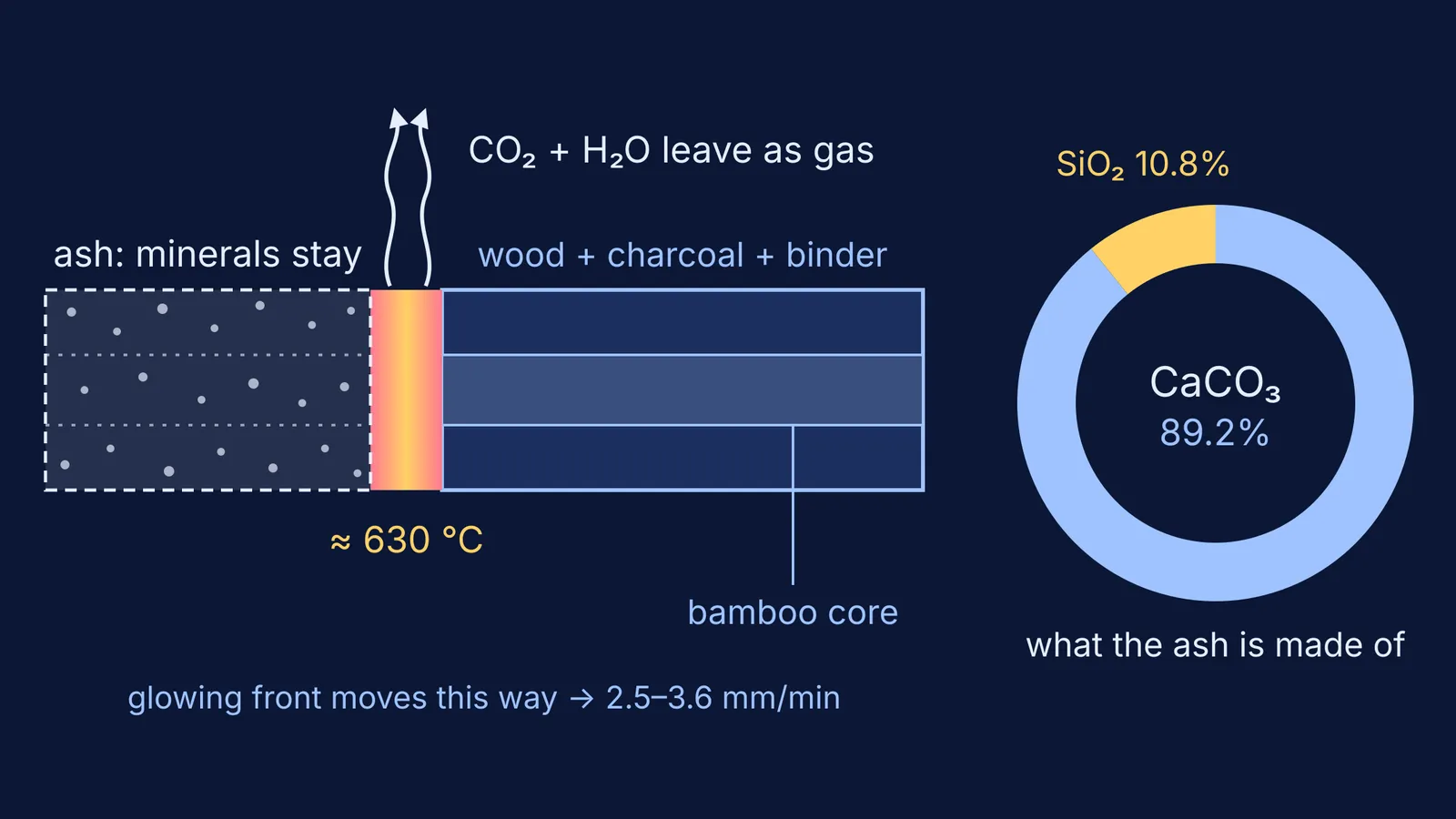
A typical Indian incense stick is a bamboo splint coated with about 1 mm of finely ground wood, charcoal and an adhesive known locally as jigit, according to a 2023 study of incense sticks by combustion researchers at Jain University, Bengaluru. Most of that coating is organic matter, built from carbon, hydrogen and oxygen. Mixed in with it is mineral matter that cannot burn.
When the same team heated a normal stick at 650 °C in a furnace and analysed the leftover by X-ray diffraction, the ash was 89.2% calcium carbonate and 10.8% quartz (Sowriraajan et al., Fire Technology). Adding hydrochloric acid to that ash made it fizz, the textbook sign of a carbonate releasing carbon dioxide.
Why does incense ash keep the stick's shape?
An incense stick does not burn with a flame. It smoulders: a glowing band creeps along the stick. In the Bengaluru study, the glowing surface of a normal stick sat at about 630 °C, and most sticks tested smouldered at 2.5 to 3.6 mm per minute (Sowriraajan et al.).
In that glowing band, the organic material reacts with oxygen from the air. Carbon leaves as carbon dioxide, hydrogen leaves as water vapour, and the smoke carries tiny particles away with them. If you have wondered why that smoke rises in a thin line before it breaks up, see why agarbatti smoke rises straight and then curls.
The minerals have nowhere to go. Calcium carbonate cannot react with oxygen any further, so it is not fuel. Calcium-rich ash is also hard to melt: a 2016 BioResources paper on wood ash notes that calcium and magnesium compounds raise the melting temperature of ash. So each mineral grain stays roughly where it sat inside the stick. Once the fuel between the grains has gone, they form a thin, porous skeleton that traces the stick's original outline.
Only weak contacts between grains hold that skeleton together, so a breath, a tap or its own weight breaks it into grey powder.
Why does incense leave so much more ash than wood?
Clean wood leaves very little ash. The BioResources paper gives ash contents of 0.21 to 0.67% for dry wood and 1.80 to 5.55% for bark, with calcium oxide making up 40 to 70% of wood ash (Dzurenda and Pňakovič, 2016).
Incense is different. The Bengaluru team tested six market samples and found ash fractions from 6.9% to 20.9% of the stick's mass (Sowriraajan et al.). That is roughly 10 to 100 times the ash share of clean wood. With that much mineral matter packed into the coating, there is enough residue to leave a continuous shell rather than a scattered dusting.
Compare camphor, a pure organic compound: it leaves no ash at all, as explained in why camphor burns without ash.
Minerals also affect burning. The study traced the rare sticks that kept going out to termite-mound mud that had got into the raw materials. The authors concluded that antigorite and quartz from the mud absorb heat as they change, and the tip cooled to about 490 °C before it stopped glowing (Sowriraajan et al.).
Worked example: how much of a stick turns into ash?
Use the study's own numbers for one normal stick: a mass of 1.63 g and an ash fraction of 15.1% (Sowriraajan et al.).
Ash left behind: 1.63 g × 0.151 = 0.246 g, about a quarter of a gram.
Mass that left as gases and smoke: 1.63 g − 0.246 g = 1.38 g, or about 85% of the stick.
Calcium carbonate in that ash: 0.246 g × 0.892 = 0.22 g.
So most of the stick's mass floats away, yet the ash column looks almost as big as the stick. Mass tells you how much burned. Shape tells you where the minerals were.
Try it: a five-minute ash investigation
Do this with an adult, on a steel plate, in a well-ventilated room and away from curtains. Wait until the ash is completely cold.
Observe: Is the ash column the same width as the unburnt stick? Where does it break first?
Predict: If the ash is mostly calcium carbonate, what should happen when an acid touches it?
Test: Add a few drops of vinegar to the cold ash and watch closely. Vinegar is a weak acid, so any fizz from carbon dioxide may be faint.
Explain: Write one sentence using the words combustion, gases and non-combustible residue.
The same logic explains why charcoal glows red without much flame: once the volatile parts of a fuel have gone, what remains behaves very differently.
If a glowing front moving through a fuel is hard to picture, the Fermi Simulation Lab has interactive simulations for ideas that are easier to see than to read.