

On this page
Most students guess that CH3F has the largest dipole moment of the methyl halides, because fluorine is the most electronegative element. The data says otherwise. It is one of the cleanest examples in Class 12 chemistry of two effects pulling in opposite directions, and once you see how to weigh them, you can reason out the whole order instead of memorising it.
What is the dipole moment order of CH3F, CH3Cl, CH3Br and CH3I?
The order is CH3Cl > CH3F > CH3Br > CH3I.
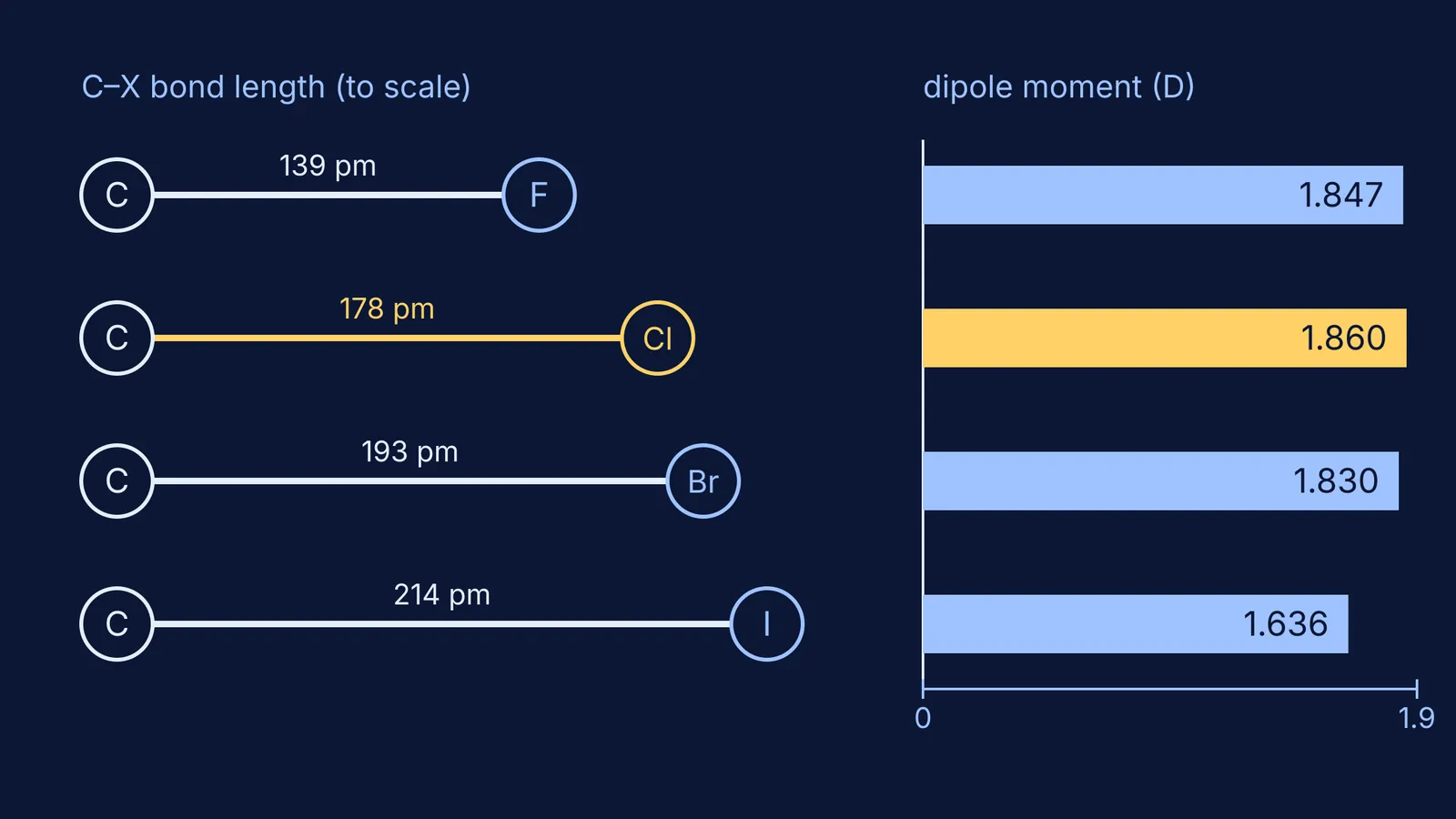
Table 10.2 of the NCERT Class 12 Chemistry textbook, Part II lists these carbon-halogen bond lengths and dipole moments:
CH3F: C–F bond 139 pm, dipole moment 1.847 D
CH3Cl: C–Cl bond 178 pm, dipole moment 1.860 D
CH3Br: C–Br bond 193 pm, dipole moment 1.830 D
CH3I: C–I bond 214 pm, dipole moment 1.636 D
The experimental values in the NIST Computational Chemistry Comparison and Benchmark Database differ slightly (1.847 D, 1.870 D, 1.810 D and 1.620 D) but give the same order. The gap between CH3Cl and CH3F is under 2% in both sources, so exam questions are testing your reasoning, not your memory for decimals.
Why does CH3Cl have a higher dipole moment than CH3F?
Dipole moment is charge multiplied by distance: μ = q × d. Two things change as you go down group 17, and they push in opposite directions.
The charge falls. On the Pauling scale, fluorine is 3.98, chlorine is 3.16, bromine is 2.96 and iodine is 2.66, against 2.55 for carbon. A smaller electronegativity difference means a smaller partial charge at each end of the C–X bond.
The distance rises. The NCERT textbook explains that halogen atoms get larger down the group, so the carbon-halogen bond gets longer from C–F to C–I.
From fluorine to chlorine, the gain in distance wins. From chlorine onwards, the loss of charge wins.
How do you work it out from the numbers?
Here is a worked example that makes the trade-off visible. Turn each dipole moment into an effective charge with q = μ ÷ d. One debye is about 0.2082 e·Å, or 20.82 e·pm (debye unit conversion), where e is the size of the charge on one electron. Using the NCERT values:
CH3F: q = (1.847 × 20.82) ÷ 139 ≈ 0.28 e
CH3Cl: q = (1.860 × 20.82) ÷ 178 ≈ 0.22 e
CH3Br: q = (1.830 × 20.82) ÷ 193 ≈ 0.20 e
CH3I: q = (1.636 × 20.82) ÷ 214 ≈ 0.16 e
Now compare neighbours. From F to Cl, the effective charge falls by about a fifth, but the bond grows by more than a quarter, so μ rises slightly. From Cl to Br, the charge falls about 9% while the bond grows about 8%, so μ dips. From Br to I, the charge falls about 19% while the bond grows only about 11%, so μ drops clearly.
Two honest caveats. First, these are teaching estimates: the molecule's dipole also includes the C–H bonds, so q is not the true charge on the halogen. Second, notice that the electronegativity difference shrinks far faster than q does, from 1.43 for C–F to 0.61 for C–Cl (using the WebElements Pauling values). That is exactly why "just compare electronegativities" gives the wrong answer here.
The same μ = q × d step drives our worked example on percentage ionic character from dipole moment. If you get stuck turning a question like this into steps, the Fermi Problem Library has worked problems with a step-by-step solver that explains the reasoning rather than printing an answer.
How should you reason about it in an exam?
Use this four-step checklist whenever a question asks you to rank dipole moments in a series:
Write μ = q × d before anything else.
For each pair of neighbours, ask which factor changes more: charge or distance.
Where both change a lot, as between F and Cl, rely on the data: CH3Cl is highest.
Where the charge loss is larger, as from Cl to Br to I, the dipole moment falls.
Boiling points and densities are covered in our post on boiling point and density trends of haloalkanes. For another case where electronegativity alone misleads you, see why NH3 has a higher dipole moment than NF3.
If polarity and bond length still feel like separate chapters, the Fermi Concept Library gives every chemistry concept its own lesson and its place in the map, so you can see how they connect.
Next time you meet a ranking question, write μ = q × d first and let the numbers settle the order.


