

On this page
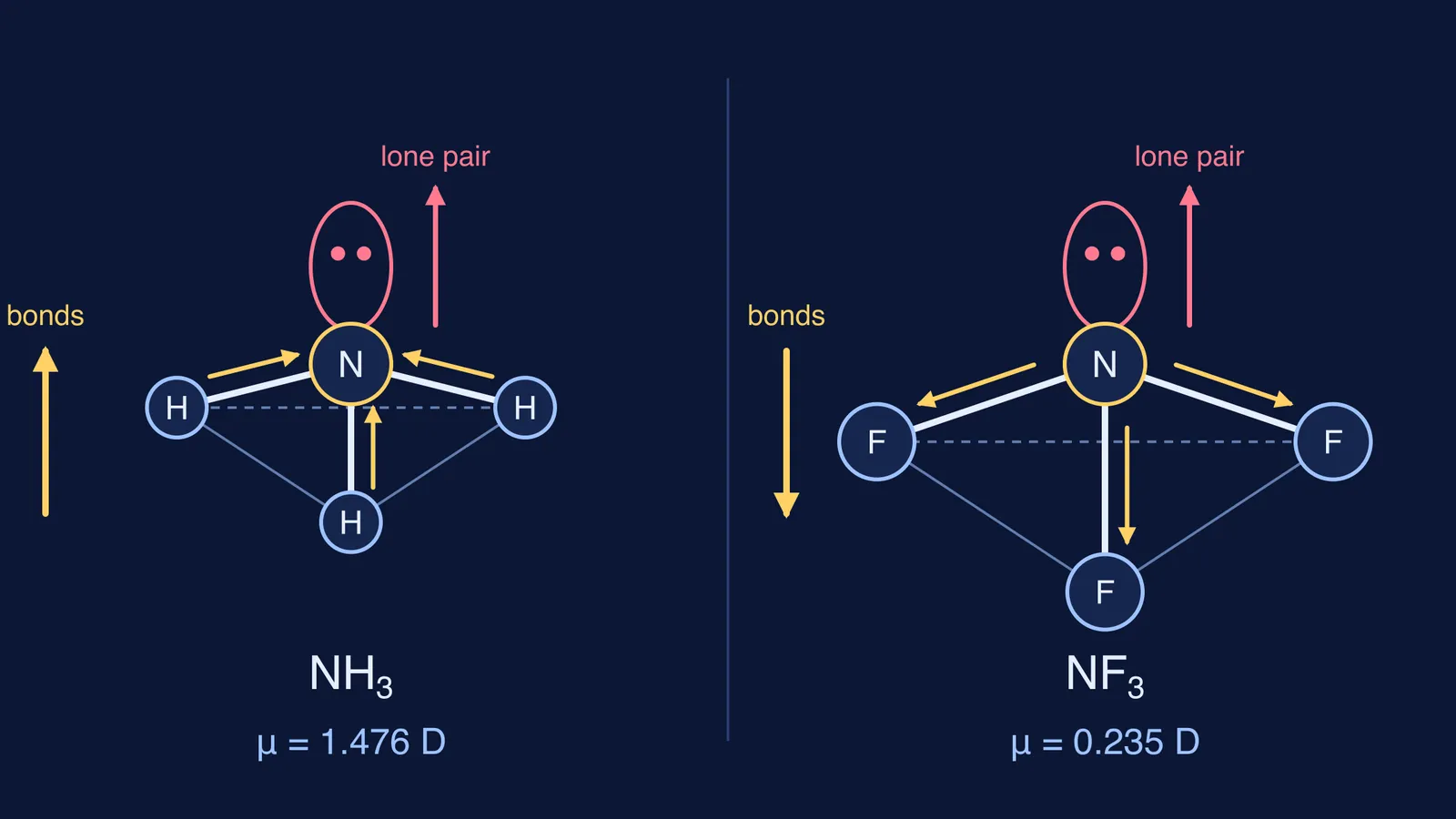
Fluorine is the most electronegative element, so many students expect NF3 to be the more polar molecule. It is not. The NIST Computational Chemistry Comparison and Benchmark Database lists experimental dipole moments of 1.476 D for ammonia and 0.235 D for nitrogen trifluoride (NIST CCCBDB dipole list). The reason is direction, not strength, and you can see it by drawing four arrows on each pyramid.
What is a dipole moment, and how do you add them?
A dipole moment measures how strongly positive and negative charge are separated in a molecule: charge times distance. Chemists measure it in debyes, and 1 D equals 3.335641 × 10⁻³⁰ C m (NIST CCCBDB). So ammonia's moment is about 4.92 × 10⁻³⁰ C m and NF3's about 0.78 × 10⁻³⁰ C m.
Dipole moment is a vector. Each polar bond contributes an arrow, and so does a lone pair, because its electron density sits on one side of the atom. The molecule's moment is the vector sum.
Why does NH3 have a higher dipole moment than NF3?
Nitrogen carries three bond pairs and one lone pair in both, so each molecule is a pyramid with nitrogen at the top and the lone pair pointing up, away from the outer atoms.
NH3. On the Pauling scale nitrogen is 3.04 and hydrogen 2.20 (PubChem periodic table data), so nitrogen is the negative end of each N–H bond. All three bond arrows point up, from H to N. The lone pair arrow also points up. Everything adds.
NF3. Fluorine is 3.98 on the same scale, the highest of any element in the PubChem data, so fluorine is the negative end of each N–F bond. All three bond arrows point down, from N to F. The lone pair still points up. The two sets largely cancel.
The electronegativity differences are similar in size: 0.84 for N–H and 0.94 for N–F, using the PubChem values above. What flips is the direction. That is why NH3 ends up about six times as polar as NF3 in the NIST data, 1.476 D against 0.235 D (NIST CCCBDB).
How does the shape of the pyramid change the sum?
Only the vertical part of each bond arrow survives; the sideways parts cancel by symmetry. If the bond angle is α, the angle θ between each bond and the axis obeys cos θ = √((1 + 2 cos α)/3). With three bonds, the total bond contribution along the axis is 3 cos θ times one bond moment. Here is the worked example.
NH3: NIST lists an H–N–H angle of 106.67° (NIST CCCBDB, ammonia). Then cos α = −0.287, cos θ = 0.377, and the three bonds add to 1.13 times one N–H moment, pointing up.
NF3: NIST lists an F–N–F angle of 102.37° (NIST CCCBDB, nitrogen trifluoride). Then cos α = −0.214, cos θ = 0.436, and the three bonds add to 1.31 times one N–F moment, pointing down.
Add the lone pair, which points up in both. In NH3 it joins a sum already pointing up. In NF3 it works against a sum pointing down, leaving a small net moment.
The flatter NH3 pyramid loses slightly more of each bond arrow to sideways cancellation, so geometry alone does not favour ammonia. The direction of the bond arrows relative to the lone pair decides the answer.
How should you answer this in an exam?
This comparison is a common Class 11 chemical bonding question. A complete answer has four parts:
State the shape: both are pyramidal, with one lone pair on nitrogen.
Give the bond polarity: nitrogen is the negative end of N–H, fluorine is the negative end of N–F.
Compare directions: in NH3 the resultant bond moment and the lone pair moment point the same way; in NF3 they point opposite ways.
Finish with the values if you know them: about 1.48 D for NH3 and 0.24 D for NF3 (NIST CCCBDB).
Draw both pyramids with their arrows beside your answer.
Where does the same idea show up next?
Lone pairs shaping molecules and their dipoles is also the story behind why CO2 is linear but SO2 is bent. Ammonia's polar N–H bonds feed into why ammonia boils 55 degrees higher than phosphine. For a case where arrangement alone switches a dipole on and off, see the dipole moments of the dichloroethene isomers.
If adding bond moments as vectors still feels shaky, the Fermi Concept Library has a lesson for every concept in chemistry, each with its place in the map, so you can revisit polarity first. For practice, the Fermi Problem Library has worked problems with a step-by-step solver that explains the reasoning rather than printing an answer.
Next time, draw the arrows first and compare directions before electronegativities.


