

On this page
The chemical formula C₂H₂Cl₂ gives rise to three different isomers depending on how the chlorine atoms are attached around the carbon-carbon double bond. Even though they contain the exact same atoms, their physical properties differ greatly. The way they are arranged changes the molecule's overall dipole moment, which in turn determines its boiling point.
What are the isomers of dichloroethene?
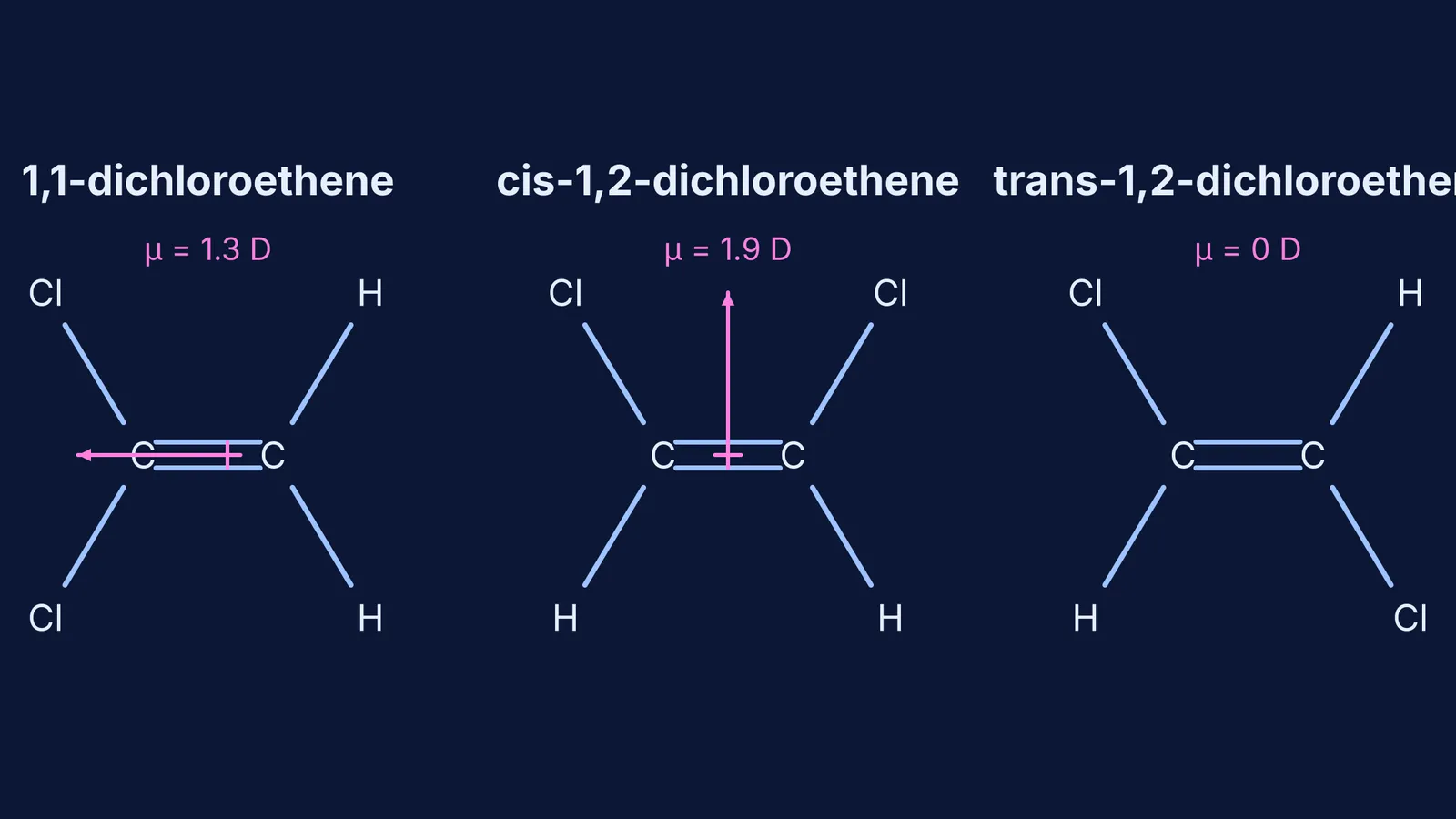
Because the carbon-carbon double bond restricts rotation, the atoms are locked in place. This gives us three distinct structures:
1,1-dichloroethene: Both chlorine atoms are attached to the same carbon atom.
cis-1,2-dichloroethene: There is one chlorine atom on each carbon, and they sit on the same side of the double bond.
trans-1,2-dichloroethene: There is one chlorine atom on each carbon, but they sit on opposite sides of the double bond.
How do their dipole moments compare?
A molecule's dipole moment measures its overall polarity. It is the vector sum of all the individual bond dipoles in the molecule.
***cis*-1,2-dichloroethene (1.9 D):** Chlorine is highly electronegative, pulling electron density towards itself. In the *cis* isomer, both chlorine atoms are on the same side. The individual carbon-chlorine bond dipoles add together to give a strong net molecular dipole of 1.9 D.
***trans*-1,2-dichloroethene (0 D):** The chlorine atoms are on opposite sides, making the molecule highly symmetrical. The two carbon-chlorine bond dipoles are equal but point in perfectly opposite directions. They cancel out entirely, leaving a net dipole moment of 0 D, which means the molecule is non-polar.
1,1-dichloroethene (1.3 D): This asymmetric molecule is polar. The bond dipoles do not cancel, giving it a net dipole of 1.3 D.
If you struggle to picture how bond dipoles add as vectors, the Fermi Concept Library has every concept in physics, chemistry, biology, mathematics and computing, each with its own lesson and its place in the map.
Why does cis-1,2-dichloroethene have a higher boiling point?
Boiling point depends on the strength of the intermolecular forces holding the molecules together in the liquid state. The stronger the attraction, the more heat energy is needed to separate them.
Because of its high dipole moment, *cis*-1,2-dichloroethene molecules attract each other with strong dipole-dipole interactions, in addition to London dispersion forces. This strong attraction gives it the highest boiling point of the three, at 60.2 °C.
In contrast, *trans*-1,2-dichloroethene relies entirely on weaker London dispersion forces because it lacks a permanent dipole. Consequently, it takes less heat to boil, doing so at 48.5 °C.
What about 1,1-dichloroethene? Despite being polar, it has the lowest boiling point, boiling at just 32 °C. This is largely due to its shape. Both large chlorine atoms are crowded onto one end of the molecule, which reduces its overall surface area. This less effective packing means its London dispersion forces are much weaker than those of the extended 1,2-isomers, resulting in the weakest total intermolecular attraction in the group.
How do you rank the boiling points of isomers?
When faced with ranking isomers in chemistry exams, you can use a three-step check:
Identify the type of forces: Do the molecules form hydrogen bonds? If not, do they have a permanent dipole moment?
Check symmetry: Look for *trans* isomers or highly symmetrical structures where bond dipoles cancel out. These will lack dipole-dipole interactions.
Compare shape and surface area: For isomers that otherwise seem similar, a branched or crowded shape (like 1,1-dichloroethene) has less contact area than an extended shape (like the 1,2-isomers). Less contact area means weaker dispersion forces and a lower boiling point.
If you hit a roadblock on ranking questions, the Fermi Problem Library has worked problems with a step-by-step solver that explains the reasoning rather than printing an answer, helping you confidently spot the trends yourself.
For more practice with how structure affects properties, read how heat of hydrogenation ranks alkene stability, or review substitution reactions with our guide on SN1 and SN2 stereochemistry.


