

On this page
Why should two molecules with the same triatomic formula—one central atom flanked by two oxygen atoms—behave so differently? In exams like JEE Main and NEET-UG, students are often asked to compare carbon dioxide (CO₂) and sulphur dioxide (SO₂). One molecule is a straight line, while the other is permanently bent. One is non-polar, while the other carries a strong molecular dipole. The difference comes down to non-bonding electrons.
Why is CO2 linear while SO2 has a bent shape?
Both molecules share a central atom bonded to two oxygen atoms, but their valence electron counts differ.
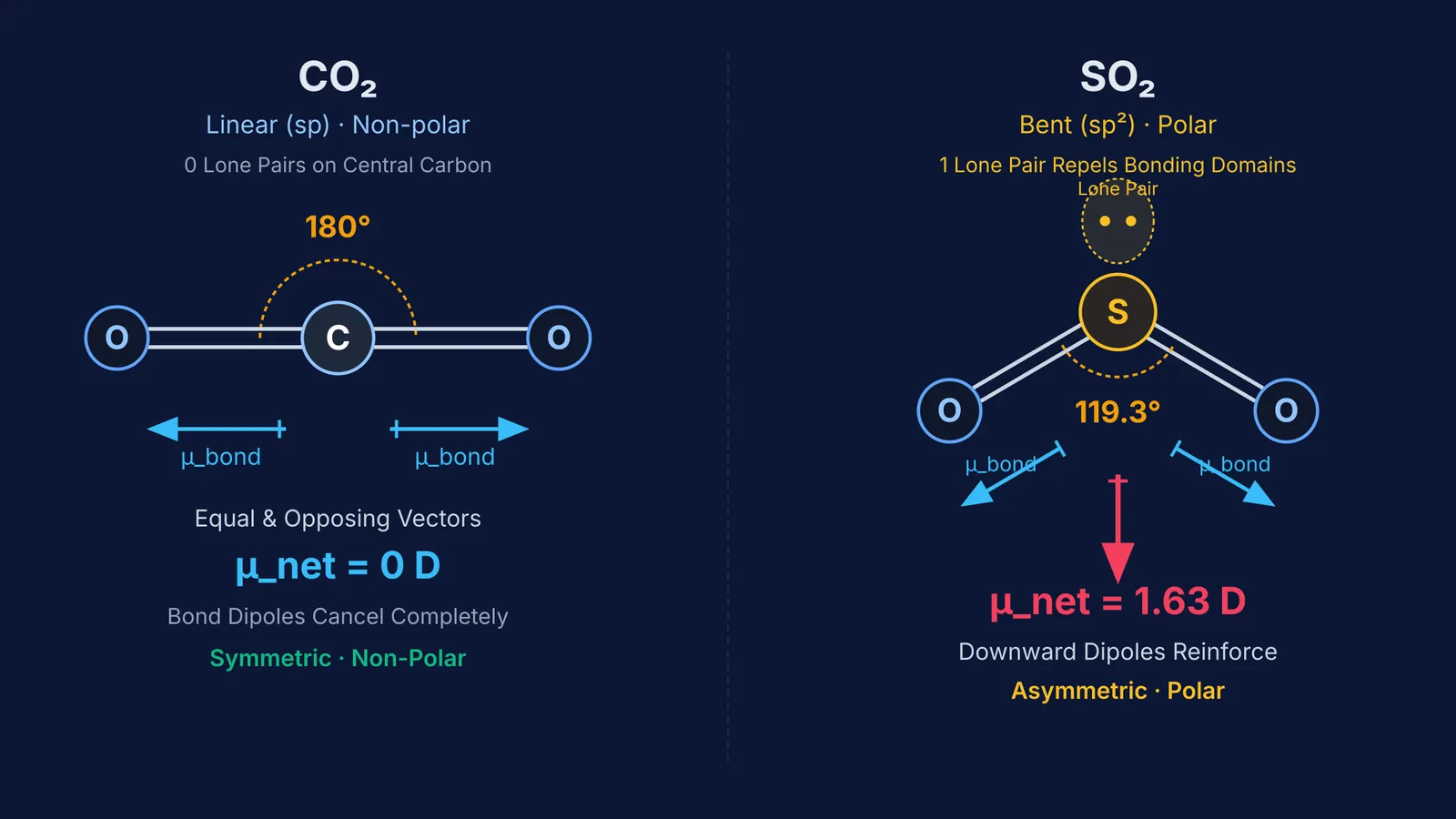
Carbon has 4 valence electrons. In carbon dioxide, it uses all 4 electrons to form two double bonds—one σ bond and one π bond with each oxygen atom. Carbon has zero lone pairs, giving a steric number of 2 (two σ bonds + zero lone pairs). The two double bonds push as far apart as possible to minimise electron repulsion, producing sp hybridisation and an experimental bond angle of 180.0° according to the NIST Chemistry WebBook for Carbon Dioxide.
Sulphur has 6 valence electrons. In sulphur dioxide, sulphur uses 4 electrons to bond with two oxygens, leaving 2 non-bonding electrons as a single lone pair. With two σ bonds and one lone pair, sulphur has a steric number of 3 and sp² hybridisation. Data from the NIST Chemistry WebBook for Sulfur Dioxide shows an experimental O–S–O bond angle of 119.3°, compressed from the ideal 120° trigonal planar geometry.
How does VSEPR theory explain lone pair repulsion?
To explain this compression, chemists turn to Valence Shell Electron Pair Repulsion (VSEPR) theory, introduced by Ronald Gillespie and Ronald Nyholm in their 1957 paper on Inorganic Stereochemistry.
Gillespie and Nyholm showed that electron pairs arrange themselves around a central atom to minimise electrostatic repulsion, following a clear hierarchy:
Lone Pair–Lone Pair repulsion is the strongest.
Lone Pair–Bonding Pair repulsion is intermediate.
Bonding Pair–Bonding Pair repulsion is the weakest.
A bonding pair is held between two positive nuclei, keeping its electron cloud concentrated along the bond axis. A lone pair is held by only the central nucleus, so its electron cloud spreads wider and repels neighbouring pairs more strongly. In SO₂, this lone pair pushes the two S–O bonds downward, closing the bond angle to 119.3°. For how orbital character changes with electronegativity, see Bent's rule: how to use it to predict bond angles.
Why does CO2 have zero dipole moment while SO2 is polar?
A bond between atoms with different electronegativities is polar, creating a bond dipole moment (μ = q × d). According to electronegativity data in NCERT Class 11 Chemistry, oxygen has a Pauling electronegativity of 3.44, compared to 2.55 for carbon and 2.58 for sulphur. Both C=O and S–O bonds are individually polar.
Yet molecular polarity depends on geometry.
In carbon dioxide, the two C=O bond dipole vectors have equal magnitude and point in opposite directions at 180°. As vector quantities, they cancel completely (μ_net = 0 D). As confirmed in NCERT Class 11 Chemistry, CO₂ has zero net dipole moment.
In sulphur dioxide, the bent 119.3° geometry prevents cancellation. While the horizontal components of the S–O dipoles cancel, their downward vertical components add together. Combined with the lone pair's asymmetric charge, SO₂ has a permanent dipole moment of 1.63 D, according to the NIST Chemistry WebBook for Sulfur Dioxide. To explore how polarity drives solubility, read Why do oil and water not mix? The chemistry of polarity.
How do you predict the geometry of any triatomic molecule?
Using the standard principles taught in NCERT Class 11 Chemistry, use this four-step sequence to determine the shape and polarity of any AB₂ molecule:
Count the valence electrons on central atom A.
Form bonds with both outer atoms and count remaining non-bonding electrons as lone pairs.
Calculate the steric number (σ bonds + lone pairs): steric number 2 gives a linear 180° shape, steric number 3 with one lone pair gives a bent shape near 120°, and steric number 4 with two lone pairs gives a bent shape near 104.5°.
Sum the bond dipole vectors. Symmetric linear shapes cancel to μ = 0 D, whereas asymmetric bent shapes retain a permanent dipole (μ > 0 D).
Before trusting quick analogies, check whether AI analogies for chemical bonding: are they right?.
How should you revise chemical bonding questions for exams?
CBSE, JEE Main, and NEET-UG exams often test CO₂ and SO₂ to catch students who assume identical formulas mean identical geometry. When revising:
Always sketch the Lewis structure to count central lone pairs before guessing the geometry.
Distinguish electron-domain geometry (trigonal planar for SO₂) from molecular shape (bent).
Remember that polar bonds only produce a polar molecule if the geometry is non-symmetrical.
To master molecular shapes and electron domains, the Fermi Concept Library provides structured lessons for every concept in chemistry alongside its place in the map. When practicing exam problems, the Fermi Problem Library offers worked problems with a step-by-step solver that explains the reasoning rather than printing an answer.


