On this page
Hospitality Management is Chapter 11 of NCERT's Human Ecology and Family Sciences Part II (reprint 2026-27). It explains how a hotel looks after a guest from booking to check-out, which departments share that work, and where the jobs are. Its figures are still numbered 17.1 to 17.6.
What does the 2026-27 syllabus include?
The CBSE Home Science (064) curriculum for 2026-27 places this chapter in Unit V, Resource Management, together with Consumer Education and Protection. Unit V carries 10 of the 70 theory marks. CBSE prints no per-chapter figure, so the two chapters share those 10 marks.
The curriculum lists the introduction, significance, basic concepts, the departments (front office, housekeeping, food and beverages, support services) and scope. It does not list the short Management Functions paragraph by name. The practical syllabus has no hospitality task; the practical exam scheme's 5-mark leaflet is on consumer education. For planning the whole paper, see how to study Home Science for the Class 12 exam.
What is hospitality, and what is the guest cycle?
NCERT defines hospitality as the relationship between guest and host: a warm welcome plus lodging, meals, entertainment and other comforts.
Know the six types of establishment:
Hotel: lodging, meals and other services, run commercially.
Motel: hotel services with parking next to the room.
Lodge: rented rooms, mainly for sleeping; food may not be offered.
Resort: built around leisure, with sports and amenities.
Furnished apartments: all essential amenities.
Furnished camps: for hikers and adventure sports.
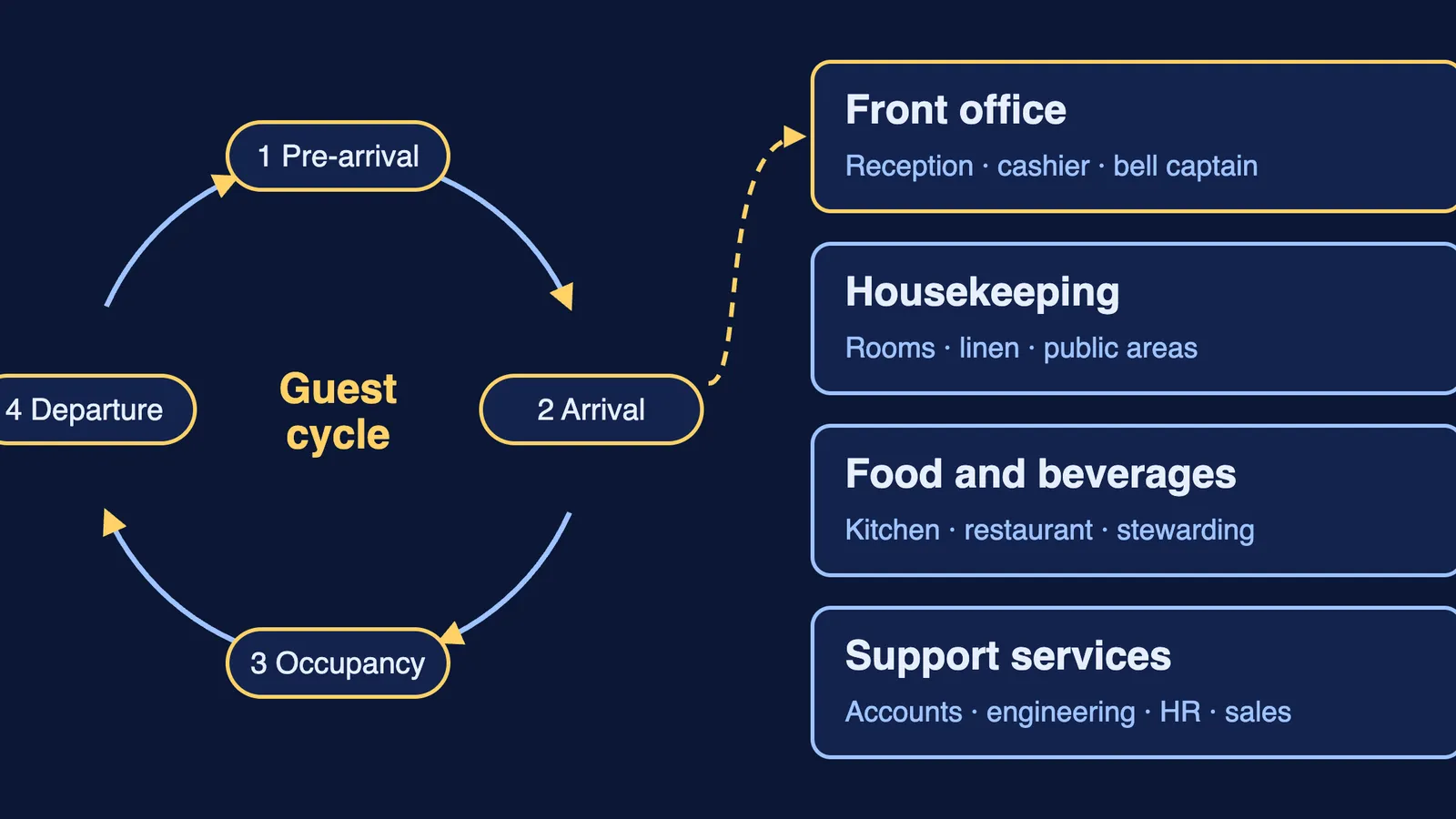
The guest cycle has four stages:
Pre-arrival: quoting rates and reserving a room.
Arrival: the guest registers, or checks in.
Occupancy: services, security and coordination, all aimed at customer loyalty.
Departure: check-out, with a "guest history" record that includes feedback.
Which departments run a hotel?
Front office. Guests first meet hotel staff here, and NCERT places most of the guest cycle in this department, so it calls the front office the focal point of a hotel. It greets and registers guests, allots rooms, issues keys, passes messages and settles bills. Key roles from the book's table:
Front office manager: runs the office, lobby and transport, and plans shifts, since hotels work for 24 hours.
Receptionist (front office agent): handles reservations, registration and room allotment.
Front office cashier: keeps guest bills and takes payment at check-out.
Bell captain: supervises uniformed staff and baggage movement.
Doorman: welcomes arrivals and escorts them to the desk.
Housekeeping. It keeps the building clean, hygienic and attractive: rooms and public areas, linen and uniforms, flowers and gardens, and pest control. Its seven sections are the control desk, management, guestroom brigade, public area brigade, linen and uniform room, horticulture and flower team, and lost and found. The executive housekeeper heads it; floor supervisors take one floor each; room attendants clean rooms, while housemen do heavy work such as mopping and moving furniture.
Food and beverages. It sells food and drink through the kitchen, restaurants, banquets, room service, bars and stewarding. The kitchen is led by the executive chef (chef-de-cuisine), then the deputy chef, section supervisors called chefs-de-partie, and cooks. Kitchen stewarding stores, cleans and issues crockery, cutlery and glassware.
Support services. Also called back office: finance and accounts, engineering, human resources, and sales and marketing.
What careers does the chapter list?
Hotels hire at every level, from top management to operations staff, and youth form most of the workforce. The competencies it names include grooming, hygiene, good manners, a cheerful attitude, physical fitness, communication skills and knowing several languages. Courses run from certificate and diploma to degree and postgraduate level.
The career list covers posts in housekeeping and the front office, your own housekeeping or flower-arrangement business, and theme-based events. For degrees after Class 12, see BSc Home Science career options.
Practice questions in the 2026-27 format
CBSE's 2026-27 sample paper tests this chapter with a 1-mark MCQ (Q5) and a 4-mark situation question (Q29, printed as 2+2=4). Our own questions, in those types:
(1 mark) In which stage of the guest cycle are room rates quoted? (a) Arrival (b) Pre-arrival (c) Occupancy (d) Departure
(1 mark) Assertion: A hotel front office schedules its staff in shifts. Reason: Hotels work for 24 hours.
(2 marks) How is a motel different from a lodge?
(3 marks) Name the head of a hotel kitchen and two other levels of kitchen staff, giving one duty of each.
(4 marks) Ananya books a hotel room online for her cousin's wedding and leaves three days later. Trace her stay through the four stages of the guest cycle, naming one front office person she deals with at each stage.
(5 marks) Give two reasons why hotels prefer young staff, and explain three competencies front office staff need.
Answers to check: 1 (b); 2 both are true and the reason explains the assertion.
Not sure where to start tonight? Fermi's AI tutor works out what you already know and builds a plan for the session.