On this page
Fashion Design and Merchandising is Chapter 9 of NCERT's Human Ecology and Family Sciences Part II (reprint 2026-27). It explains how styles become fashion and fade, and who plans, buys and sells them.
What does the 2026-27 syllabus include?
The CBSE Home Science (064) curriculum for 2026-27 places this chapter in Unit IV, Fabric and Apparel, alongside Design for Fabric and Apparel and Care and Maintenance of Fabrics in Institutions. Unit IV carries 17 of the 70 theory marks, shared by those three chapters with no per-chapter split.
The topic list covers significance, the four terms, fashion development and evolution, merchandising, retail organisations, careers and scope. NCERT ends with a practical on sketching a fashion figure (croquis); the curriculum's Class 12 practical list does not list it.
The 2026-27 sample paper takes Q9 (1 mark, Yves Saint Laurent), Q12 (1 mark, matching the four terms) and Q32 (5 marks, a merchandiser's roles and three levels) from this chapter.
What are fashion, style, fad and classic?
Fashion: whatever style or styles most people are choosing at one moment.
Style: a distinct look in clothing or accessories. It can drop out of fashion, but the style itself still exists.
Fad: a short-lived fashion that may last only one season because its design cannot hold interest.
Classic: a simply designed style that stays broadly accepted for many years and never fully dates.
Key dates in NCERT's history of fashion:
Early 18th century: King Louis XIV's court and France's silk industry made Paris Europe's fashion capital. Clothes were hand sewn to measure; couture was the term for the art of dressmaking.
Industrial Revolution: the spinning jenny and power looms made fabric faster, and a new middle class could buy better clothes.
1849: Levi Strauss made work trousers from fabric meant for tents and wagon covers, later called denims.
1859: Isaac Singer developed a foot treadle for the sewing machine (NCERT spells the name "Issac").
1880s: women adopted separate skirts and blouses.
1920: ready-to-wear arrived; fashion merchandising became a specialisation.
1960s: prêt-à-porter (factory-made, standard-size) lines reached boutiques; Yves Saint Laurent was the first French haute couturier with a full line.
What are the stages of the fashion cycle?
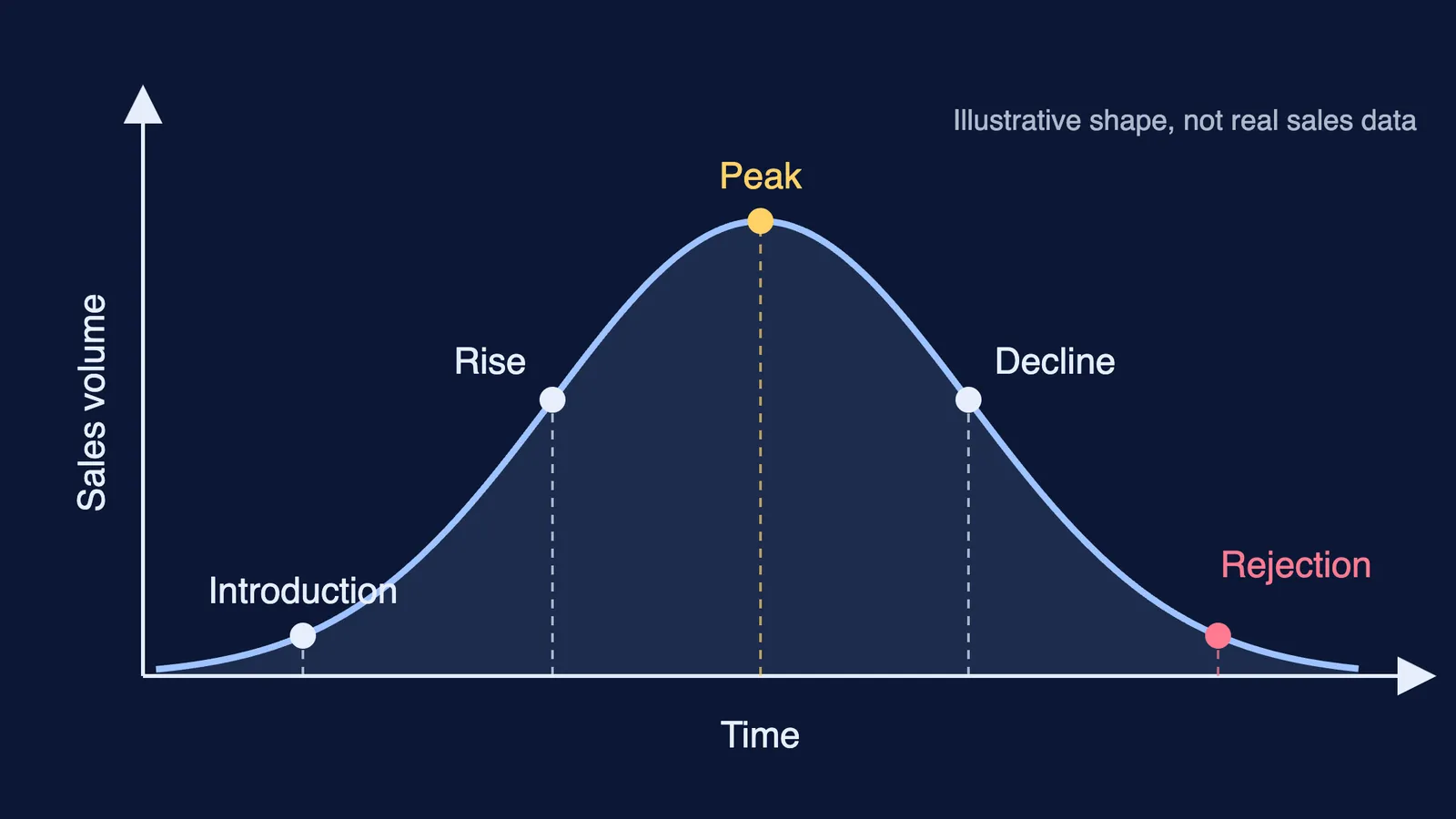
NCERT draws the fashion cycle as a bell-shaped curve of sales against time; its figure marks introduction, rise, peak and decline. The text names five stages:
Introduction of a style: designers vary line, colour, shape, fabric and details.
Increase in popularity: more people buy and wear the style, so it spreads.
Peak of popularity: manufacturers copy or adapt it at several price levels.
Decline in popularity: copies tire fashion-conscious buyers; stock goes on sale.
Rejection of a style (obsolescence): buyers move to new looks; a new cycle begins.
What does a fashion merchandiser do?
Merchandising means planning the right goods, place, time, quantity, price and promotion.
A merchandiser has four roles: manufacturing (advising on fabric and production within price and target market), buying (ordering for a store from trend forecasts), promoting (pitching a designer's range to stores, often through fashion shows) and selling (advising stores on quantities and display).
There are three levels:
Retail organisation: internal planning that keeps enough stock selling at acceptable prices.
Buying agency: the buyer's procurement office; it finds vendors, negotiates costs and checks quality.
Export house: a buyer merchandiser handles sourcing and sampling; a production merchandiser keeps production on schedule.
Target markets come from four segmentation types: demographic (age, income), geographic (region, climate), psychographic (lifestyle) and behavioural (opinions on a product). Retailers are single-unit, department or chain stores, with merchandising, sales and promotion, finance and control, operational, and personnel divisions. Shoppers' rights are in our Consumer Education and Protection guide.
What careers does the chapter list?
NCERT names three abilities: forecasting, analysis of costs and profit, and communication. It gives certificate or diploma courses 6 months to 1 year and bachelor's degrees 4 years, and says about a third of fashion designers are self-employed. Careers listed: visual merchandise, fashion, set and interior designer. Also read BSc Home Science career options and fashion technology after PCM.
Practice questions in the 2026-27 format
Mark types follow the sample paper; the questions are ours.
(1 mark) Bright neon caps sell out in May and fill sale bins by August. Which term fits? (a) Classic (b) Fad (c) Style (d) Couture
(2 marks) Name the stage of the fashion cycle at which cheaper adaptations appear, and give one reason.
(3 marks) A raincoat brand plans different stock for two cities with different weather. Which segmentation is this, and why does it matter?
(4 marks) Explain how a buyer merchandiser and a production merchandiser in an export house divide their work.
(5 marks, 2 + 3) I. Contrast department and chain stores. II. Explain three "rights" of merchandising for a school-uniform shop.
Answers: 1 (b). 2 Peak of popularity; high demand leads manufacturers to copy it. 3 Geographic; climate shapes what clothes people buy.
Short on time this week? Fermi's AI tutor works out what you already know and builds a plan for the session.