On this page
Oscillations is Chapter 13 of the NCERT Class 11 Physics textbook, Part II (reprint 2026-27). The CBSE Physics syllabus for 2026-27 lists periodic motion, period and frequency, SHM and its link with uniform circular motion, phase, the loaded spring, energy in SHM and the simple pendulum. Terms follow NCERT usage, with SI units. For the whole chapter, see our Oscillations Class 11 physics guide.
What is the difference between periodic and oscillatory motion?
Periodic motion: any motion that repeats itself after equal intervals of time. Example: the Earth turning on its axis.
Equilibrium (mean) position: the point where no net force acts on the body, so it could stay there at rest.
Oscillatory motion: periodic to-and-fro motion about an equilibrium position. Example: a ball rolling back and forth in a bowl. Don't confuse with: periodic motion in general; circular motion repeats but does not go to and fro, so it is periodic without being oscillatory.
Oscillation and vibration: the same kind of motion; it is called vibration when the frequency is high, as in a sitar string.
Period (T): the shortest time after which the motion repeats. SI unit: second (s).
Frequency (ν): the number of repetitions per second, ν = 1/T. SI unit: hertz (Hz), where 1 Hz = 1 s⁻¹. Example: NCERT Example 13.1 takes a heart beating 75 times a minute, which gives 1.25 Hz and a period of 0.8 s.
Displacement (general sense): the change with time of whatever quantity is oscillating, not only position. Example: the angle of a pendulum string, or the voltage across a capacitor in an ac circuit.
Periodic function: a function of time that takes the same value again after one period, such as A cos ωt. Not periodic: e^(−ωt), which only falls.
What is simple harmonic motion?
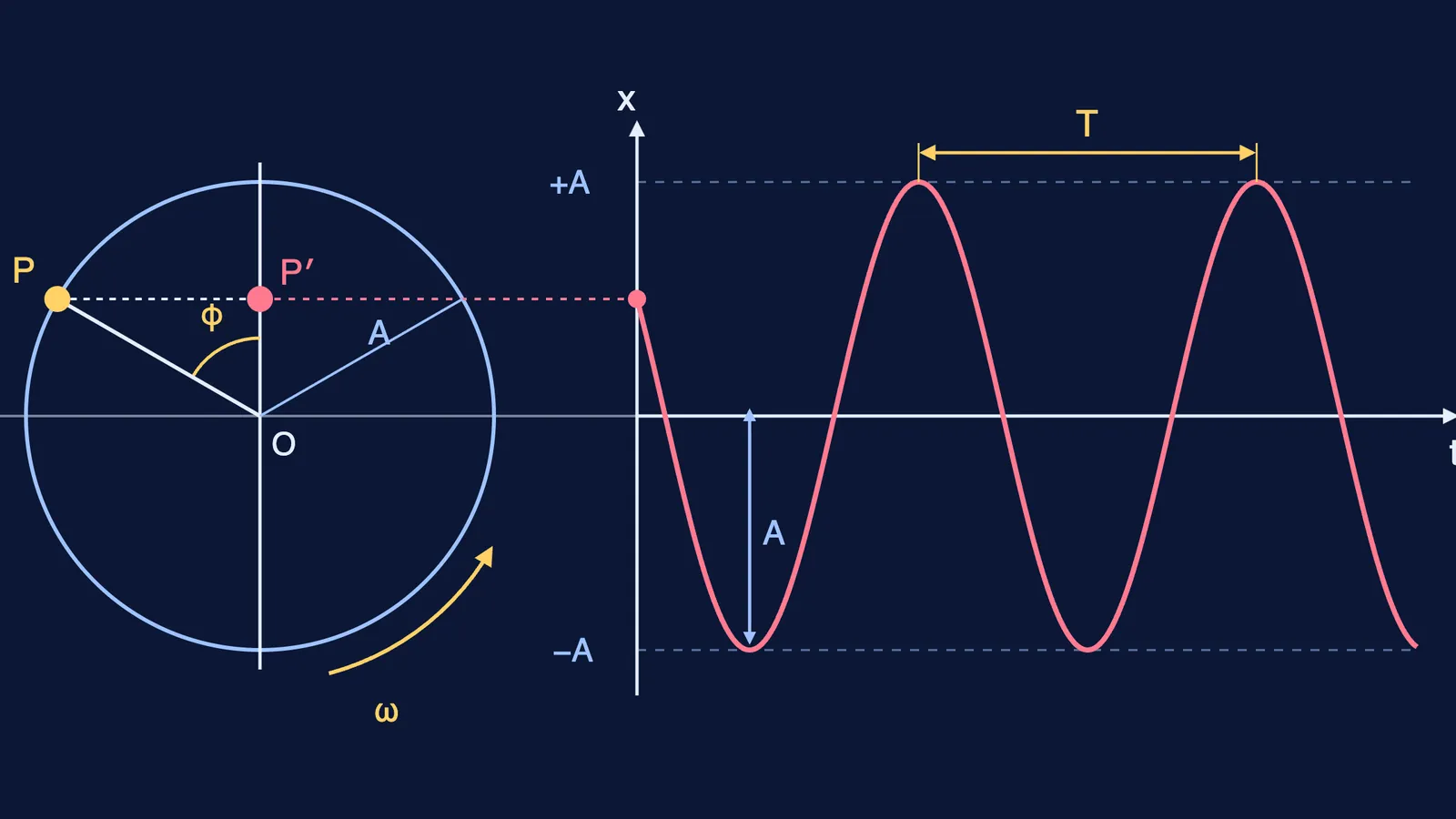
Simple harmonic motion (SHM): oscillation in which the displacement is a sine or cosine function of time, x(t) = A cos(ωt + φ). Don't confuse with: periodic motion; every SHM is periodic, but not every periodic motion is SHM.
Amplitude (A): the size of the largest displacement from the mean position. SI unit: metre (m).
Phase (ωt + φ): the changing angle inside the cosine; it fixes the particle's position and motion at time t. SI unit: radian (rad).
Phase constant (phase angle, φ): the value of the phase at t = 0, found from the starting position and velocity. SI unit: radian (rad). Don't confuse with: phase, which changes with time.
Angular frequency (ω): ω = 2π/T = 2πν. SI unit: radian per second (rad s⁻¹). Don't confuse with: frequency ν, in Hz, which is 2π times smaller.
Reference circle and reference particle: a particle P moving uniformly on a circle of radius A; the foot of its perpendicular on any diameter performs SHM (diagram above).
How are velocity, acceleration and force related in SHM?
Velocity in SHM: v(t) = −ωA sin(ωt + φ); its size is largest, ωA, at the mean position and zero at the extremes. SI unit: m s⁻¹.
Acceleration in SHM: a(t) = −ω²x; it is proportional to displacement and always points towards the mean position. SI unit: m s⁻². Don't confuse with: velocity, which is zero where acceleration is largest.
Restoring force: the force that pulls the body back towards the mean position, F = −kx. The minus sign shows it opposes the displacement. SI unit: newton (N).
Force constant (spring constant, k): force per unit displacement, k = mω². SI unit: newton per metre (N m⁻¹). For a mass on a spring, T = 2π√(m/k).
Linear harmonic oscillator: a body moving under a force proportional to −x.
Non-linear oscillator: a real oscillator whose force also has small terms in x², x³ and so on.
How does energy change in simple harmonic motion?
Kinetic energy (K): K = ½mv², largest at the mean position and zero at the extremes. SI unit: joule (J).
Potential energy (U): U = ½kx², zero at the mean position and largest at the extremes. SI unit: J.
Total mechanical energy (E): E = K + U = ½kA², constant when there is no friction. SI unit: J. Example: in NCERT Example 13.7, a 1 kg block on a 50 N m⁻¹ spring pulled out 10 cm has 0.25 J in total at every point.
Period of K and U: each repeats every T/2 (in s), because each peaks twice per oscillation. Don't confuse with: the period T of the displacement.
What are the key terms for the simple pendulum?
Simple pendulum: a small bob of mass m on a light, inextensible string of length L, swinging in a vertical plane about a fixed support.
Restoring torque: the torque −L(mg sin θ) from the component of weight perpendicular to the string; it turns the bob back towards the vertical. SI unit: N m.
Small-angle approximation: for small θ in radians, sin θ ≈ θ, so the motion is close to SHM and T = 2π√(L/g). NCERT's table shows the approximation stays close even at 20 degrees.
Seconds pendulum: a pendulum with a period of 2 s, about 1 m long for g = 9.8 m s⁻² (NCERT Example 13.8). Don't confuse with: a period of 1 s; it is each one-way swing that takes 1 s.
Damped oscillations, forced oscillations and resonance are left out: the CBSE 2026-27 syllabus does not list them, and the current NCERT chapter has no section on them, mentioning damping only in passing.
How to learn these terms
Learn the pairs together: period and frequency, frequency and angular frequency, phase and phase constant, velocity and acceleration.
Redraw the reference circle above from memory and label A, φ, ω, P and P′.
Tabulate x, v, a, K and U at the mean position and at each extreme.
Apply the SHM test above to every "is this SHM?" question first.
Revise this chapter before waves; our Waves Class 11 physics guide builds on it, and our assertion-reason traps on waves and oscillations test the mix-ups above.
If one term still feels vague, the Fermi Concept Library has every concept in physics with its own lesson.