On this page
Oscillations is Chapter 13 of NCERT Class 11 Physics Part II (Reprint 2026-27), and the CBSE 2026-27 Physics syllabus lists periodic motion, SHM, the loaded spring, energy in SHM and the simple pendulum. Formulas below are grouped by topic, with SI units and conditions. Not included: damped and forced oscillations, which are not sections of the current chapter.
For explanations and practice questions, see our Oscillations Class 11 physics guide.
Periodic motion: period, frequency and angular frequency
T = 1/ν, where T is the period in seconds (s), the least time after which the motion repeats, and ν is the frequency in hertz (1 Hz = 1 s⁻¹).
ω = 2π/T = 2πν, where ω is the angular frequency in rad s⁻¹.
A sin ωt + B cos ωt = D sin(ωt + φ), with D = √(A² + B²) and φ = tan⁻¹(B/A) for A > 0. D has the same unit as A and B (m for a displacement); φ is in radians. The period stays 2π/ω (s).
Worked example: a block makes 40 oscillations in 16 s. T = 16/40 = 0.4 s, ν = 2.5 Hz and ω = 2π × 2.5 = 15.7 rad s⁻¹. And (3 sin ωt + 4 cos ωt) m = 5 sin(ωt + 0.927) m, since φ = tan⁻¹(4/3) = 0.927 rad.
Watch for: period means one full cycle, so extreme to extreme in 0.2 s means T = 0.4 s.
What are the displacement, velocity and acceleration formulas in SHM?
Displacement: x(t) = A cos(ωt + φ), in m. A is the amplitude (m, taken positive), ωt + φ is the phase (rad) and φ is the phase constant (rad), the phase at t = 0.
Velocity: v(t) = −ωA sin(ωt + φ), in m s⁻¹. Maximum speed vₘ = ωA (m s⁻¹), at x = 0.
Acceleration: a(t) = −ω²A cos(ωt + φ) = −ω²x, in m s⁻². Maximum aₘ = ω²A (m s⁻²), at x = ±A. The minus sign means a always points to the mean position.
Speed at displacement x: v = ω√(A² − x²) in m s⁻¹, for −A ≤ x ≤ A.
Reference circle: SHM is the projection, on a diameter, of uniform circular motion of radius A (m) at angular speed ω (rad s⁻¹).
Phase: v differs from x by π/2 rad and a by π rad (NCERT section 13.5).
Worked example: x = 0.08 cos(4πt + π/3) m. At t = 0.25 s the phase is 4π/3 rad, so x = −0.04 m, v = +0.87 m s⁻¹ and a = −(4π)²(−0.04) = +6.3 m s⁻².
Watch for: keep your calculator in radian mode for ωt + φ.
See why the velocity-displacement graph in SHM is an ellipse.
Force law and the spring-mass oscillator
Force law: F = −kx, where F is the restoring force in N, x the displacement from equilibrium in m and k the force constant in N m⁻¹.
k = mω², with m in kg and ω in rad s⁻¹.
ω = √(k/m) in rad s⁻¹, and T = 2π√(m/k) in s. Conditions: massless spring obeying Hooke's law, no friction.
Block between two identical springs (each k, N m⁻¹), both attached: F = −2kx (N), so T = 2π√(m/2k) in s (NCERT Example 13.6).
Worked example: m = 0.5 kg on a spring with k = 200 N m⁻¹. ω = √(200/0.5) = 20 rad s⁻¹ and T = 2π/20 = 0.314 s. Fixed between two such springs, T = 2π√(0.5/400) = 0.222 s.
Watch for: convert grams to kg and N cm⁻¹ to N m⁻¹ before using √(k/m).
What are the energy formulas in simple harmonic motion?
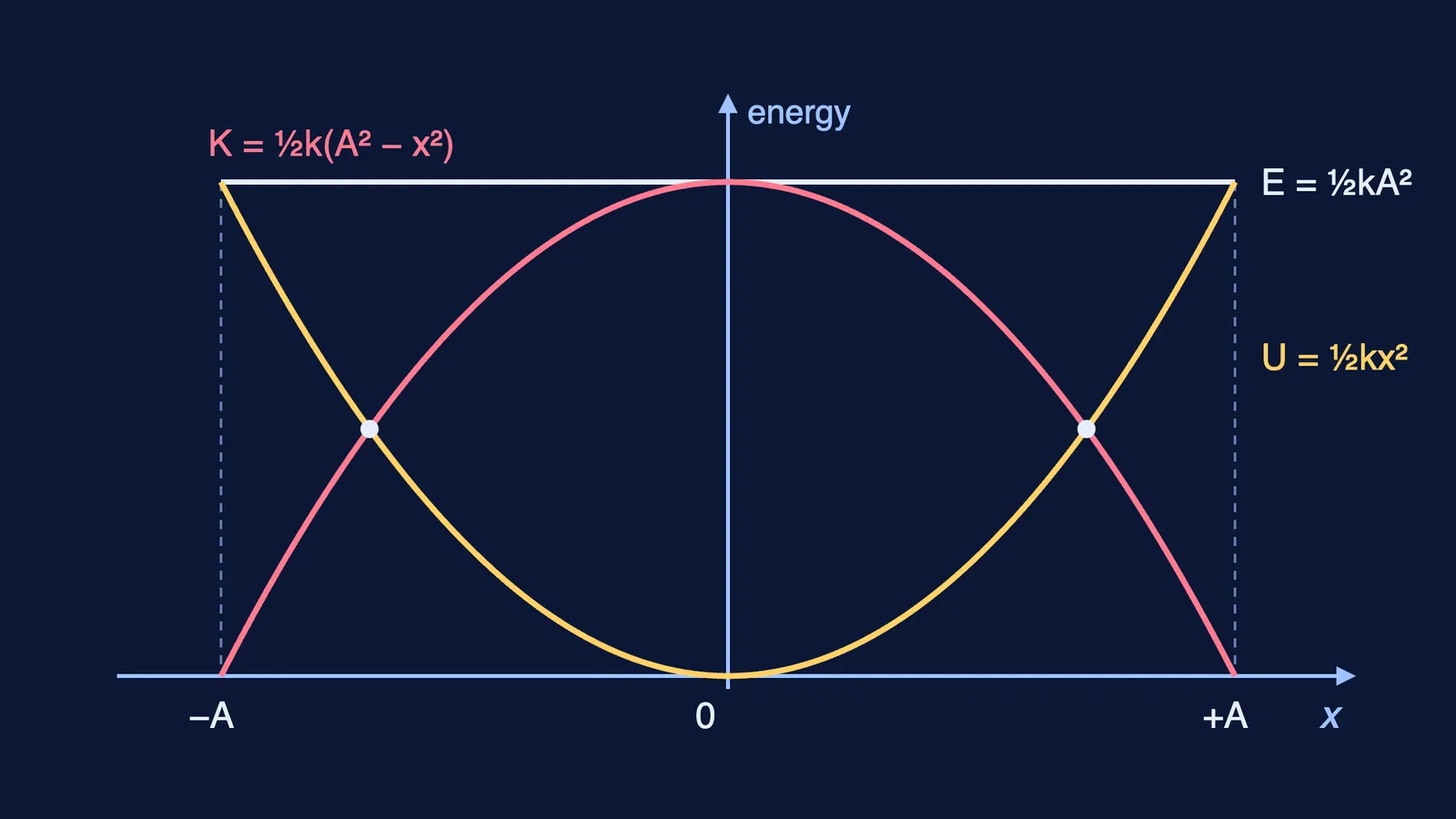
Kinetic energy: K = ½mv² = ½kA² sin²(ωt + φ), in J.
Potential energy: U = ½kx² = ½kA² cos²(ωt + φ), in J, taking U = 0 at the mean position.
Total energy: E = K + U = ½kA² (J), constant when there is no friction.
As a function of position: K = ½k(A² − x²) J, so K = U at x = ±A/√2 (m).
K and U each repeat every T/2 (s).
Worked example: k = 80 N m⁻¹, A = 0.05 m. E = ½ × 80 × 0.05² = 0.1 J. At x = 0.03 m, U = ½ × 80 × 0.03² = 0.036 J and K = 0.1 − 0.036 = 0.064 J.
Watch for: E grows as A². Doubling A quadruples E; the period is unchanged.
Simple pendulum time period formula
Restoring torque: τ = −mgL sin θ, in N m, where m is the bob's mass (kg), g the acceleration due to gravity (m s⁻²), L the string length (m) and θ the angle from the vertical (rad).
τ = Iα and, for small angles, sin θ ≈ θ (radians) give α = −(mgL/I)θ, SHM with ω = √(mgL/I) (rad s⁻¹) and T = 2π√(I/mgL) (s). I is the moment of inertia about the support (kg m²), α the angular acceleration (rad s⁻²).
For a point bob on a massless, inextensible string, I = mL², so T = 2π√(L/g) in s, and L = gT²/4π² in m.
Conditions: small angles, light string, small bob. T does not depend on the bob's mass.
Worked example: L = 0.64 m and g = 9.8 m s⁻² give T = 2π√(0.64/9.8) = 1.61 s. Quadrupling L to 2.56 m doubles T to 3.21 s.
Watch for: θ − sin θ is 0.5% of sin θ at 10° and 2.1% at 20°, so keep swings small. Measure L to the centre of the bob.
The derivations behind these results are worked step by step in our Oscillations Class 11 derivations.
How to revise this formula sheet
Learn x(t) = A cos(ωt + φ) and differentiate twice to rebuild v, a and a = −ω²x.
Turn every problem into "find ω". A spring gives √(k/m), a pendulum √(g/L), and T = 2π/ω.
Sketch the energy graph from memory: two parabolas crossing at x = ±A/√2 under the line E = ½kA².
If phase and the reference circle feel abstract, the Fermi Simulation Lab has interactive simulations for the ideas that are easier to see than to read.