On this page
Chapter 13 of the rationalised NCERT Class 11 Physics textbook, Oscillations (Reprint 2026-27), builds simple harmonic motion (SHM) from one equation and then derives everything else from it. The CBSE 2026-27 Physics syllabus for Classes XI-XII lists SHM, the loaded spring, energy in SHM and, in its own words, "simple pendulum derivation of expression for its time period". For formulas, solved questions and a revision plan, start with our Oscillations Class 11 physics guide.
Which derivations are in the NCERT oscillations chapter?
The chapter derives five results:
Displacement in SHM, from uniform circular motion.
Velocity and acceleration in SHM.
The force law and the period of a loaded spring.
Energy in SHM.
The time period of a simple pendulum.
Learn them as a chain: once you have result 1, results 2 to 4 follow by differentiating and substituting.
Displacement in SHM: x(t) = A cos(ωt + φ), with ω = 2π/T
Setup: a particle P moves anticlockwise at constant angular speed ω on a circle of radius A centred at O; P′ is the foot of the perpendicular from P to the x-axis.
At t = 0, OP makes angle φ (the phase constant) with the +x axis; after time t the angle is ωt + φ.
The x-coordinate of P′ is the projection of OP: x(t) = A cos(ωt + φ). This is the defining equation of SHM.
The motion repeats after one period T, so A cos ωt = A cos ω(t + T) (taking φ = 0).
Cosine first repeats when its argument grows by 2π, so ωT = 2π.
Result: x(t) = A cos(ωt + φ), with angular frequency ω = 2π/T = 2πν.
Where students slip: projecting on the y-axis gives A sin(ωt + φ), also SHM but shifted in phase by π/2. Say which axis you use.
Velocity and acceleration: v = −ωA sin(ωt + φ) and a = −ω²x
Setup: the same reference particle P, which has speed ωA along the tangent and a centripetal acceleration ω²A towards O.
The velocity of P makes angle ωt + φ + π/2 with the x-axis, so its x-component is v(t) = −ωA sin(ωt + φ). Differentiating x(t) once gives the same.
The acceleration of P points towards O; its x-component is a(t) = −ω²A cos(ωt + φ).
Since A cos(ωt + φ) = x(t), this becomes a(t) = −ω²x(t).
Result: v(t) = −ωA sin(ωt + φ) and a(t) = −ω²x(t), so acceleration always points towards the mean position.
Where students slip: dropping the minus sign, which carries the physics: when x is positive, a is negative.
Force law for SHM: F = −kx and T = 2π√(m/k)
Setup: a block of mass m on a frictionless floor, fixed to a spring of spring constant k, displaced x from equilibrium.
Newton's second law: F = ma.
Put in the SHM acceleration: F = −mω²x.
Call the constant mω² = k, so F = −kx. This is the restoring force.
Rearrange: ω = √(k/m).
Use T = 2π/ω: T = 2π√(m/k).
Result: a force F = −kx gives SHM with ω = √(k/m) and period T = 2π√(m/k), whatever the amplitude.
Where students slip: writing √(k/m) inside T. A heavier block oscillates more slowly, so m belongs on top in T.
Energy in SHM: total energy E = ½kA², always the same
Setup: the same block and spring, moving as x = A cos(ωt + φ).
Kinetic energy: K = ½mv² = ½mω²A² sin²(ωt + φ).
Replace mω² with k: K = ½kA² sin²(ωt + φ).
Potential energy of the spring: U = ½kx² = ½kA² cos²(ωt + φ).
Add them: E = K + U = ½kA²[sin²(ωt + φ) + cos²(ωt + φ)].
Since sin² + cos² = 1, E = ½kA², which does not depend on time.
Result: K = ½kA² sin²(ωt + φ), U = ½kA² cos²(ωt + φ), and E = ½kA² stays constant.
Where students slip: saying K and U have period T. Because they depend on sin² and cos², each repeats every T/2, so both peak twice in one oscillation.
Simple pendulum: T = 2π√(L/g)
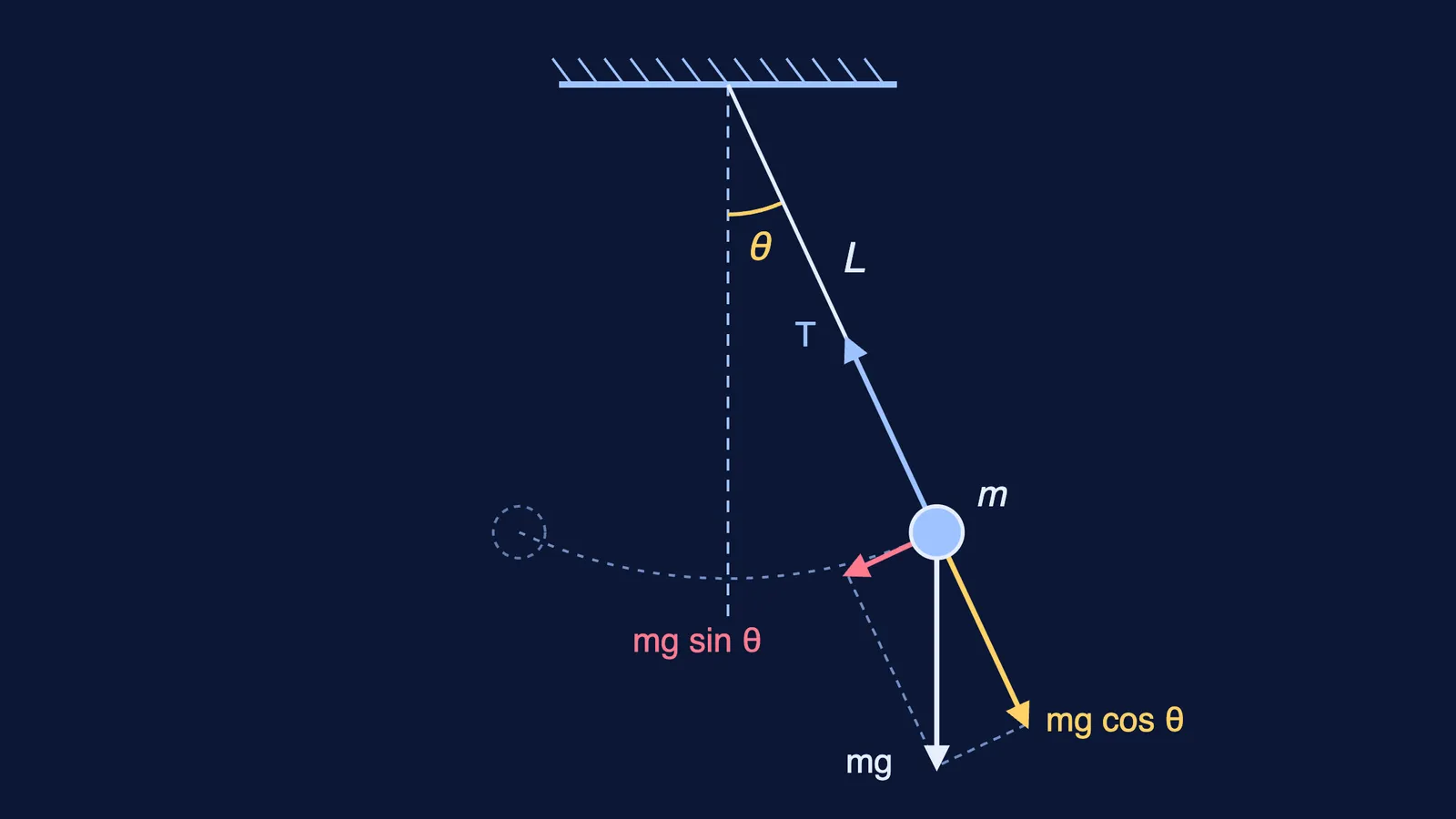
Setup: a bob of mass m on a light, inextensible string of length L, pulled aside by angle θ from the vertical. Forces on the bob: tension along the string and weight mg.
Split mg into mg cos θ along the string and mg sin θ perpendicular to it.
Tension and mg cos θ pass through the support, so only mg sin θ gives a torque: τ = −L(mg sin θ), negative because it restores θ to zero.
Rotational form of Newton's law: τ = Iα, so Iα = −mgL sin θ.
For small θ in radians, sin θ ≈ θ, which gives α = −(mgL/I)θ.
This has the same form as a = −ω²x, so ω = √(mgL/I).
For a light string, I = mL². Then ω = √(g/L) and T = 2π√(L/g).
Result: for small angles, a simple pendulum moves in SHM with period T = 2π√(L/g), independent of the bob's mass.
Where students slip: skipping the small-angle step. Without sin θ ≈ θ the motion is periodic but not simple harmonic, so state the assumption.
How should you practise these derivations?
Write the chain from memory: x(t), then v and a, then F = ma, then energy.
Draw the figure first: the reference circle for results 1 and 2, the pendulum with force components for result 5.
Check units at the end: √(m/k) and √(L/g) must both come out in seconds.
Redo the spring derivation for the chapter's two-spring example, where the block feels −2kx; your result should be T = 2π√(m/2k).
Watch the motion before you derive it. The Fermi Simulation Lab has interactive simulations for the ideas that are easier to see than to read.
Then test yourself with our oscillations and waves case study questions for Class 11 and these oscillations practice questions with solutions.