On this page
Organic Chemistry: Some Basic Principles and Techniques is Unit 8 of the NCERT Class 11 Chemistry Part II textbook (reprint 2026-27), and the CBSE 2026-27 Chemistry syllabus lists the whole unit. For the full chapter, read our Organic chemistry basic principles Class 11 chapter guide.
How are organic compounds drawn and classified?
Hybridisation: carbon mixes its s and p orbitals into equal hybrids: sp3 in methane (tetrahedral), sp2 in ethene (planar), sp in ethyne (linear). More s character means shorter, stronger bonds.
Pi bond: sideways overlap of two parallel p orbitals. Its electrons lie above and below the molecule's plane, exposed to reagents. Don't confuse with: sigma bond, made by head-on overlap; a double bond is one sigma plus one pi.
Bond-line formula: a zig-zag where every corner and line end is a carbon with enough hydrogens for four bonds; only atoms like O, N or Cl are written. Don't confuse with: condensed formula, such as CH3CHBrCH2CH3.
Functional group: the atom or group that decides how a compound reacts. Example: –OH, –CHO, –COOH.
Homologous series: a family with one functional group and a general formula, each member differing from the next by CH2. Example: the alkanols.
Heterocyclic compound: a ring containing at least one atom other than carbon. Example: pyridine, furan. Don't confuse with: homocyclic, where the ring is all carbon.
How do naming and isomerism work?
Principal functional group: when a compound has several groups, the highest-priority one gives the suffix and the rest become prefixes. Example: HOCH2(CH2)4COCH3 is 7-hydroxyheptan-2-one.
Ortho, meta, para: positions 1,2, 1,3 and 1,4 on a disubstituted benzene ring.
Chain isomers: compounds with the same molecular formula but different carbon skeletons. Example: pentane and 2,2-dimethylpropane.
Position isomers: same skeleton, group in a different place. Example: propan-1-ol and propan-2-ol.
Functional group isomers: different functional groups. Example: propanal and propanone.
Metamerism: different alkyl groups on each side of the functional group. Example: methoxypropane and ethoxyethane.
Stereoisomers: atoms joined in the same order but arranged differently in space. NCERT names two kinds: geometrical and optical.
What happens when a covalent bond breaks?
Heterolytic cleavage: the shared pair stays with one fragment, giving ions. Example: CH3–Br gives CH3+ and Br–.
Homolytic cleavage: each atom keeps one electron, giving free radicals; a half-headed "fish hook" arrow shows one electron moving.
Carbocation: a positively charged carbon with only six electrons, sp2 and flat. Stability rises from methyl to primary, secondary, tertiary.
Carbanion: a negatively charged carbon with a lone pair, usually sp3.
Free radical: a neutral species with an unpaired electron.
Nucleophile: a reagent that donates an electron pair to an electron-poor atom. Example: OH–, CN–, water. Don't confuse with: electrophile, which accepts an electron pair, such as a carbocation.
Which electron displacement effects should you know?
Inductive effect: a permanent shift of sigma electrons passed along a chain from a polar bond, negligible after three bonds. –NO2 and halogens withdraw; methyl donates.
Resonance hybrid: the real structure when no single Lewis structure fits; it is lower in energy than any contributing structure (resonance energy). In benzene every C–C bond is 139 pm, between single (154 pm) and double (134 pm), per the NCERT chapter.
Resonance (mesomeric) effect: +R groups such as –OH and –NH2 push electrons into a conjugated system; –R groups such as –NO2 and –CHO pull them out.
Electromeric effect: a temporary, complete shift of pi electrons to one atom of a multiple bond while a reagent attacks. Don't confuse with: inductive effect, which is permanent and partial.
Hyperconjugation: a permanent effect in which the C–H sigma electrons of an alkyl group attached to a positive carbon or a multiple bond spread into it, also called no-bond resonance. Example: (CH3)3C+, with nine such C–H bonds, is more stable than CH3CH2+.
Which purification techniques should you know?
Boiling points come from section 8.8 of the NCERT chapter.
Crystallisation: dissolve the solid in a hot solvent it barely dissolves in when cold; pure crystals form on cooling and impurities stay in the mother liquor.
Sublimation: a solid turns straight to vapour, leaving non-sublimable impurities behind.
Simple distillation: for liquids with far-apart boiling points, such as chloroform (334 K) and aniline (457 K). Don't confuse with: fractional distillation, which adds a fractionating column for close boiling points.
Distillation under reduced pressure: lower pressure lowers the boiling point, for liquids that decompose. Example: glycerol from spent lye.
Steam distillation: for steam-volatile liquids that do not mix with water; the vapour pressures add, so the mixture boils just below 373 K. Example: aniline.
Differential extraction: shaking with an immiscible organic solvent that dissolves the compound better than water.
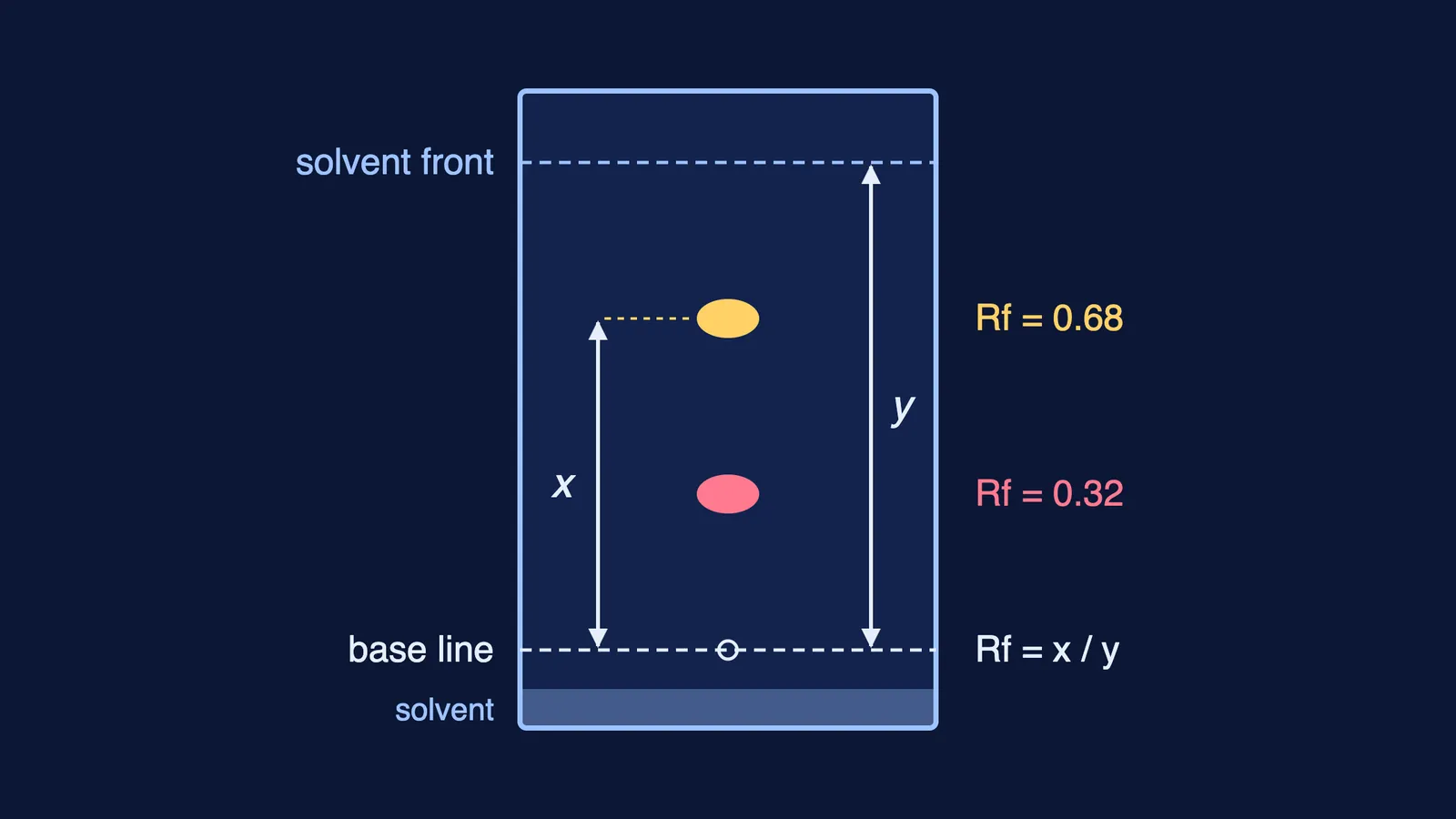
Chromatography: a mobile phase carries the components over a stationary phase at different speeds. Column and thin layer chromatography work by adsorption; paper chromatography is partition, with water in the paper as the stationary phase.
Retardation factor (Rf): distance moved by the spot divided by distance moved by the solvent, both from the base line.
How are elements detected and estimated?
Lassaigne's test: fusing with sodium turns N, S and halogens into NaCN, Na2S and NaX. Nitrogen gives Prussian blue; sulphur a black lead sulphide precipitate; with nitric acid and silver nitrate, chloride gives a white precipitate.
Dumas method: heat with copper oxide and measure the volume of nitrogen gas. Don't confuse with: Kjeldahl's method, which converts nitrogen to ammonia and titrates it, and fails for nitro, azo and ring nitrogen.
Carius method: heat in a sealed Carius tube; for halogens, with fuming nitric acid and silver nitrate, weighing silver halide; for sulphur, with sodium peroxide or fuming nitric acid, weighing barium sulphate.
How to learn these terms
Learn mix-ups as pairs: sigma vs pi, carbocation vs carbanion, nucleophile vs electrophile, inductive vs electromeric, Dumas vs Kjeldahl.
Beside each purification method, write the property it uses: solubility, boiling point, vapour pressure or adsorption.
Work out an Rf value from a sketched TLC plate, then practise with our case-study questions on organic chemistry basics and assertion-reason questions on this chapter.
If a term still feels abstract, the Fermi Concept Library covers every concept in chemistry, each with its own lesson and its place in the map.