On this page
Organic Chemistry: Some Basic Principles and Techniques is Unit 8 of the CBSE 2026-27 Class XI Chemistry curriculum, worth 11 of the 70 theory marks. Class 11 papers are set by schools, so use these three original cases as practice, not a forecast of your paper. Every answer follows the rationalised NCERT Chemistry Part II, Unit 8 (Reprint 2026-27). For the whole chapter, start with our Class 11 guide to organic chemistry basic principles and techniques.
Case 1: Which C4H10O is in each bottle?
A school lab in Pune is clearing an old cupboard and finds five bottles whose labels have faded. The register says each holds a liquid of formula C4H10O: butan-1-ol, butan-2-ol, 2-methylpropan-2-ol, ethoxyethane and 1-methoxypropane. Before relabelling, the lab assistant burns 0.370 g from one bottle in a combustion train with excess oxygen and copper(II) oxide. The calcium chloride tube gains 0.450 g and the potassium hydroxide tube gains 0.880 g.
(i) Butan-1-ol and ethoxyethane are: (a) chain isomers (b) position isomers (c) functional group isomers (d) metamers.
(ii) From the five bottles, name one pair of position isomers and one pair of metamers.
(iii) Calculate the percentages of carbon, hydrogen and oxygen in the sample.
(iv) Suppose the C–O bond of butan-1-ol and of 2-methylpropan-2-ol breaks heterolytically, with OH taking the bond pair. Which carbocation is more stable, and why?
Answers.
(i) (c). One is an alcohol and the other an ether, so the functional groups differ.
(ii) Position isomers: butan-1-ol and butan-2-ol (OH on a different carbon of the same chain). Metamers: ethoxyethane and 1-methoxypropane (different alkyl groups on either side of the oxygen).
(iii) %C = (12 × 0.880 × 100) / (44 × 0.370) = 64.86%. %H = (2 × 0.450 × 100) / (18 × 0.370) = 13.51%. %O = 100 − 64.86 − 13.51 = 21.62%.
(iv) 2-methylpropan-2-ol gives the tert-butyl cation, (CH3)3C+, a tertiary carbocation; butan-1-ol gives the primary CH3CH2CH2CH2+. Its three methyl groups release electrons (+I effect), and nine adjacent C–H bonds can hyperconjugate, against two in the primary cation. Both spread the positive charge, so the tertiary cation is more stable.
Case 2: How does a chemical plant purify aniline and glycerol?
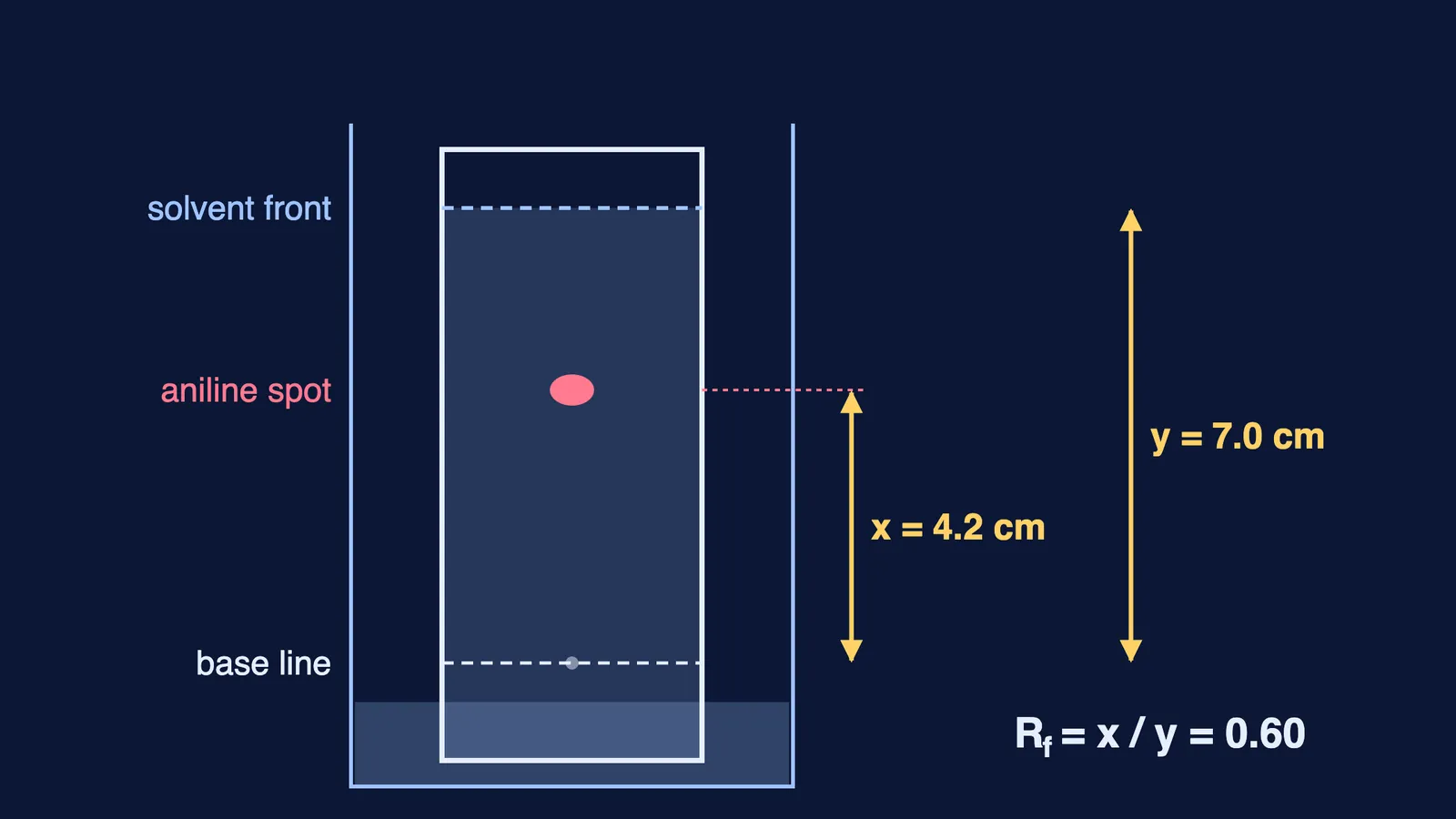
A plant in Ankleshwar, Gujarat, runs two recovery lines. Line A separates aniline, which does not mix with water and is steam volatile, from an aniline–water mixture by steam distillation. At 760 mm Hg the mixture boils at 98.5 °C, where the vapour pressure of water is 720 mm Hg. Line B, next to the soap unit, recovers glycerol from spent lye. A quality chemist runs a silica gel TLC plate of the recovered aniline. After development, one spot sits 4.2 cm above the base line and the solvent front is 7.0 cm above it.
(i) The technique on Line B is: (a) steam distillation (b) sublimation (c) distillation under reduced pressure (d) differential extraction.
(ii) Find the Rf value of the aniline spot. Aniline is colourless; give one way to see its spot.
(iii) Calculate the vapour pressure of aniline in the boiling mixture on Line A.
(iv) A trainee asks why aniline distils below 100 °C, and why glycerol cannot simply be steam distilled too. Answer both.
Answers.
(i) (c). Glycerol boils very high and decomposes on strong heating, so lowering the pressure lets it boil at a lower temperature.
(ii) Rf = 4.2 / 7.0 = 0.60. Look at the plate under ultraviolet light, or keep it in a closed jar with a few iodine crystals so the spot turns brown.
(iii) The mixture boils when p(aniline) + p(water) = 760 mm Hg, so p(aniline) = 760 − 720 = 40 mm Hg.
(iv) The mixture boils once the two vapour pressures together reach 760 mm Hg, which happens below the boiling point of either liquid alone. Steam distillation suits only steam-volatile compounds immiscible with water; glycerol mixes with water.
Case 3: Can Kjeldahl's method check a sulphonamide?
A pharmaceutical quality lab in Hyderabad tests a new batch of 4-aminobenzenesulphonamide, C6H8N2O2S (molar mass 172 g/mol). The compound is fused with a small piece of sodium (not an excess), and the extract, treated with iron(III) chloride, turns blood red. Next, 0.344 g of the compound is digested in Kjeldahl's flask and the ammonia released is absorbed in 50.0 mL of 0.100 M H2SO4. The leftover acid needs 60.0 mL of 0.100 M NaOH. The lab also makes this compound from a nitro-containing starting material and wants to check that material's nitrogen content too.
(i) The blood-red colour shows: (a) nitrogen only (b) sulphur only (c) nitrogen and sulphur together (d) a halogen.
(ii) Why does this extract give no Prussian blue in the usual nitrogen test?
(iii) Calculate the percentage of nitrogen and compare it with the value from the formula.
(iv) Can Kjeldahl's method be used for the nitro-containing starting material? If not, which method should the lab use?
Answers.
(i) (c). With both elements present, sodium thiocyanate forms, and SCN⁻ gives the blood-red [Fe(SCN)]²⁺ with Fe³⁺.
(ii) Without excess sodium, nitrogen is held as thiocyanate, so there are no free cyanide ions to form sodium hexacyanidoferrate(II) and then Prussian blue.
(iii) %N = 1.4 × M × 2(V − V1/2) / m = 1.4 × 0.100 × 2 × (50.0 − 30.0) / 0.344 = 16.28%. From the formula, 28 × 100 / 172 = 16.28%, so the batch result matches.
(iv) No. Nitrogen in a nitro group does not change to ammonium sulphate under Kjeldahl conditions. Use the Dumas method, which collects the nitrogen as N2 gas.
How to attack case-study questions
In isomerism parts, draw each structure before naming the type.
For carbocations, count alkyl groups and adjacent C–H bonds before you rank.
For purification, match the clue word to one method.
In Lassaigne questions, check whether N and S are both present before predicting Prussian blue.
In numericals, write the NCERT formula first, substitute with units, and check against the molecular formula when one is given.
If a method keeps slipping, the Fermi Problem Library has worked problems with a step-by-step solver that explains the reasoning rather than printing an answer. For more analysis numericals, try our practice questions on purification and analysis of organic compounds, and read how to approach case-based questions.