On this page
Oceans and Continents is Chapter 2 of NCERT's new Class 6 Social Science book, Exploring Society: India and Beyond (code fees1, First Edition June 2024, reprinted February 2025 and February 2026). It sits in Theme A, between Locating Places on the Earth and Landforms and Life (NCERT, fees1 contents). CBSE publishes no separate 2026-27 curriculum for Classes 6 to 8; they follow the NCERT book, and the chapter is assessed by the school.
What does the Oceans and Continents chapter cover?
The chapter asks two big questions: what oceans and continents are and where they lie, and how they shape life on Earth, including ours (NCERT Chapter 2 PDF).
Water covers almost three-fourths of the Earth's surface, so from space the Earth looks mostly blue; early astronauts called it the blue planet (NCERT).
Land covers a little over one-fourth. A large continuous stretch of land is a continent.
The two hemispheres differ: there is more land north of the Equator than south of it.
Most water is salty seawater; freshwater (glaciers, rivers, lakes, air, groundwater) is a small share.
How many oceans are there, and which is the largest?
The book names five oceans. By size, from largest to smallest, they are the Pacific, the Atlantic, the Indian, the Southern (or Antarctic) and the Arctic (NCERT).
The lines between them on a map are only conventions: seawater flows from one ocean to the next. The Indian Ocean has Asia on its northern side, Africa and Australia to its west and east, and the Southern Ocean below. India has the Arabian Sea on its west and the Bay of Bengal on its east.
Why can we count four to seven continents?
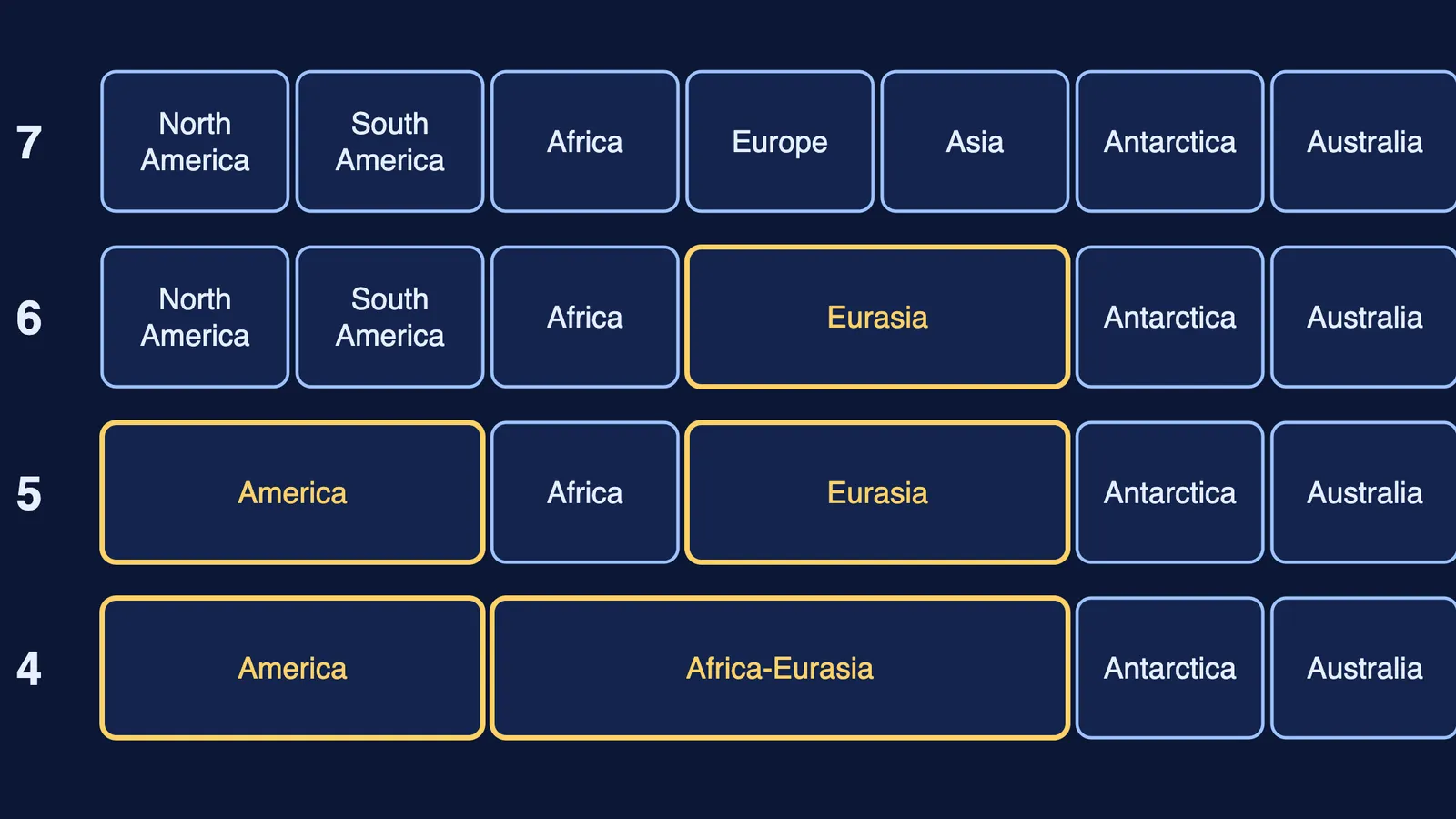
The answer depends on which landmasses you join. The book shows four ways to count, and the hero diagram above sets them out row by row (NCERT).
North and South America can be seen as one landmass, America.
Europe and Asia form one landmass; geologists often call it Eurasia. History and culture are the reason we usually split it in two.
Africa and Eurasia are sometimes taken together as one.
The seven-continent list is the one most widely used. Land too small to be a continent, with water all round, is an island. Greenland is the world's largest island, and India has more than 1,300 islands, including the Andaman and Nicobar Islands and Lakshadweep (NCERT).
How do oceans affect life on land?
Clouds formed over the oceans bring rain, including India's summer monsoon; without oceans the Earth would be a desert (NCERT). Ocean plant life makes over half the oxygen on Earth, so oceans are called the planet's lungs. People have also used the seas for migration, trade and fishing.
Oceans bring danger too: cyclones, and tsunamis, huge waves usually set off by an undersea earthquake or volcanic eruption. On 26 December 2004 a tsunami from an earthquake in Indonesia hit India and 13 other countries, killing more than two lakh people; the Andaman and Nicobar Islands, Tamil Nadu and Kerala suffered badly (NCERT). India contributes to the Indian Ocean Tsunami Warning System.
The chapter ends on threats: several million tonnes of plastic enter the oceans every year, and overfishing reduces marine life.
Worked example: ocean, sea, continent or island?
Bay of Bengal. Not an ocean on its own: it is a part of the Indian Ocean, east of India.
Australia. Water surrounds it, but it is far too large to be an island, so it is a continent.
Lakshadweep. A group of small islands in the Arabian Sea.
Eurasia. One landmass: one continent in the five- and six-continent counts, two (Europe and Asia) in the seven-continent count, and part of Africa-Eurasia in the four-continent count.
Greenland. Land surrounded by water but not a continent, so an island, the largest one.
Practice questions and how this chapter connects
These questions are our own; the marks are our suggestion.
Name the parts of the Indian Ocean on the western and eastern sides of India. (1 mark)
Water surrounds Australia on every side. Why is it still not called an island? (2 marks)
Your cousin insists there are exactly seven continents. Use two examples to show why the count can range from four to seven. (3 marks)
Give two ways in which oceans support life on the continents. (2 marks)
What is a tsunami, and how does an early warning system help coastal people? (3 marks)
The chapter builds on Chapter 1's hemispheres and latitudes (see our guide to the globe, latitudes and longitudes), and Chapter 3 returns to disasters. The older textbook covers similar ground in major domains of the Earth, and Class 9 continues with oceans and life.
Not sure where to begin your revision? Fermi's AI tutor works out what you already know and builds a plan for the session.