

On this page
Every place on Earth has an address made of two numbers. The current NCERT Class 6 social science textbook, Exploring Society: India and Beyond, teaches this in Chapter 1, Locating Places on the Earth. Here are the numbers your exam asks for, plus three worked time sums.
What are latitudes and longitudes?
Latitude is a place's distance north or south of the Equator; the Equator is 0° and the poles are 90°N and 90°S (NCERT Class 6). Parallels of latitude are circles that shrink towards the poles, so the Equator is the longest parallel.
Longitude is a place's distance east or west of the Prime Meridian, measured from 0° to 180° with E or W added. Meridians are half-circles running from pole to pole. Together, latitude and longitude are a place's coordinates: NCERT rounds Delhi to 29°N, 77°E.
The NCERT Class 11 practical geography chapter adds two useful facts. Each degree is divided into 60 minutes (′), and each minute into 60 seconds (″), so 82°30′ means 82.5°. Parallels one degree apart are about 111 km apart.
Which are the important parallels and heat zones?
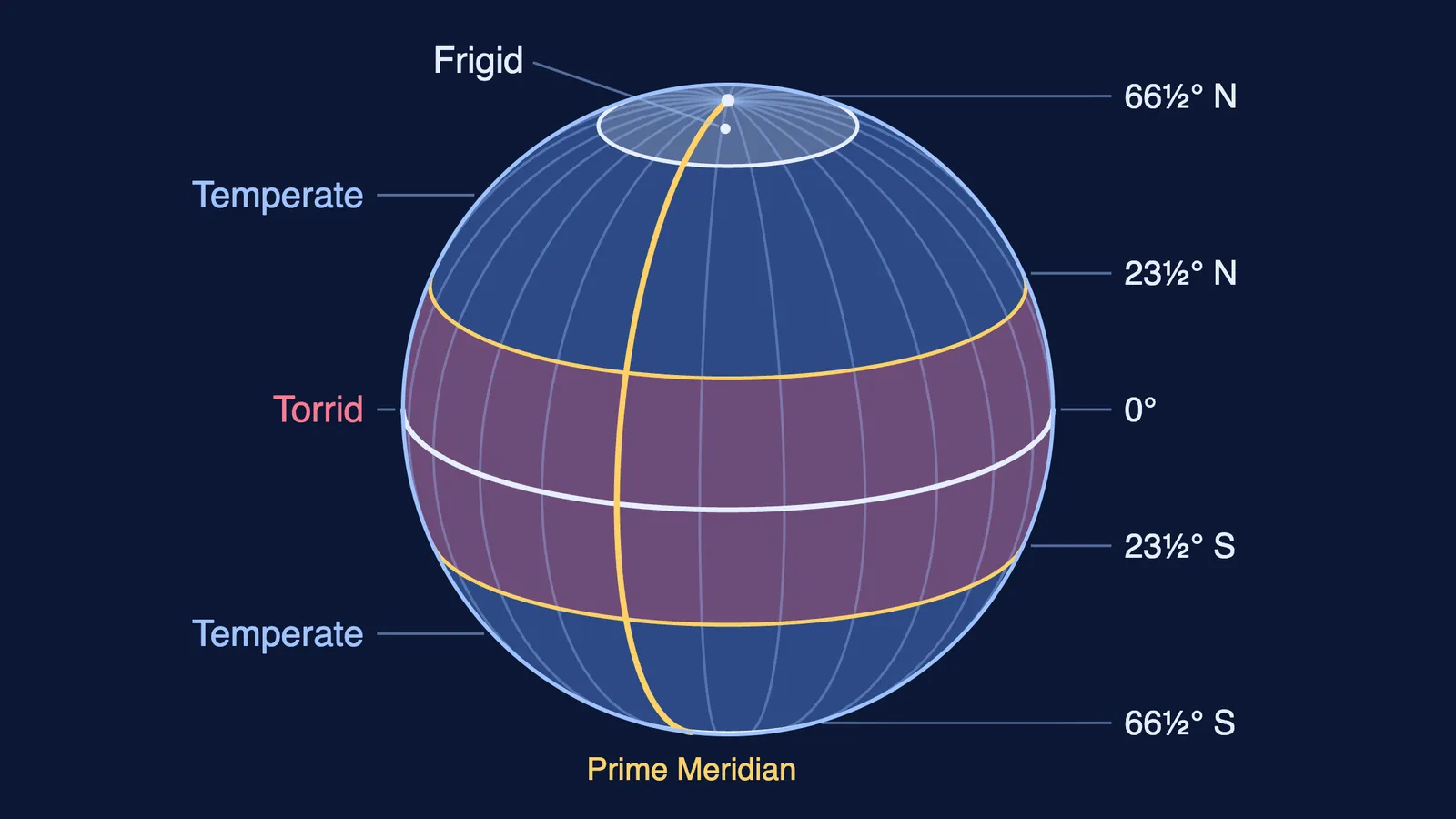
The Class 6 book says the climate is torrid (hot) near the Equator, temperate further away and frigid near the poles. The boundaries come from the Class 11 NCERT chapter: 0° to 23½° north and south is the torrid zone, 23½° to 66½° the temperate zone, and 66½° to 90° the frigid zone.
Tropic of Cancer, 23½°N: the Sun's vertical rays strike it during the June solstice, according to National Geographic Education.
Tropic of Capricorn, 23½°S.
Arctic Circle, 66½°N: National Geographic's glossary gives 66.5 degrees north.
Antarctic Circle, 66½°S.
Notice that 23½ + 66½ = 90. The 23½ is close to the tilt of Earth's axis, which NASA gives as 23.4 degrees. You will learn in Science how that tilt gives us seasons.
Why is Greenwich the Prime Meridian?
Longitude has no natural starting line, so one had to be chosen. The NCERT Class 6 book says that in 1884 some nations decided the meridian through Greenwich, in London, would become the international standard for the Prime Meridian, marked 0°. Royal Museums Greenwich records that in 1884 the Greenwich Meridian was recommended as the Prime Meridian of the World.
India had a prime meridian centuries earlier. The NCERT textbook describes the madhya rekha through Ujjayini (today's Ujjain), the reference line for Indian astronomical texts; its map places it at 75.8°E.
How do you calculate time from longitude?
The Earth turns 360° in 24 hours: 15° every hour, as the Class 6 chapter works out, or 1° every 4 minutes, as the Class 11 chapter puts it. Places east of Greenwich are ahead of it; places west are behind.
Use four steps:
Find the longitude difference. Both places on the same side of Greenwich: subtract. On opposite sides: add.
Multiply by 4 to get minutes.
Divide by 60 to get hours and minutes.
Moving east, add the time. Moving west, subtract it.
Worked example 1 (NCERT Class 11). It is noon at Greenwich. What is the local time at Thimphu, 90°E? 90 × 4 = 360 minutes = 6 hours. Thimphu is east, so add: 6 pm. At New Orleans, 90°W, you subtract: 6 am.
Worked example 2: why IST is 5:30 ahead. The Class 11 chapter says Indian Standard Time is calculated from the 82°30′E meridian through Mirzapur. 82.5 × 4 = 330 minutes = 5 hours 30 minutes. CSIR-NPL, which maintains IST, describes it as UTC(NPLI) plus 5:30 hours. For the full story, read why IST is 5 hours 30 minutes ahead of UTC.
Worked example 3 (ours): Delhi's sun time. Take NCERT's rounded 77°E for Delhi. The gap to 82.5°E is 5.5°, and 5.5 × 4 = 22 minutes. Delhi lies west of the IST meridian, so at 12 noon IST, local time in Delhi is about 11:38 am.
Related reads: how sailors found longitude with Harrison's clock, and how the pole star gives your latitude.
How should you revise this chapter in 20 minutes?
Draw a circle, mark the five important parallels with their degrees, and shade the three zones.
Write one-line definitions of latitude, longitude, Prime Meridian and coordinates.
Do three time sums: one place east, one west, and one pair on opposite sides of Greenwich.
Explain local time and standard time to someone at home with the Porbandar and Tinsukia example from the NCERT Class 6 chapter. Take its hint of a 30° gap: 30 × 4 = 120 minutes, so local times differ by 2 hours.
If a step keeps tripping you up, Fermi's AI tutor works out what you already know, builds a plan for the session and draws the figure as it explains. That way you practise the sums until the rule feels natural.


