On this page
Chapter 4 explains how India became a land of cities again, about a thousand years after the Harappan cities faded. It opens Theme B, Tapestry of the Past, in Exploring Society: India and Beyond, Part I (book code gees1, first edition April 2025, reprinted February 2026), on pages 67 to 82.
Classes 6 to 8 follow the NCERT book; CBSE's 2026-27 curriculum page covers Classes 9 to 12 only. This chapter is assessed by the school.
What is the Second Urbanisation of India?
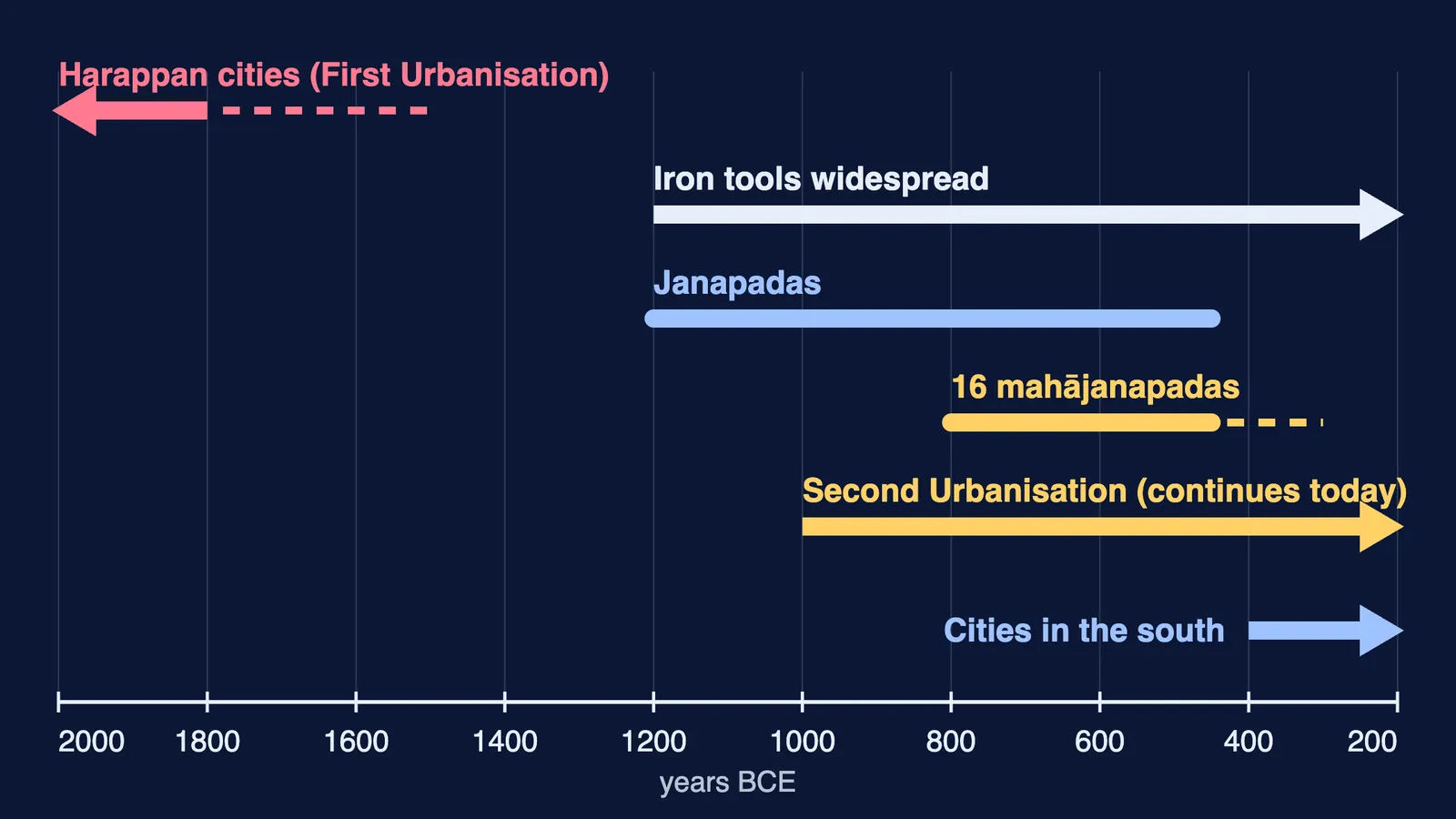
The chapter calls the Harappan civilisation India's "First Urbanisation". In the early 2nd millennium BCE it broke up, and for roughly a thousand years north India had few, if any, towns.
The Second Urbanisation is the new wave of city life that began in the 1st millennium BCE across the Ganga plains, some of the Indus (Sindhu) basin and nearby lands, then spread across the Subcontinent. The book adds that this phase has continued to the present day.
The evidence: excavated cities, plus late Vedic, Buddhist and Jain texts.
What were janapadas and mahājanapadas?
Janapada: late in the 2nd millennium BCE, clans that likely shared a language and customs settled a territory led by a rājā. The word means where a people (jana) set foot (pada) and settled.
Mahājanapada: by the 8th or 7th century BCE, some janapadas had merged into larger states. The list found most often in the texts has 16, stretching from Gandhāra (northwest) and Anga (east) to Aśhmaka near the Godavari.
The strongest: Magadha, Kosala, Vatsa and Avanti. Magadha's capital was Rājagṛiha (Rajgir, Bihar); Vatsa's was Kauśhāmbī.
Most mahājanapada capitals were fortified, with a moat and narrow gateways where guards checked who and what came in.
How were the mahājanapadas governed?
Each janapada had an assembly, the sabhā or samiti, probably of clan elders, whose advice a good rājā took. Some texts say an incompetent ruler could be removed, though the book warns this was not an established law.
Mahājanapadas took two forms:
Monarchies such as Magadha, Kosala and Avanti: a hereditary rājā collected taxes, kept order, built fortifications and maintained an army, with ministers and an assembly of elders.
Gaṇas or sanghas such as Vajji (Vṛijji) and Malla: the assembly decided major matters by discussion and, when needed, a vote, even choosing the rājā. Scholars often call them early republics.
Which new technologies drove the change?
Iron: the Harappans worked copper and bronze. Iron-working was perfected in several regions from the early 2nd millennium BCE, and iron tools were in wide use by the late 2nd millennium BCE. They helped farming on a larger scale, and iron weapons were lighter and sharper than bronze.
Coins: growing trade led to India's first coins, silver punch-marked coins stamped with symbols. Coins of copper, gold and other metals came later, and neighbouring regions' coins also changed hands.
Roads: the Uttarapatha linked the northwest to the Ganga plains and the east; the Dakṣhiṇapatha ran from Kauśhāmbī across the Vindhyas to the south.
Śhiśhupalgarh, capital of the Kalinga region, had a square plan; southern cities emerged from about 400 BCE, alongside the Chola, Chera and Pāṇḍya kingdoms (the book prints "Pānḍyas"; Pāṇḍya is the usual spelling). By 300 or 200 BCE, the book says, almost the whole Subcontinent was connected, and the mahājanapadas had ended.
The chapter also introduces the varṇa–jāti system, a two-fold system. A jāti was a community linked to an occupation, with skills usually handed down; varṇa, a concept from Vedic texts, had four groups. The book notes broad scholarly agreement that the system was more flexible early on, when people sometimes changed occupations, and grew more rigid over time, particularly under British rule. It gave society some stability but in time led to inequalities and discrimination, a topic for a higher grade.
Worked example: how long did the mahājanapadas last?
Start: the mahājanapadas had formed by the 8th or 7th century BCE, so take roughly 800 to 600 BCE.
End: they ceased to exist around 300 BCE.
Span: 800 − 300 = 500 and 600 − 300 = 300, so roughly three to five centuries.
Practice questions and where this chapter fits
Marks are our suggestion; your school sets the real paper.
Which four mahājanapadas does the chapter name as the most powerful? (1)
Name two gaṇas and say who chose the rājā there. (2)
What were the first Indian coins made of, and why were they called punch-marked? (2)
Name the two long routes in the chapter and the regions each one linked. (3)
Why did city gateways have narrow openings, and what was the moat for? Use one example from the chapter. (3)
The chapter looks back to the Harappan cities, drains and seals and forward to Chapter 5, The Rise of Empires. The older Class 6 book covered this period in kingdoms, kings and an early republic; Class 9 continues with State and Society up to 1000 CE.
Not sure where to begin revising? Fermi's AI tutor works out what you already know and builds a plan for the session.