On this page
A nerve impulse is a wave of electrical change that runs along an axon, from the cell body towards the axon terminals. Two separate things keep it moving forward. The stretch of axon the impulse has just left cannot fire again for a moment, and the chemical synapse at the far end passes signals from one side to the other but not back.
What happens at each step along the axon?
A resting neuron sits at about -70 mV, and an action potential starts when the membrane depolarises to a threshold of about -55 mV, according to OpenStax Anatomy and Physiology 2e. The same chapter says the impulse begins at the initial segment of the axon, which has a high density of voltage-gated sodium channels, and that the membrane reaches about +30 mV at the peak.
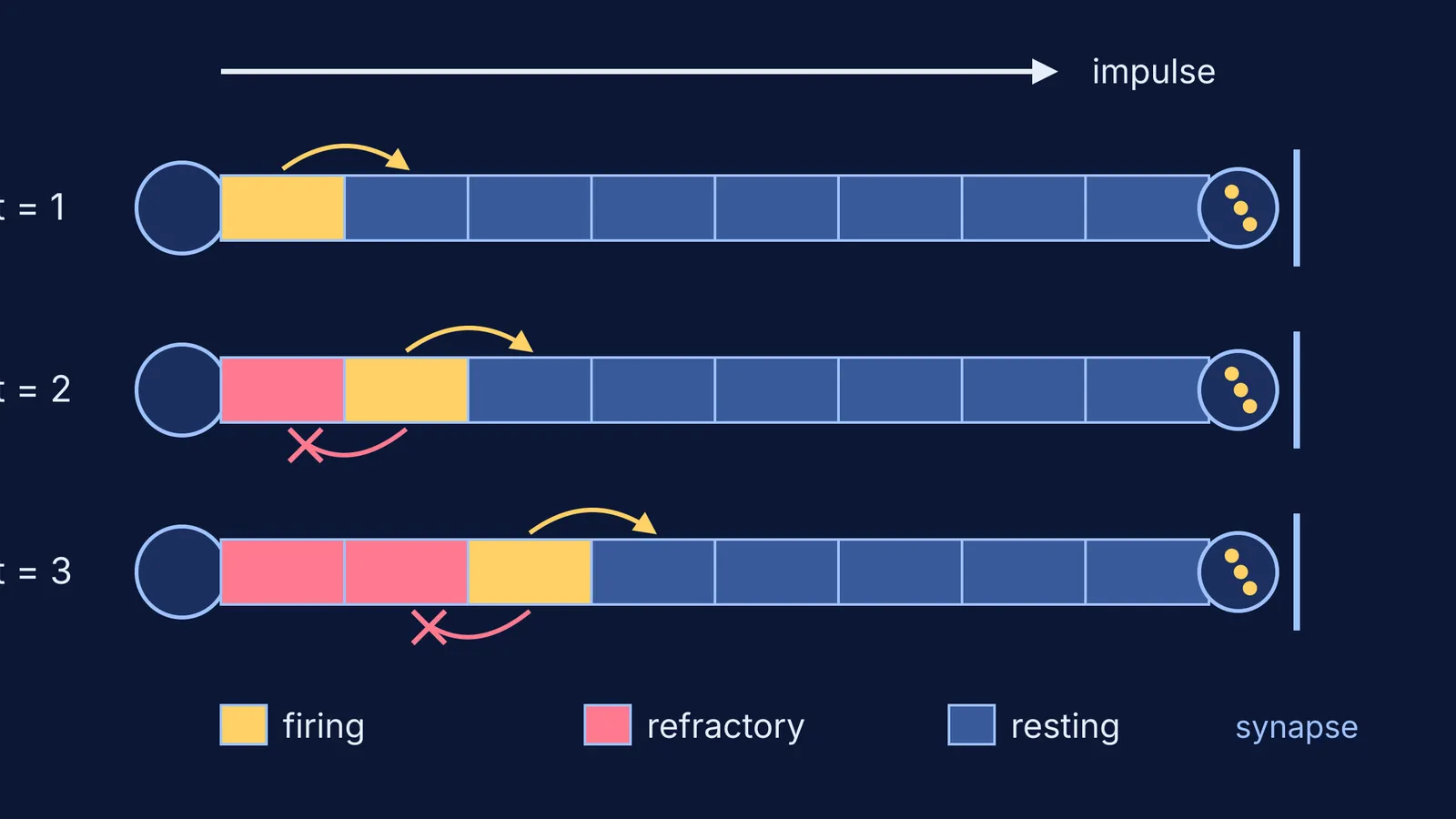
Picture the axon as a row of short patches, as in the diagram above. Each patch is in one of three states: resting (ready to fire), firing, or refractory (has just fired and cannot fire yet).
t = 1: Patch 1 reaches threshold. Its sodium channels open, sodium ions rush in and the inside turns positive.
That positive charge spreads inside the axon to both sides. Patch 2, ahead, is resting, so it reaches threshold and fires.
t = 2: Patch 2 is firing and its charge also spreads both ways. Forward, patch 3 is resting and fires next. Backward, patch 1 is refractory, so nothing happens there.
t = 3: Patch 3 fires and patch 2 is now refractory. The wave has moved one step forward and none back.
This repeats all the way to the axon terminals.
The key point is step 3. Current does spread backwards; it just meets a patch that cannot respond.
Why can't a nerve impulse travel backwards along an axon?
A voltage-gated sodium channel has an inactivation gate that closes a fraction of a millisecond after the channel opens (OpenStax Anatomy and Physiology 2e). Because those channels are inactivated at the peak, they cannot open again for a brief time, and the textbook notes that 'depolarization spreading back toward previously opened channels has no effect.'
The absolute refractory period lasts about 1-2 ms, and during it no stimulus, however strong, can trigger a second action potential (PhysiologyWeb). In the relative refractory period that follows, a stronger than normal stimulus is needed, because some sodium channels are still inactivated and potassium permeability is above its resting value. By the time the patch behind has recovered, the impulse has moved on.
So the axon itself is not a one-way pipe. The direction comes from where the impulse starts. The Wikipedia article on the action potential notes that if an axon is stimulated in its middle in a lab, both halves are unfired, so two impulses set off: one towards the cell body and one towards the terminals.
Speed is a separate question: conduction velocity in nerves ranges from about 100 metres per second to under 0.1 metres per second (Neuroscience Online, UTHealth Houston). For why, see myelinated vs unmyelinated nerve speed.
Why does a chemical synapse pass signals only one way?
When the impulse reaches the axon terminal, calcium entry makes synaptic vesicles fuse with the presynaptic membrane and release neurotransmitter into the gap; the transmitter then diffuses to receptors on the postsynaptic membrane (OpenStax Anatomy and Physiology 2e, section 12.5). The release machinery is on one side; the receptors that pass the message on are on the other.
OpenStax Biology 2e states that chemical synaptic signalling 'is unidirectional', while some electrical synapses, where the two cells are joined by gap junctions, are bidirectional. For the full comparison, see electrical vs chemical synapses: speed, direction and gap width.
How do you write this in an exam answer?
Use this four-line frame for a 3-mark question:
Where it starts: the impulse begins at the initial segment of the axon and spreads to the next patch.
Mechanism: the patch that has just fired has inactivated sodium channels, so it is absolutely refractory.
Effect: current spreading backwards cannot fire the refractory patch; the resting patch ahead fires.
Synapse: transmitter is released from the presynaptic terminal onto postsynaptic receptors, so transfer is one-way.
Common slips to check for:
Writing that current cannot flow backwards. It can; the patch behind cannot respond.
Swapping absolute and relative refractory periods. Absolute means no response at all; relative means a stronger stimulus is needed.
Saying every synapse is one-way. Some electrical synapses are bidirectional.
If the chain from ion channels to synapses still feels loose, the Fermi Concept Library gives each biology concept its own lesson and its place in the map, so you can see how the pieces connect. To watch the spike itself, try our action potential simulation: predict the spike, then test it.