On this page
You can get back on a bicycle after years away from it, and your fingers find the keys without you looking down. People call this muscle memory, but the name is misleading. The memory for how to move is stored in your brain, in a network that includes the motor cortex and the cerebellum. Your muscles carry out the plan, but they don't store it.
Where is muscle memory stored?
The clearest evidence comes from Henry Molaison, known in research papers as patient H.M. He became amnesic in 1953, after surgery on both medial temporal lobes, and could no longer form lasting new memories of events (Corkin, 2002; Corkin, 196890024-9)).
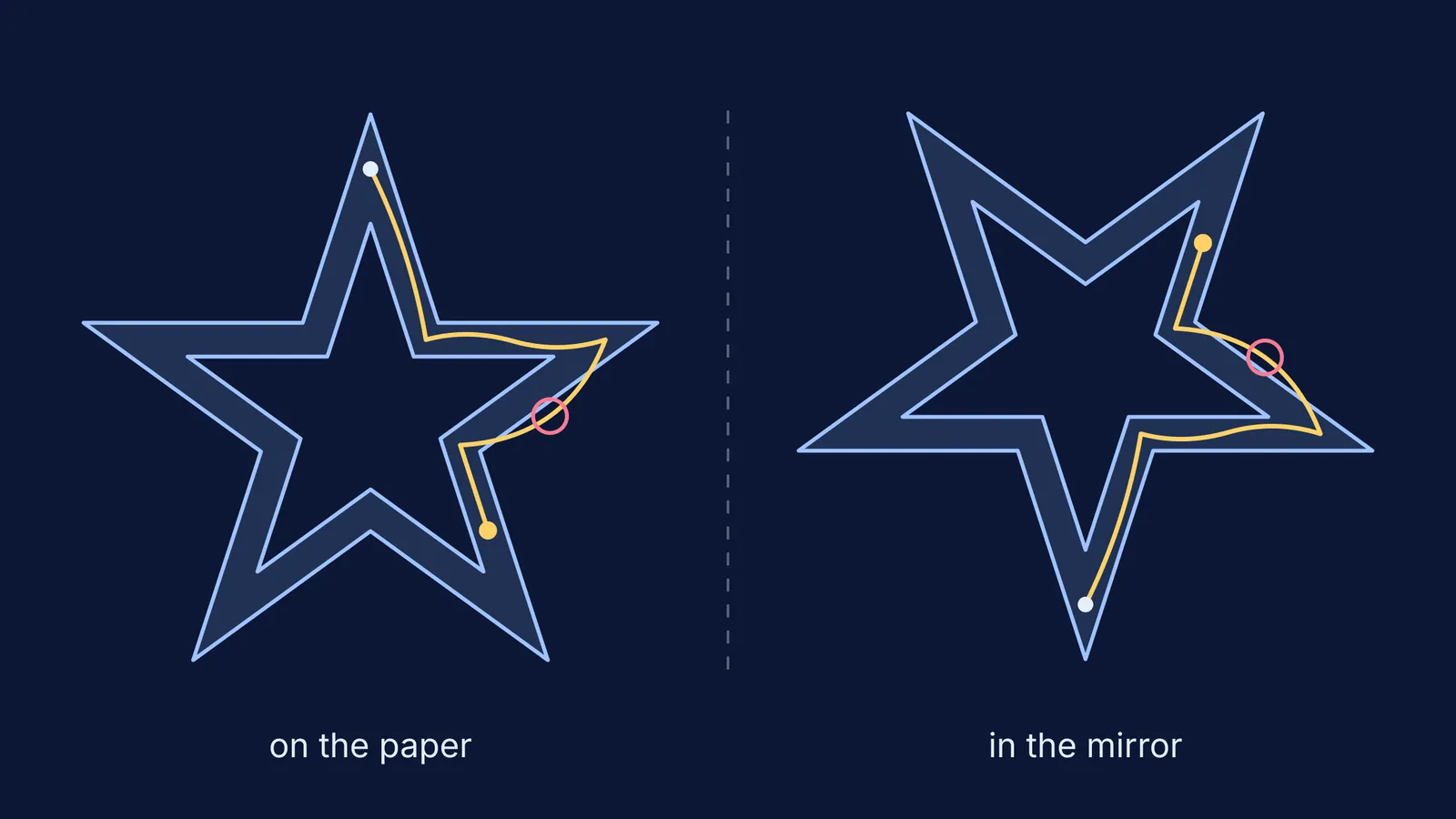
In a mirror-drawing test, H.M. traced a star with a double outline while seeing his hand only in a mirror. He picked up the skill within ten trials and kept it well across 3 days. Yet at the end he had no memory of ever doing the task, as the neuroscientist Larry Squire summarised in Neuron in 2009.
So memory for skills and memory for facts run on separate systems. H.M. lost the system that records what happened, but the one that learns how to move kept working. Our story on what Brenda Milner learned from patient H.M. tells how this was first found.
How does muscle memory work in the brain?
Motor cortex. In a 1995 Nature study, adults practised a finger-tapping sequence every day. By week 4, the patch of primary motor cortex that lit up for the practised sequence had grown, compared with an unpractised one, and the change lasted for several months. The gains in speed and accuracy did not carry over to the other hand, or to the same finger movements in a different order.
Cerebellum. "The cerebellum is essential for error-driven motor learning," says a 2016 review in The Cerebellum. It compares the movement you expected with what your senses report back, and uses the gap to adjust your next attempt. The same review notes that people with cerebellar damage struggle to adapt when a reaching task is distorted.
Brain-imaging work by Julien Doyon and colleagues suggests the two share the job with the striatum, a structure deep in the brain. Their model predicts that the cortex-striatum and cortex-cerebellum loops play different parts depending on whether you are learning a sequence of movements or adapting a movement to new conditions (Doyon and Benali, 2005). Mirror drawing is an adaptation task, and a typing pattern is a sequence.
Muscles aren't completely forgetful, though. In mice and rats, overloading a muscle added nuclei to its fibres, and those nuclei stayed through a long period of disuse (Bruusgaard et al., 2010). That may be a memory for strength, but it is not a memory for skill.
Does sleep help muscle memory?
For at least some skills, yes. In a 2002 Neuron study00746-8), 62 people learned to type a five-key sequence. After a night of sleep, they were 20% faster with no loss of accuracy. The same number of hours awake gave no significant benefit.
Try it: a 3-day mirror-drawing experiment
You need a standing mirror, cardboard, paper, a pencil, a stopwatch and a helper.
Draw a five-pointed star with two outlines about 1 cm apart. Make 15 copies, one for each trial.
Stand the mirror just beyond the paper. Your helper holds the cardboard above your hand so you can see the star and your hand only in the mirror.
Start at the top point and trace once round the star, between the outlines. Your helper times you and counts errors, meaning each time your line touches or crosses an outline.
Do 5 trials a day for 3 days, at about the same time each day. Write down the time and errors for every trial.
On day 3, add one trial with your other hand and one with a new shape, such as a triangle.
To read your results, compare the last trial of each day with the first trial of the next. If you got faster overnight without more errors, your skill held up or improved between sessions. The day-3 trials show how much of the skill carries over.
How to use this when you practise
Practise the exact movement you need. The 1995 gains didn't carry over to a reordered sequence. If your exam is handwritten, practise drawing diagrams by hand, not just looking at them.
Notice your errors. The cerebellum learns from the gap between what you planned and what happened, so pay attention to where each attempt went wrong.
Spread practice over days and sleep in between, as in the studies above.
Skills like these are learned behaviour, the theme of our guide to innate vs learned behaviour. Practice shapes animal skills too, as in how baya weavers build their hanging nests.
If the parts of the brain are still a blur before your biology exam, the Fermi Concept Library gives every biology concept its own lesson and shows where it sits in the map.