

On this page
A spider on your balcony spins a wheel-shaped web the first time it tries. A bonnet macaque on Chamundi hill near Mysuru twists the cap off a plastic bottle, a trick no monkey could be born with, because bottles are far newer than macaques. One is innate, the other learned. Here is the evidence, and a test you can use on any behaviour.
What is the difference between innate and learned behaviour?
Innate behaviour is behaviour an animal performs correctly the first time, without practice and without ever seeing another animal do it.
Learned behaviour is behaviour that changes with the animal's own experience: practice, trial and error, or copying others.
Most real behaviour mixes the two: genes supply a starting kit, and experience tunes it.
Is a spider born knowing how to build a web?
Largely, yes. In a 1970 paper in Animal Behaviour, Paul Peters summarised earlier experiments: spiders raised in isolation, so that they could not build webs, built adult webs the first time they were released.
That does not make the web a fixed photocopy. A 2015 review in Current Zoology by Thomas Hesselberg describes orb-web spiders changing the geometry of their webs to suit conditions such as limited space, and suggests learning about their surroundings while exploring may help. The plan is innate; the fitting is flexible.
Do birds learn their songs or are they born with them?
For songbirds, mostly learned. A 2021 review in Current Opinion in Neurobiology explains that a young zebra finch copies an adult male tutor in two phases: first it listens and stores the song as a template, then it practises until its own version matches. Birds raised without a tutor still sing, but their songs are simple, with fewer and longer syllables and no proper repeated motif. So the urge to sing is innate, while the song itself is learned.
Some calls are innate, and a familiar Indian bird shows why that makes sense. The Asian koel lays its eggs in other birds' nests, and a 2021 study in PLoS One notes that the house crow is its oldest known host, recorded in Sanskrit literature around 375 AD. A koel chick is raised by crows, not by koels. A 2021 review in Frontiers in Ecology and Evolution describes cross-fostering experiments on two other brood parasites: screaming cowbird chicks developed host-like begging calls innately, and Horsfield's bronze cuckoo chicks raised by a different host tuned their innate calls to it within a few days. Innate start, learned adjustment. For more on how songbirds pick up their tunes, read how birds learn to sing from tutors and practice.
How do monkeys in India learn new skills?
In 1997, Anindya Sinha reported a wild bonnet macaque making tools in Folia Primatologica.
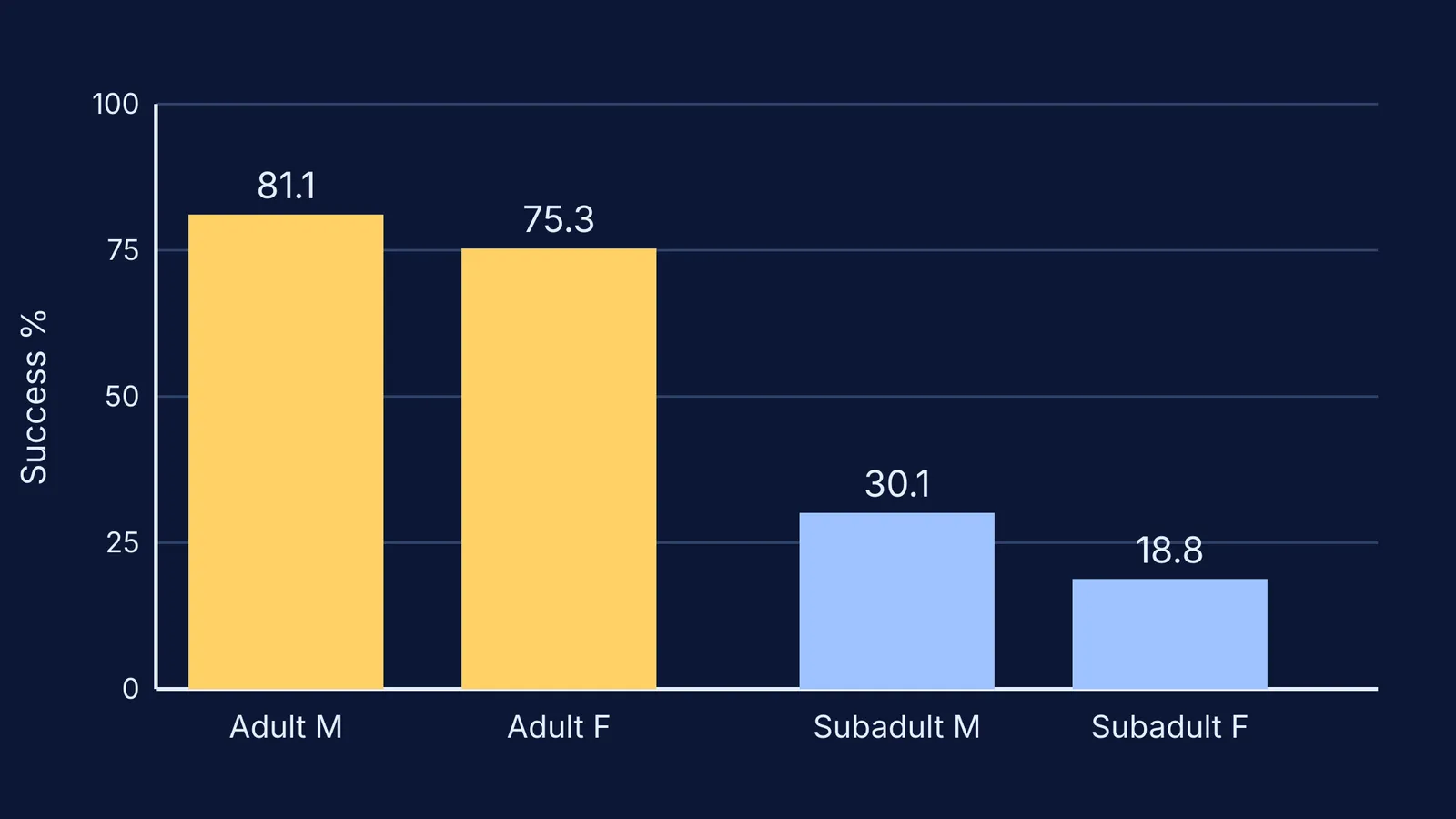
At a temple site in India, researchers recorded 2,704 attempts by bonnet macaques to put out offering lamps to reach the food inside. Adult males succeeded 81.1% of the time and adult females 75.3%, against 30.1% for subadult males and 18.8% for subadult females. The authors concluded that the skill develops slowly.
On Chamundi hill in Karnataka, a 2022 study in Frontiers in Psychology followed four macaque groups opening plastic bottles across 123 recorded events. The groups differed in technique: two used cap removal more, while the other two relied more on force. Juveniles were less successful. The authors credit maturation and trial and error, and argue the techniques probably spread socially rather than being invented many times over.
How can you tell if a behaviour is innate or learned?
Ask three questions, in this order.
The first-try question: does the animal do it correctly the first time, with no practice?
The no-model question: does it appear in an animal raised without ever seeing or hearing another of its kind do it?
The variation question: does it improve with age and practice, or differ between groups living in different places?
Yes, yes, no points to innate. No, no, yes points to learned. A mixed result means both.
Worked example: the three behaviours above
Spider web: first try works, isolation-reared spiders build it, only the details change with space. Innate, with flexible details.
Zebra finch song: needs a practice phase, isolated birds sing only a simple version, adults copy their tutor. Learned, built on an innate drive to sing.
Macaque bottle opening: young monkeys are less successful, no macaque could inherit a plastic-bottle trick, and groups use different methods. Learned, by trial and error and probably from each other.
In an exam, give the evidence with the label: innate because isolation-reared animals still do it; learned because it improves with age or varies between groups.
Practise the test on two more cases: how baya weavers build hanging nests, and Konrad Lorenz's imprinting experiments with young geese, where an inborn readiness meets learning about whom to follow.
If instinct, reflex, imprinting and conditioning start to blur together, the Fermi Concept Library gives each biology concept its own lesson and its place in the map, so you can see how they connect. If you are not sure where to start on the chapter, Fermi's AI tutor can work out what you already know and build a plan for the session.
Next time you see a balcony web or a monkey with a bottle, run the three questions.


