

On this page
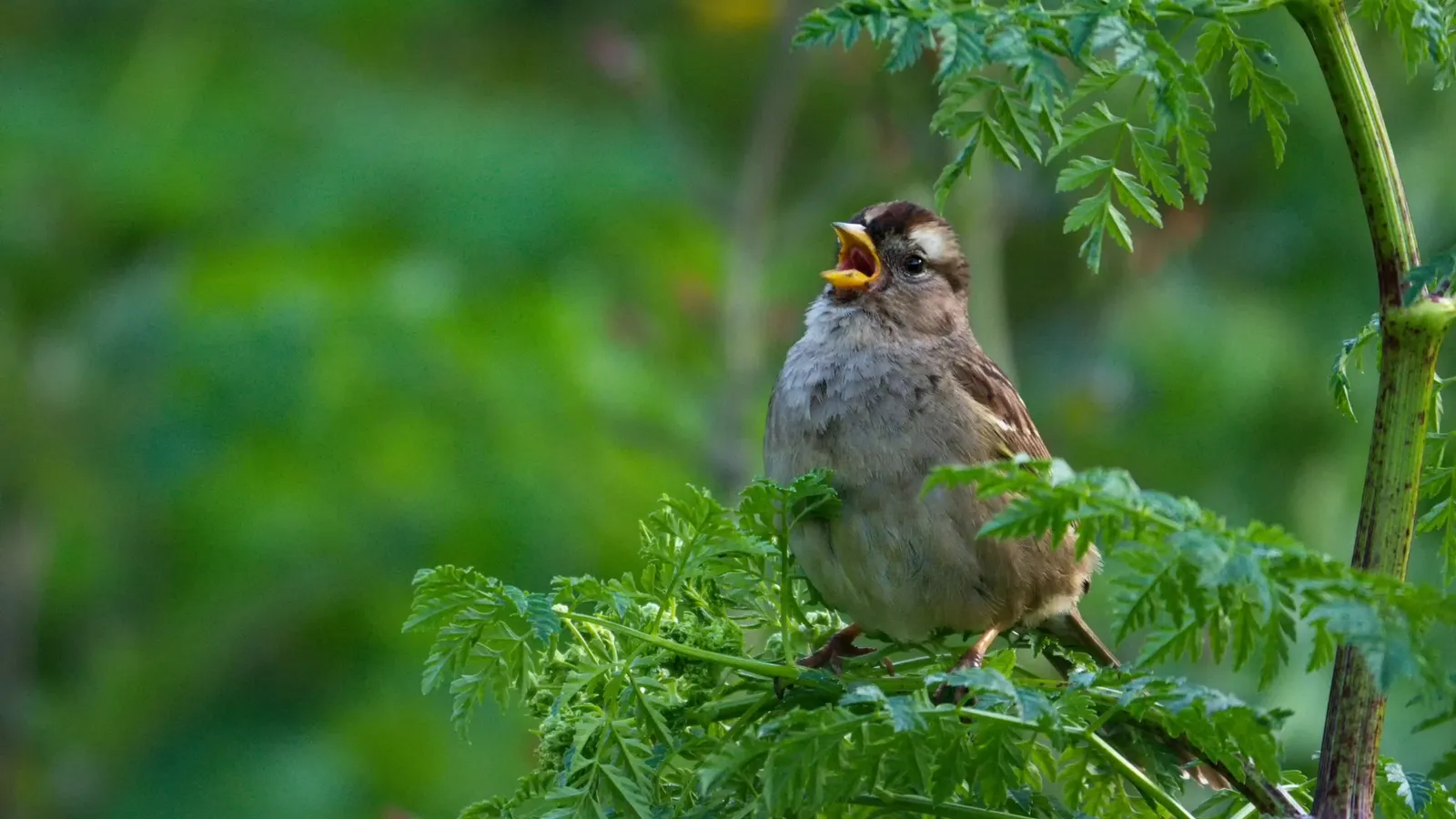
A sparrow is not born knowing its song. It hears adults, stores what it heard, and then spends weeks practising until its own voice matches. Scientists study it because it looks a lot like the way children learn to speak, and because it shows how a brain learns a skill through practice.
How do birds learn to sing?
They copy a tutor while they are young. In 1964, Peter Marler and Miwako Tamura reported in Science that male white-crowned sparrows have local song "dialects", acquired in about the first 100 days of life by learning from older males. In the laboratory, they could teach a young bird another region's dialect.
Two details matter. The song is learned early and then fixed; biologists call an early learning window like this a sensitive period. And the birds were choosy: they did not copy recorded songs of other sparrow species played under similar conditions.
A 2002 Nature review by M. S. Brainard and A. J. Doupe, What songbirds teach us about learning, sums up the parallel: like humans, birds must hear the sounds of adults during a sensitive period, and must hear their own voice while learning to vocalise. Listening to the tutor gives the bird a target. Listening to itself tells the bird how far off it is.
What does a young bird's practice sound like?
Messy at first. Ofer Tchernichovski and colleagues tracked young zebra finches over a 7-week period, from first exposure to a model song until they matched it (Science, 2001). The birds began by repeating structured sounds the authors called prototypes, then slowly moved to singing the syllables in sequence. Some sounds drifted further from the target before an abrupt correction brought them back.
Sleep plays a part too. In a 2005 Nature study, S. Derégnaucourt and colleagues found that, during periods of rapid learning, a young zebra finch's song lost much of its structure after a night's sleep and regained it after intense morning singing. The day's gain came late in that morning recovery. Birds whose song deteriorated more after sleep ended up with a better final copy, and the effect faded as the birds grew older.
How can a bird sing two notes at once?
Because it has two sound sources. A songbird's vocal organ, the syrinx, sits where the windpipe splits into the two bronchi. A review by T. Riede and F. Goller states that in songbirds sound is generated with two independently controlled sound sources in the syrinx (Brain and Language, 2010). Sound comes from a pair of thickened folds, called labia, on either side of the syrinx, and several pairs of muscles give independent control of pitch and loudness (Suthers and Zollinger, 2004).
In male canaries, experiments by R. S. Hartley and R. A. Suthers suggested that most syllables are sung by the left side alone, some by the right alone, and some by both sides together (Journal of Neurobiology, 1990). Because each side is controlled on its own, the two sides sounding together can produce two different sounds at the same moment. For how your own vocal folds set pitch, read why your voice changes at puberty; for the air sacs that power a bird's breathing, see why bird bones are hollow.
How two sound waves add into one is easier to see than to read; the Fermi Simulation Lab has interactive simulations for ideas like that.
What can students learn from how birds learn to sing?
Birds are not students, and these studies do not prove that a study method works for people. But the shape of song learning is a useful checklist for any skill you build by copying a model: a numerical method, a diagram, an essay structure, or a raag your music teacher sings first.
Tutor: start from a correct model, such as a full worked solution, before you try.
Try: attempt it yourself without looking.
Listen to yourself: compare with the model and mark the first place you differ.
Repeat in short daily rounds: expect rough first versions, like the finches' prototypes.
Sleep, then warm up: next morning, do one quick attempt first. If it is shakier than last night, do not read that as failure; keep practising and compare again.
A worked example: Riya, in Class 11, keeps losing marks on projectile problems. On day 1 she studies one solved problem, then tries a fresh one and compares: she mixes up horizontal and vertical components. On days 2 to 5 she does two problems each evening and one each morning, marking where she first drifts from the model. On day 6 she writes the method from memory, then checks it.
If you need a model to copy, the Fermi Problem Library has worked problems with a step-by-step solver that explains the reasoning rather than printing an answer. To spread your practice rounds over weeks rather than one night, see what Harry Bahrick learned about memory over 50 years.
Next time you hear a bird repeating a phrase that is not quite right, listen again tomorrow. It is practising, the same way you do.


