On this page
You have probably read the one-line version: birds have hollow bones and air sacs, so they are light enough to fly. NCERT's Class 11 chapter on the animal kingdom lists wings, feathers, long bones "hollow with air cavities (pneumatic)", "the crop and gizzard", a four-chambered heart, and air sacs that "supplement respiration" (NCERT Biology Class 11, Chapter 4), then asks which modifications help birds fly. Here is what each feature does, what research adds, and an answer frame you can reuse.
Why are bird bones hollow?
Bird bones are hollow because the breathing system grows into them. A 2025 review in Philosophical Transactions of the Royal Society B describes air-filled extensions of the lungs and air sacs invading the skeleton, a process that "replaces marrow and bone tissue" with air (Moore and Schachner, 2025). Among living four-limbed vertebrates, only birds have air from the respiratory system inside the bones behind the skull.
Not every bird keeps this. Penguins, auks, diving ducks and darters have lost some or all of it, a pattern the review links in most cases to feeding under water.
Are hollow bones really lighter?
Here the textbook needs a footnote. Elizabeth Dumont measured the mass and volume of the skull, humerus and femur in songbirds, rodents and bats, and found that on average these bones were densest in birds, followed closely by bats (Dumont, 2010, Proceedings of the Royal Society B). Denser bone tissue is stiffer and stronger. Her paper concludes that bird skeletons look thin and delicate yet "contribute just as much to total body mass" as the skeletons of land mammals.
The 2025 review agrees: it confirms that the skeletons of birds with air in their bones are not lighter for their body mass than those of birds without it (Moore and Schachner, 2025). So think strength and stiffness for each gram of bone, not a featherweight skeleton. For the bone structure behind this, see our explainer on compact bone versus spongy bone.
How do air sacs help birds breathe while flying?
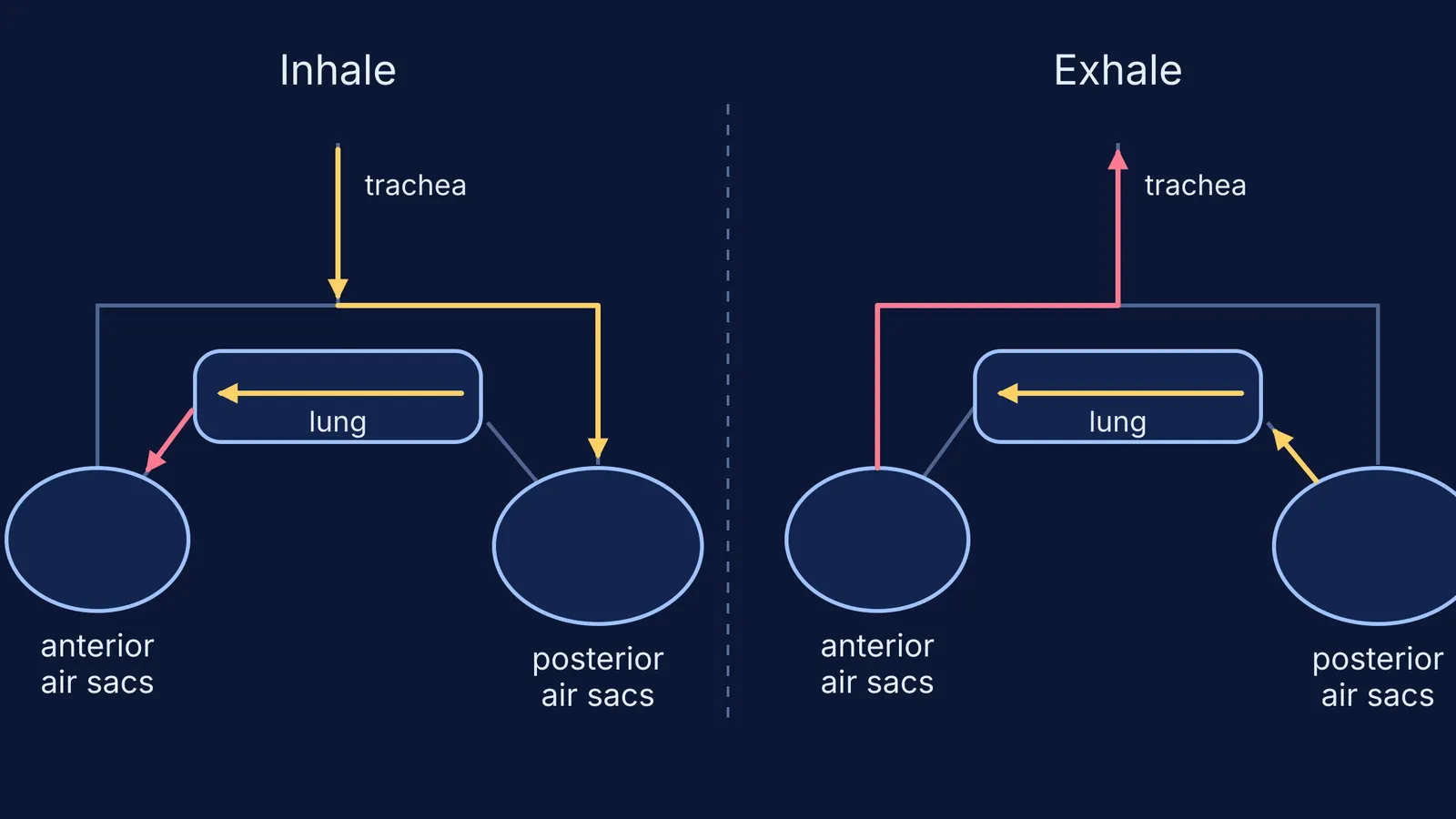
In a bird, the lung and the air sacs split the job. John Maina's review in the Journal of Ornithology describes the lung as the gas exchanger and the air sacs as the ventilators: their bellows-like movements push air through a near-rigid lung in one direction, from the tail end towards the head (Maina, 2015). The air sacs themselves are not directly involved in gas exchange.
One-way flow means air crosses the lung in the same direction on both the in-breath and the out-breath, as the diagram above shows.
One surprise: a review by Robert Cieri and C. G. Farmer notes that one-way airflow has also been found in crocodilians and some lizards, animals that do not fly, which undercuts the traditional idea that it evolved to meet the demands of flight (Cieri and Farmer, 2016).
What do the crop and gizzard do?
A chicken has no teeth, so the work of chewing moves down the gut. A University of Kentucky extension guide explains that the crop is an out-pocketing of the oesophagus where swallowed feed and water are stored until they pass on, and that the gizzard is the "mechanical stomach", two sets of strong muscles that act as the bird's teeth (Poultry Extension, avian digestive system). The crop lets a bird eat fast and digest later somewhere safer.
Many birds also swallow grit to help the gizzard grind. In an experiment with 68 male chicks, Ryuji Takasaki and Yoshitsugu Kobayashi found that chicks on a plant-based diet swallowed and kept more grit than other chicks (Takasaki and Kobayashi, 2020, PeerJ). Cows handle tough food differently; see how ruminant digestion and cud work.
How do you answer "modifications in birds that help them fly"?
Write each point in three parts: the feature, what it does, and how it helps flight.
Feathers and wings: forelimbs are modified into wings covered with feathers, which give a lifting surface.
Pneumatic bones: long bones are hollow with air cavities linked to the air sacs; research suggests the gain is stiffness and strength for each gram of bone rather than a lighter skeleton overall.
Air sacs: connected to the lungs, they keep air moving one way through the lung for a steady oxygen supply.
Four-chambered heart and warm blood: NCERT lists both; add them as supporting points after the main three.
Crop and gizzard: food is stored in the crop, then ground by the muscular gizzard, often with swallowed grit, so the bird can feed quickly without chewing.
Before a test, check that you can:
say where the air in a pneumatic bone comes from
trace one breath through posterior sacs, lung and anterior sacs
name one bird group that has lost pneumatic bones
say what the crop and the gizzard each do in one sentence
If any of these feel shaky, the Fermi Concept Library gives each biology concept its own lesson and its place in the map, so you can see how breathing, bones and digestion connect. For flight muscles and wing movement, read how earthworms, snails and birds move.