

On this page
An earthworm after rain, a snail on a wet wall and a crow taking off are three answers to one problem: how do you push against the world to move yourself? Each pushes on something (soil, a slimy surface, or air) and is pushed forward in return.
How does an earthworm move without legs or bones?
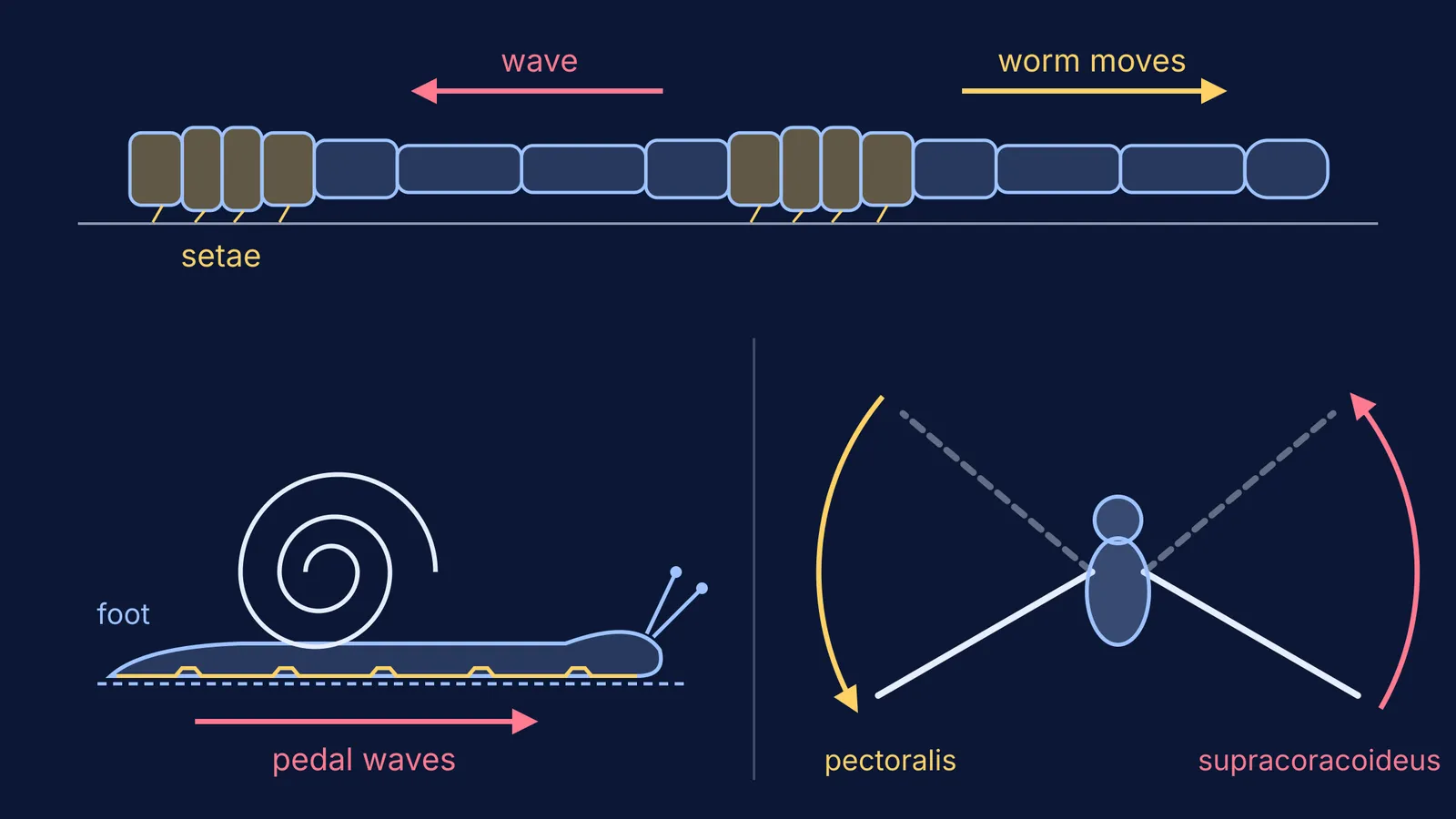
An earthworm has no bones; it has a hydrostatic skeleton, a fluid-filled body whose segments change shape instead of bending at joints, as Kim Quillin's study of the earthworm *Lumbricus terrestris* explains (Journal of Experimental Biology, 1999). Each segment has two muscle layers working as a pair.
Circular muscles wrap around each segment. Contracting, they make it thin and long, pushing the front forward.
Longitudinal muscles run along the body. Contracting, they make the segment short and fat.
Setae are tiny bristles on the skin. Fat segments press outward and the setae grip the soil or burrow wall, so the worm does not slip backward (Tirado and colleagues, Advanced Science, 2024).
The same paper calls this retrograde peristalsis; "retrograde" means the wave of fat and thin segments runs backward along the body while the worm moves forward. Quillin measured worms from 0.012 g to 8.5 g and found that they crawled faster mainly by taking longer strides (Quillin, 1999). To watch live worms choose between light and moisture, try our earthworm choice chamber experiment.
Worked example: why a fat segment gets short
The fluid inside a segment cannot be squashed, so its volume stays the same. Treat a segment as a cylinder: volume = π × r² × length.
Start with a segment of radius 2 mm and length 4 mm. Volume = π × 2² × 4 = 16π mm³.
The longitudinal muscles contract and the radius grows to 3 mm, 1.5 times wider.
Keep the volume at 16π mm³: length = 16π ÷ (π × 3²) = 16 ÷ 9 ≈ 1.8 mm.
A segment 1.5 times wider ends up about 2.25 times shorter, because the radius is squared. That is why anchored parts of a worm look short and fat, and parts reaching forward look long and thin.
How does a snail move on one foot?
A snail crawls on a single flat, muscular foot. Janice Lai and colleagues measured the forces under crawling snails and slugs on a smooth surface (Journal of Experimental Biology, 2010). They describe the movement as driven by a train of muscle contractions, called pedal waves, that travel from the tail to the head, with a thin layer of mucus passing the forces to the ground.
Their force maps fit a foot that lifts where each wave passes, with forward force produced under the still patches between waves. The mucus behaves a little like toothpaste: it holds like a solid until pushed hard enough, then flows. The team found this property, called yield stress, important for producing thrust.
How do birds fly using muscles and wings?
Andrew Biewener's review explains that bird flight muscles, especially in small birds, contract at high frequencies and do a lot of work to support the bird's weight and overcome drag (Philosophical Transactions of the Royal Society B, 2011). Two chest muscles do most of the job.
The pectoralis pulls the wing down. It is the largest muscle in the body of generalist birds and 3 to 5 times larger than the next largest wing muscle (Deetjen and colleagues, eLife, 2024).
The supracoracoideus controls the upstroke, raising the wing again.
Both muscles shorten by 33 to 42% of their resting fibre length during a wingbeat, so the wings sweep through a large arc (Biewener, 2011).
What about light, hollow bones? That is the usual exam answer, with a twist. Elizabeth Dumont compared skull, upper-arm and thigh bones of small perching birds, rodents and bats and found that, on average, the bird bones were the densest (Proceedings of the Royal Society B, 2010). She links weight saving to bone shape, and suggests denser tissue helps keep thin bones strong and stiff. Some birds also save energy by flying in a V formation.
How do you answer "how does this animal move?" in an exam?
Use three questions for any animal: what pushes, what grips, and what does it push against?
Earthworm: two muscle layers push; setae grip; soil.
Snail: waves in the muscular foot push; mucus holds and passes on the force; ground.
Bird: pectoralis and supracoracoideus flap the wings; air.
Then add one mechanism detail, such as the constant-volume rule or the downstroke muscle. A flapping wing is also periodic motion, covered in our guide to types of motion with Class 6 examples.
If a word like peristalsis is the sticking point, the Fermi Concept Library gives every biology concept its own lesson and its place in the map.


