

On this page
In Class 6 science, classifying how objects move is a foundational step in physics, alongside learning to record those distances (see Measurement of length and motion in Class 6: standard units). The NCERT Science textbook *Curiosity* defines motion as a change in position relative to a reference point [[1]](https://ncert.nic.in/textbook.php?fesc1=0-12). When you look closely at a child on a swing or a bicycle moving down the street, you start to see that a single object can have more than one type of motion at the same time. Learning to spot these patterns helps you understand the mechanical world.
What are the types of motion in Class 6?
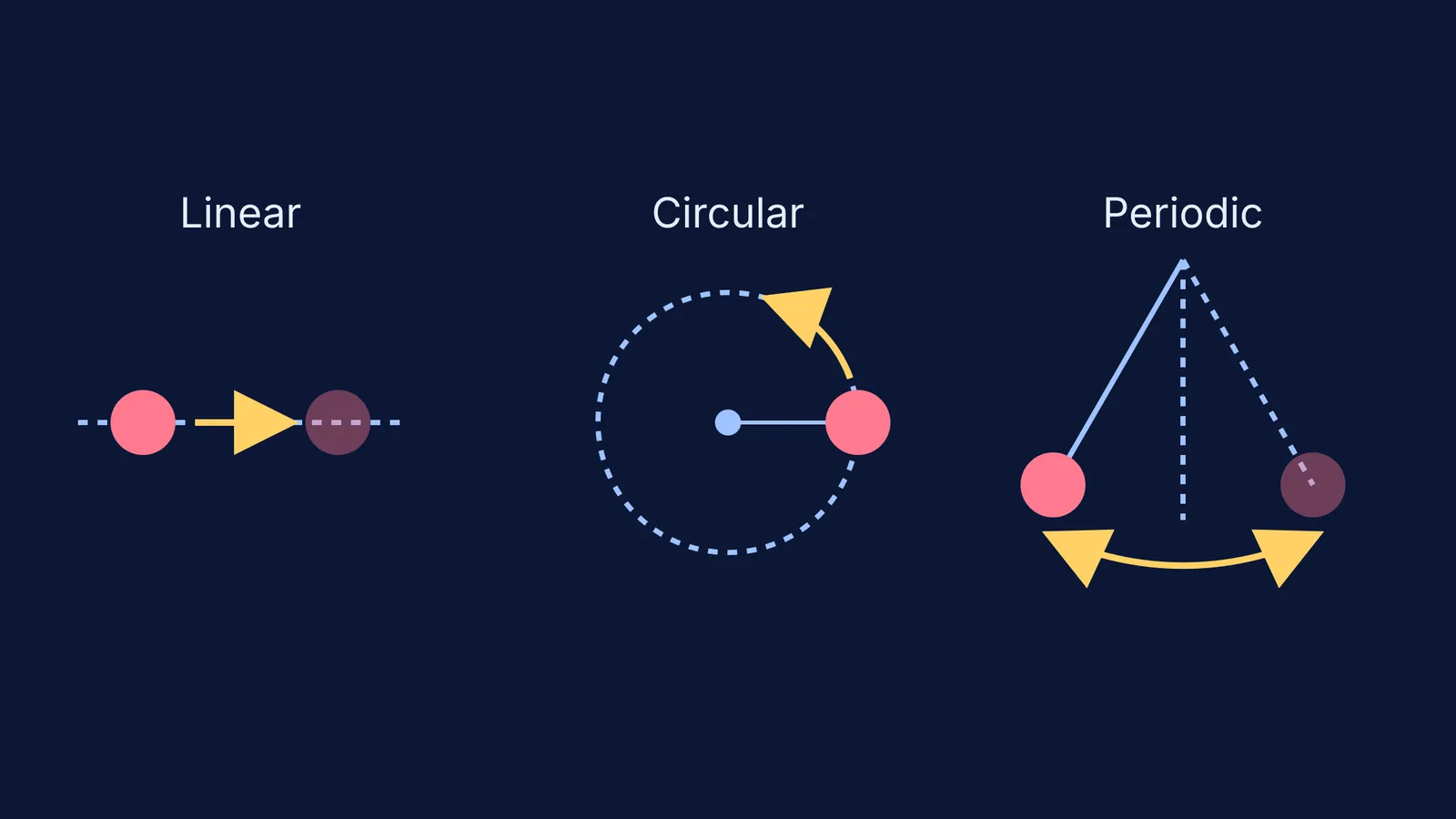
The syllabus sorts motion into three main paths. The way an object travels tells us its type:
Linear motion: The object moves in a straight line.
Circular motion: The object moves in a circle around a fixed centre.
Periodic motion: The motion repeats itself exactly after a fixed interval of time.
If you are unsure where a movement belongs or need a quick refresher before an exam, you can check the Fermi Concept Library, which covers the definitions of physics concepts like these.
What is an example of linear motion?
Linear motion (often called rectilinear motion) happens when an object travels along a straight path. A dropped stone falls straight down, making its motion linear. A sprinter running a 100-metre race on a straight track or a car driving along a straight highway are also classic examples of linear motion. As long as the direction does not bend or curve, the motion remains purely rectilinear.
What are examples of circular and periodic motion?
In circular motion, an object stays at the exact same distance from a fixed central point. Just as a compass needle pivots around its centre (a concept explored in Exploring magnets in Class 6: poles, compasses and attraction), the hands of an analogue clock or a point marked on the blade of a ceiling fan move in a circle.
Periodic motion, on the other hand, is defined by time rather than geometry. It repeats after a set time interval. Oscillatory motion is a special kind of periodic motion where an object moves to and fro about a resting position. A child on a swing moves back and forth, so the swing is both oscillatory and periodic. Other common examples of periodic motion include the pendulum of a wall clock, the plucked string of a guitar, and the vibrating membrane of a tabla when it is struck.
Can a body have more than one type of motion?
Yes, objects in the real world often combine different paths. A bicycle moving on a straight road has two types of motion at once. The bicycle itself moves forward in a straight line (rectilinear motion), while its wheels rotate around their axles (circular motion) [[1]](https://ncert.nic.in/textbook.php?fesc1=0-12).
Similarly, a sewing machine has a hand-cranked wheel that undergoes rotational motion, while the needle goes up and down in a straight, periodic motion. A ball rolling across the floor is both spinning in a circle and travelling in a straight line.
If you are stuck on sorting these out, Fermi's AI tutor teaches by asking you to look at one part of the system at a time. It holds a line of reasoning, perhaps asking you what the centre of the wheel is doing while the rim spins, to help you figure out the two motions yourself instead of just printing the answer.
How do you spot rotational versus circular motion?
Sometimes, the terms circular motion and rotational motion are used interchangeably in early science, but there is a subtle difference. When an object as a whole moves along a circular path (like a stone tied to a string being whirled around), it is in circular motion. When a body spins around an internal axis passing directly through it (like a spinning top or the Earth spinning on its axis), it is called rotational motion.
The Motion Sorting Checklist
To classify an object's motion, you can use this practical framework. Ask these three questions in order for each moving part:
Is it travelling along a straight line? If yes, it has linear (or rectilinear) motion.
Is it moving around a fixed centre? If yes, it has circular or rotational motion.
Does it repeat the exact same journey after a fixed time? If yes, it has periodic motion. (If it also goes back and forth, it is oscillatory).
By testing each component of a moving object against this list, you can easily spot when an object is doing more than one thing at once.


