

On this page
Watch a cow resting under a tree in the afternoon, and its jaws are almost always moving in a slow, rhythmic grind. Even with no fresh feed in front of it, the animal chews steadily. This is chewing the cud, or rumination.
Grass consists mostly of cellulose, a tough structural carbohydrate that vertebrate digestive enzymes cannot break down. Rather than spending hours grinding every stalk before swallowing, cattle swallow forage rapidly for storage. Once resting away from danger, they regurgitate that fibrous material to chew it a second time.
Why do cows chew even when they are not eating?
In open grasslands, ancestral herbivores faced predators with zero cover. Chewing every mouthful in the open invited attack. Ruminants evolved a "harvest now, chew later" strategy: animals cut grass rapidly with their lower incisors and dental pad, swallow it virtually unchewed, and retreat to safety.
Once resting, rumination begins. A review by Beauchemin (2018) shows lactating dairy cows spend roughly 7 hours daily ruminating (spanning 2.5 to 10.5 hours) alongside 4.5 hours eating, accumulating up to 16 hours of total chewing. Controlled trials record 508 to 560 minutes of daily rumination across lactation stages (Maekawa et al., 200274180-5)).
During rumination, a cow performs 50 to 60 chews per regurgitated bolus before reswallowing (Beauchemin, 2018), totaling 25,000 to over 40,000 daily jaw cycles. Regurgitation occurs when an extra contraction of the reticulum forces digesta against the esophageal sphincter. Inhaling against a closed glottis creates negative chest pressure, aspirating cud into the esophagus where antiperistalsis carries it to the mouth.
What are the four chambers of a cow's stomach?
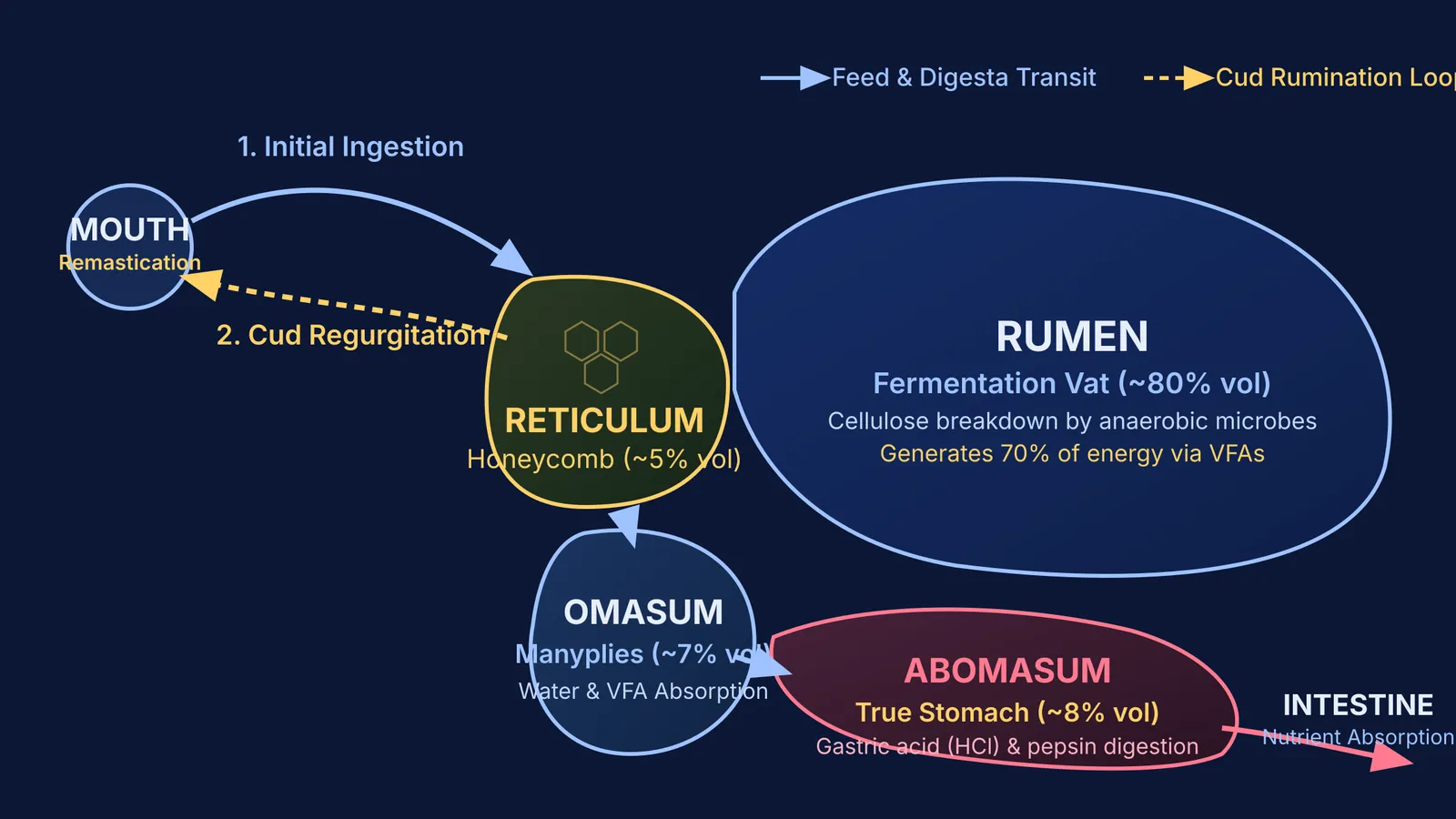
Unlike monogastric animals, cattle possess a four-chambered organ:
Rumen (paunch): The largest chamber, comprising roughly 80% of stomach volume and holding up to 180 litres in an adult cow (Liu et al., 2023). It serves as an anaerobic fermentation vat teeming with symbiotic bacteria, protozoa, and fungi.
Reticulum (honeycomb): Positioned at the front, its honeycomb wall traps heavy debris and coordinates contractions that trigger regurgitation.
Omasum (manyplies): Contains broad muscular leaves that absorb water, minerals, and residual fatty acids, preventing fluid from diluting gastric juices.
Abomasum ("true stomach"): The glandular compartment analogous to the human stomach, secreting hydrochloric acid and pepsinogen to digest microbial protein.
Our Class 7 guide to digestion and respiration in animals introduces these chambers to show how herbivores digest tough plants. This sequence contrasts with the acid-first digestion described in William Beaumont's pioneering observations on stomach digestion, because ruminants rely on microbial fermentation before gastric acid touches the feed.
How does rumination help microbes break down cellulose?
Cellulose consists of repeating D-glucose units linked by β-(1→4) glycosidic bonds. Cattle lack endogenous cellulase, relying instead on symbiotic rumen microbes like *Fibrobacter succinogenes* and *Ruminococcus flavefaciens*.
Rumination supports these microbes in three ways:
Exposing surface area: Chewing fractures plant cell walls and waxy cuticles, exposing entry points where bacteria build digestive biofilms (Beauchemin, 2018).
Supplying continuous alkaline buffer: Chewing stimulates salivary flow, producing 100 to 200 litres of saliva daily (Bailey, 1961; Erdman, 198879930-0)). Rich in sodium bicarbonate and phosphate, this saliva neutralizes fermentation acids to keep rumen pH above the critical acidosis threshold of 5.8 (Erdman, 198879930-0)).
Generating absorbable energy: Microbial fermentation converts sugars into volatile fatty acids—chiefly acetate, propionate, and butyrate. A review by Bergman (1990) showed that volatile fatty acids absorbed through the rumen wall provide roughly 70% of the animal's daily caloric energy.
Only particles ground down to 1 to 2 millimetres become dense enough to pass through the reticulo-omasal orifice into the omasum (Beauchemin, 2018).
How can students master ruminant digestion for exams?
In CBSE and NEET-UG examinations, questions test chamber sequence, microbial action, and evolutionary distinctions:
Verify the true stomach: The abomasum is the true stomach because its gastric glands secrete HCl and pepsin. The rumen, reticulum, and omasum are non-glandular forestomachs derived from esophageal tissue.
Remember methanogens: NCERT highlights that methanogenic archaebacteria (*Methanobacterium*) inhabit the rumen, converting fermentation byproducts into methane gas.
Distinguish pseudoruminants: Camels and llamas ruminate but lack an omasum, classifying them as pseudoruminants. Non-ruminant herbivores like horses digest cellulose in an enlarged caecum (hindgut fermentation) and cannot chew the cud.
When studying NCERT lines closely for NEET biology, tracing digesta flow prevents errors on sequence questions.
Visualizing multi-chamber organ flow can be difficult from flat sketches. The Fermi Simulation Lab provides interactive simulations for the ideas that are easier to see than to read. For structured study across animal physiology, the Fermi Concept Library covers every concept in physics, chemistry, biology, mathematics and computing, each with its own lesson and its place in the map. When working through complex biological systems, Fermi's AI tutor works out what you already know, builds a plan for the session, and teaches through it.


