

On this page
Somewhere around Class 7 or 8, many boys hear their voice crack in the middle of a sentence, and over the next few years it settles lower. Girls' voices change too, more quietly. Both come from physics you meet in the chapter on waves: a vibrating string sounds lower when it is longer or heavier.
What happens to the voice box at puberty?
Your voice starts at two vocal folds in the larynx, which open and close many times a second as air from the lungs pushes past them. For the full tour, read how your vocal cords make sound and what sets the pitch.
At birth, the vibrating part of each vocal fold is about 2 mm long in both boys and girls, according to the National Center for Voice and Speech (NCVS).
The same page says the folds then grow by about 0.7 mm a year in boys and 0.4 mm a year in girls, reaching about 16 mm in men and 10 mm in women. In boys, puberty also brings faster growth of the larynx and thicker vocal folds. Boys' voices often begin to change at 12 to 13 years of age and taper off between 15 and 18.
Why do longer vocal folds make a deeper voice?
Treat a vocal fold as a string clamped at both ends. In its lowest mode the wavelength is twice the string's length, and the wave speed is the square root of tension divided by mass per unit length, as HyperPhysics shows. Put together:
f = (1 / 2L) × √(T / μ)
Here f is the frequency, L the vibrating length, T the tension and μ the mass per unit length. Three ways to get a lower note follow:
Make the string longer: frequency falls as 1/L.
Make it heavier (bigger μ): frequency falls as 1/√μ.
Loosen it (smaller T): frequency falls with √T.
Puberty works mainly on the first two. You can hear both on a guitar, sitar or veena: pressing a string at a fret shortens it and raises the note, and the thicker strings play lower.
Worked example: does length alone explain it?
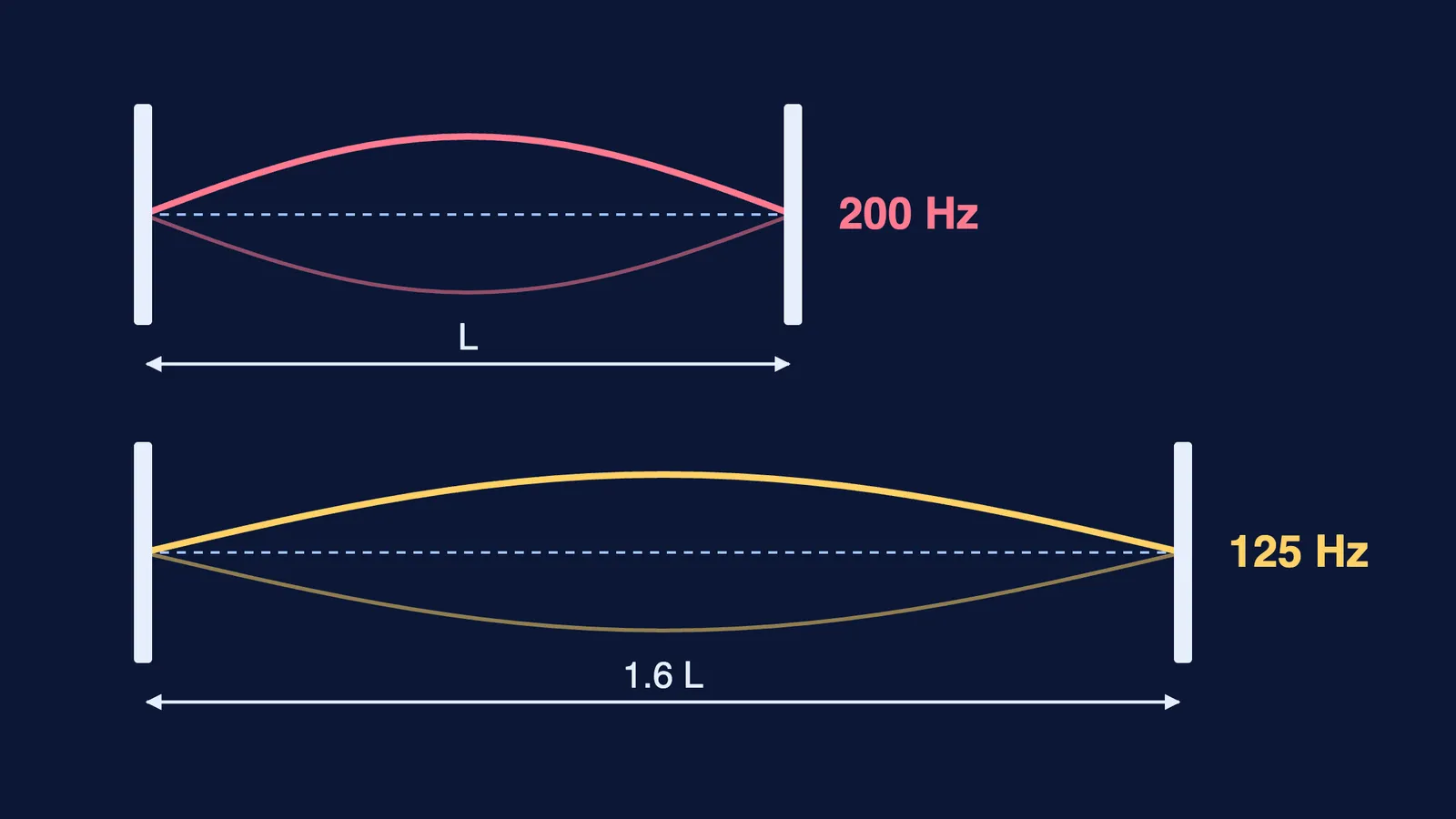
The NCVS puts adult women's average speaking pitch at around 200 Hz and adult men's at around 125 Hz.
Assume T and μ are the same for both, so frequency depends only on 1/L. Then f(men) / f(women) = L(women) / L(men).
Put in the adult lengths: 10 mm / 16 mm = 0.625.
Predict: 200 Hz × 0.625 = 125 Hz.
The prediction lands on the measured average. NCVS reaches the same conclusion: men's effective vocal fold length is about 60% longer than women's, and that fully accounts for the difference in pitch. Both numbers are averages, though, and the simple model hides changes in thickness. On a keyboard, a frequency ratio of 1.6 is about eight semitones, since 12 × log₂(1.6) ≈ 8.1.
Why does the voice break suddenly instead of sliding down?
If growth in length did all the work, the voice would slide down smoothly. It doesn't. Researchers in Brighton, UK, followed 26 boys through puberty and found abrupt voice changes between Tanner stages 3 and 4, late in puberty (Harries and colleagues, Archives of Disease in Childhood, 1997).
In a second study, the team measured the folds of boys at different stages of puberty with ultrasound. Length increased gradually, but the sudden drop in pitch between stages 3 and 4 did not match a jump in length; images of the vibrating folds suggested a change in their structure and mass at that point (Harries and colleagues, Journal of Laryngology and Otology, 1998). In string terms, L creeps up steadily while μ seems to change quickly, so much of the fall in pitch is packed into a short window.
What helps while your voice is changing?
A short plan for students:
Expect it. NCVS notes that girls can also notice breathiness, occasional cracking and a lower average speaking pitch.
Don't force old notes. If you sing in a choir or school band, tell your music teacher so your part can move with your range.
Give a tired voice a break after shouting at a match or a long day of talking.
See a doctor, such as an ENT specialist, if hoarseness doesn't go away, speaking hurts, or anything about your voice worries you.
For parents, one way to put it: “Your voice is getting deeper because your vocal folds are growing, the same way a longer, thicker string plays a lower note. The cracks are temporary.” For the wider conversation, see how to talk to your child about puberty using NCERT.
Standing waves on a string also sit behind forced vibration and resonance.The Fermi Simulation Lab has interactive simulations for ideas that are easier to see than to read. If waves still feel shaky before a test, Fermi's AI tutor can work out what you already know and build a plan for the session.
Next time you hear a voice break, think of 1/2L and a heavier μ.


