

On this page
Suppose a NEET option says "calcareous" and you tick it quickly. You may have just lost a mark. The word fits a snail's shell, a coral and a starfish. Only one of them keeps its hard parts inside the body, and that difference is what the question is testing.
Which invertebrate has an endoskeleton?
The answer is the echinoderms. That means starfish (*Asterias*), sea urchin (*Echinus*), sea lily (*Antedon*), sea cucumber (*Cucumaria*) and brittle star (*Ophiura*), the examples in the NCERT Class 11 Biology chapter on Animal Kingdom.
NCERT says: "These animals have an endoskeleton of calcareous ossicles and, hence, the name Echinodermata", which means spiny bodied (NCERT, section 4.2.9).
An ossicle is a small, hard plate. Calcareous means it is made of calcium carbonate. The same NCERT page lists the other features you will need alongside this one. All echinoderms are marine. Adults are radially symmetrical but larvae are bilaterally symmetrical. Their most distinctive feature is the water vascular system. Our explainer on how the echinoderm water vascular system powers tube feet covers that part.
Why is a starfish skeleton called an endoskeleton?
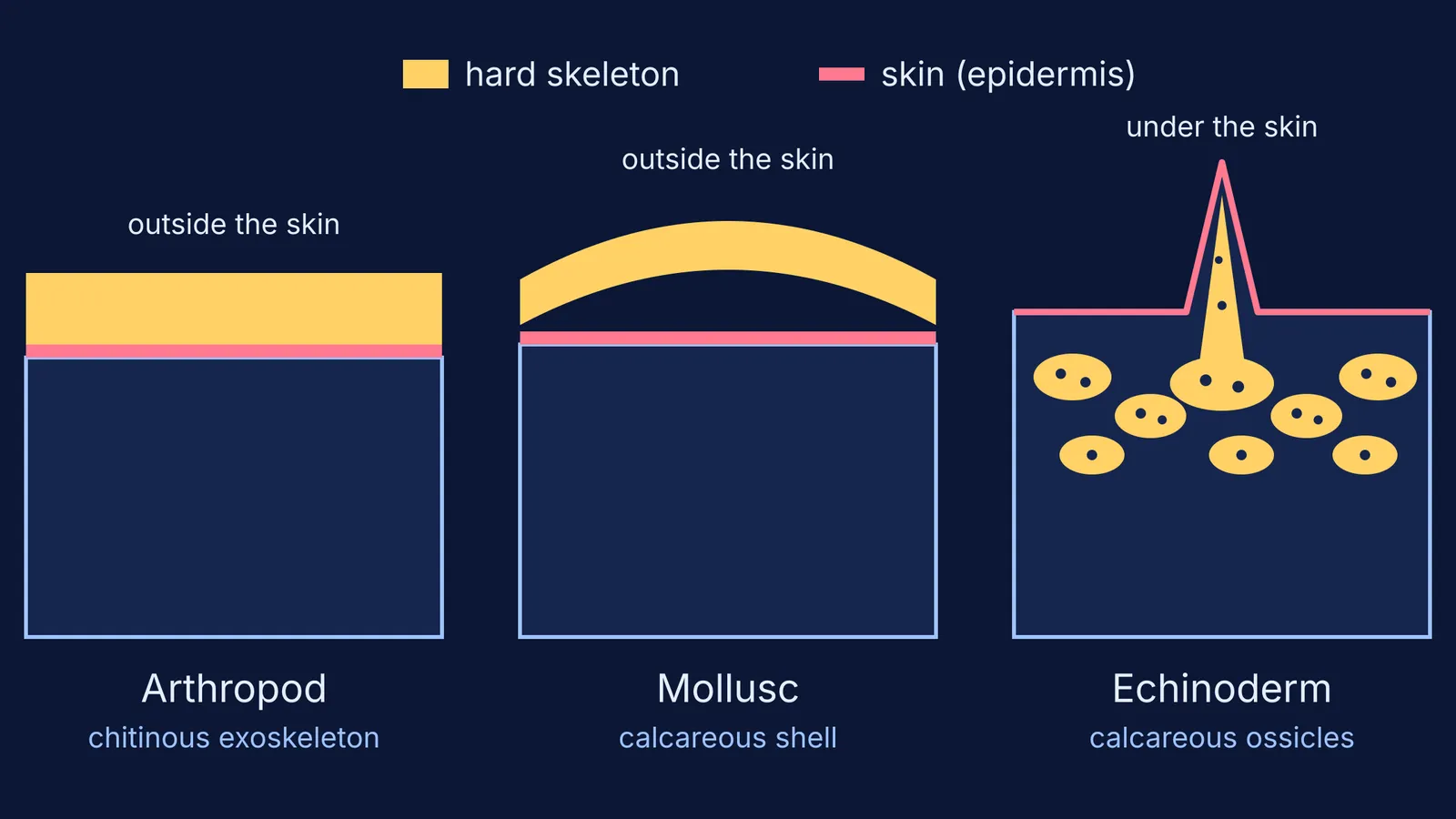
It is about position, not material. The OpenStax Biology 2e textbook says echinoderm ossicles are "covered by the epidermis", so "it is an endoskeleton like our own, not an exoskeleton like that of arthropods." That is why the skeleton counts as internal, even though it sits just under the surface.
The chemistry is different from ours. A review by P.U.P.A. Gilbert and Fred Wilt says echinoderms have a rigid endoskeleton made of calcite with small amounts of organic matrix proteins, while the vertebrate endoskeleton uses calcium phosphate (Gilbert and Wilt, 2011). The same review notes that echinoderms and hemichordates are the closest relatives of the chordates.
Each ossicle has a distinctive microstructure called stereom (Digital Atlas of Ancient Life, Paleontological Research Institution). An X-ray tomography study of the sea urchin *Cidaris rugosa* describes stereom as consisting primarily of magnesium-calcite, often built as sponge-like mesh-works rather than solid blocks (Jessop et al., 2024, Journal of the Royal Society Interface).
What do other invertebrates have instead?
Here is how the NCERT chapter describes the hard parts of each invertebrate phylum that has them:
Porifera (sponges): a skeleton made up of spicules or spongin fibres.
Coelenterata (Cnidaria): some, such as corals, have a skeleton of calcium carbonate.
Arthropoda: the body is covered by a chitinous exoskeleton.
Mollusca: the body is covered by a calcareous shell.
Echinodermata: an endoskeleton of calcareous ossicles.
NCERT's descriptions of flatworms, roundworms and annelids mention no skeleton at all. Of the invertebrate phyla in the chapter, Echinodermata is the only one it says has an endoskeleton. For a wider view, see our post on vertebrates vs invertebrates and their skeletons.
How does NEET word the echinoderm trap?
The trap usually swaps either the material or the position. Here are four NEET-style items built from the NCERT text, with the reasoning.
Statement: "Molluscs have an endoskeleton of calcareous ossicles." False. The material word fits, but NCERT says the mollusc body is *covered by* a calcareous shell. That is outside, not inside.
Match the list: chitinous exoskeleton goes with Arthropoda, calcareous shell with Mollusca, calcareous ossicles with Echinodermata, and spicules or spongin fibres with Porifera. If two options differ only in the Mollusca and Echinodermata rows, check position first.
Assertion-reason: A, "A starfish is an invertebrate with an endoskeleton." R, "Echinoderms possess a notochord." A is true and R is false. NCERT's Table 4.1 lists the notochord as absent in non-chordates, and echinoderms are non-chordates. An endoskeleton does not make an animal a chordate.
Odd one out: *Pila*, *Pinctada*, *Asterias*, *Sepia*. The answer is *Asterias*. The other three are molluscs in NCERT's list, and only the starfish has calcareous ossicles.
If the name "starfish" keeps pulling you towards fish, read why a starfish is not a fish.
A 20-second check before you mark the option
Circle the position words: endoskeleton, exoskeleton, "covered by".
Circle the material words: calcareous, chitinous, spicules, spongin.
Match the pair to a phylum using the list above.
Read the reason or second statement separately. A true fact about echinoderms can sit next to a false one.
If you get these items right on paper but miss them in a mock, the gap may be in the concept rather than your memory. The Fermi Concept Library covers every concept in physics, chemistry, biology, mathematics and computing, each with its own lesson and its place in the map. For practice, the Fermi Problem Library has worked problems with a step-by-step solver that explains the reasoning rather than printing an answer.


