

On this page
A question that asks you to match an insect to its mouthparts is really asking: what does this insect eat, and in what form? Every structural fact below comes from the mouthparts page of NC State University's General Entomology course (ENT 425) unless another link is given.
What are the basic parts of an insect's mouth?
Chewing (mandibulate) insects have five basic mouthparts: a labrum (upper lip), a pair of mandibles, a pair of maxillae, a hypopharynx and a labium (lower lip), according to NC State's ENT 425 course.
The same course says the sucking types are built from these five blocks too, reshaped for liquid food, though most butterflies and moths have lost the labrum and mandibles.
What are the types of mouthparts in insects, with examples?
Biting and chewing: cockroach. The cockroach's mandibles have toothed inner surfaces for grinding or crushing food, its maxillae carry sensory palps for tasting, and its labium carries a second pair of sensory palps (NC State ENT 425). That kit suits a diet the same course calls opportunistic: decaying matter, plant material, organic wastes and even dead insects. For each cockroach part in turn, see our cockroach mouthparts guide with a mnemonic.
Piercing and sucking: mosquito. In a female mosquito, the labium is a sheath around six slender stylets: two mandibles, two maxillae, the labrum and the hypopharynx (NC State ENT 425). During feeding the labium pulls back and all six stylets enter the host. Saliva goes down a canal inside the hollow hypopharynx, and blood comes up a food canal in a groove on the back of the labrum. Only females feed on blood; males have similar mouthparts but feed only on nectar.
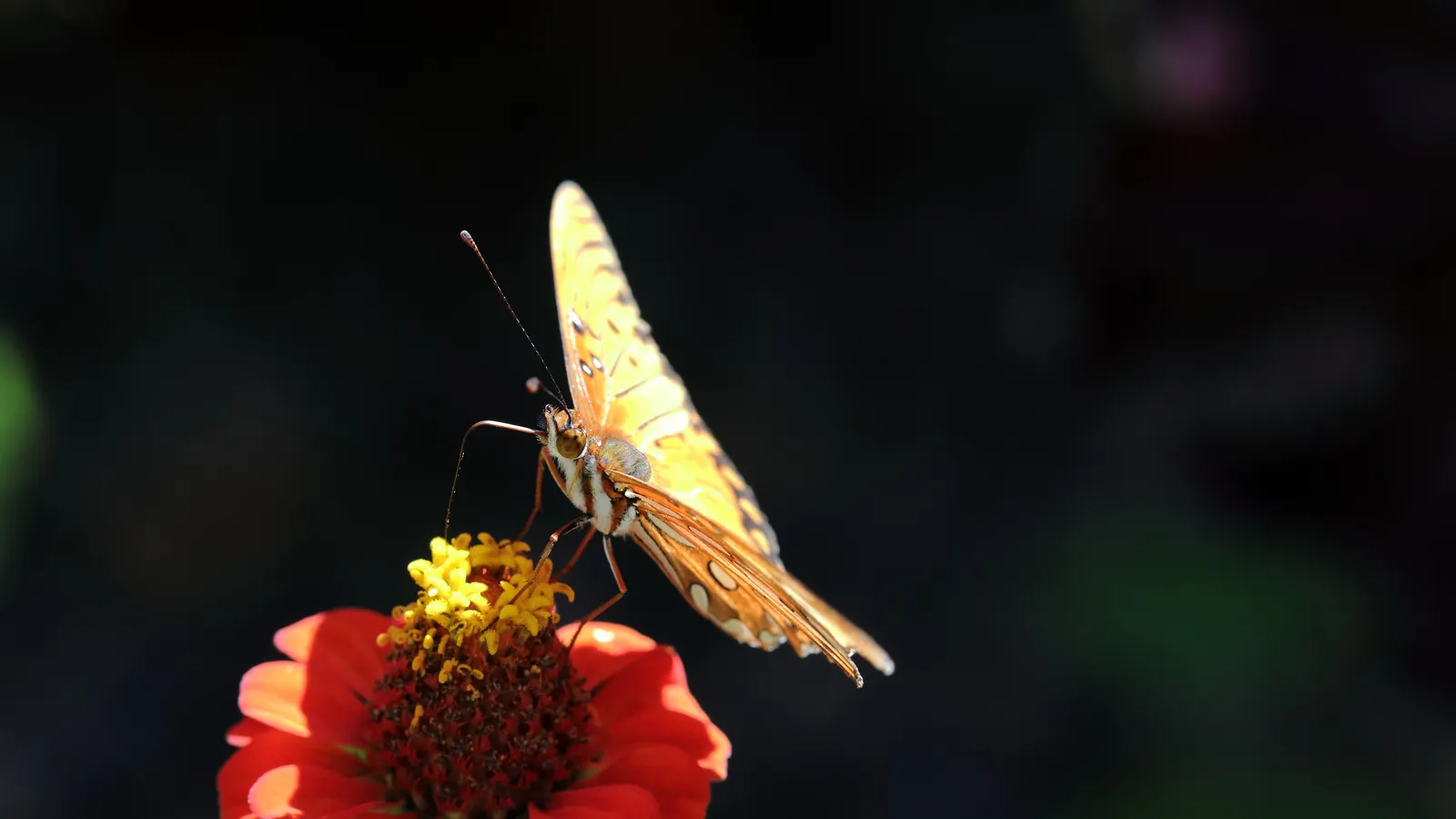
Siphoning: butterfly. A butterfly's proboscis is formed by the two galeae of the maxillae, which interlock around a central food canal (NC State ENT 425). At rest it stays coiled under the head, and it uncoils by hydrostatic pressure when the insect feeds.
Siphoning is more than a drinking straw. A 2011 study by Monaenkova and colleagues in the Journal of the Royal Society Interface found that the proboscis also pulls liquid in by capillary action through pores spanning nano and micro scales, and a sucking pump in the head moves it to the gut. The authors link this design to butterflies drinking from rotting fruit and wet soil, not just flowers.
Chewing and lapping: honeybee. The honeybee keeps both tool sets. Its mandibles gather pollen, handle wax and groom, while its maxillae and labium interlock into a hinged proboscis that extends to lap up nectar (NC State ENT 425). The tongue-like centre of that proboscis comes from the fused glossae of the labium.
How do you match mouthparts to diet in an exam?
Ask three questions:
Is the food solid or liquid? Solid food means the mandibles do the work: biting-chewing, or chewing-lapping if nectar is also on the menu.
If liquid, where is it? Liquid hidden inside a host needs stylets (piercing-sucking). Nectar deep in a flower needs a long coiled tube (siphoning). Liquid lying on a surface is soaked up, as house flies and blow flies do with the grooved lobes (labellae) at the tip of the labium (NC State ENT 425).
Which basic part was reshaped? Mosquito: the labrum, mandibles, maxillae and hypopharynx become six stylets inside a sheath made by the labium. Butterfly: the maxillae. Honeybee: maxillae plus labium, with the mandibles kept.
Can you match these insects to their mouthparts?
Match each insect (A) with its mouthpart type (B) and food (C).
Column A (insect)
A. Cockroach
B. Female mosquito
C. Butterfly
D. Honeybee
E. Blow fly
Column B (mouthpart type)
P. Sponging-lapping
Q. Chewing-lapping
R. Biting-chewing
S. Siphoning
T. Piercing-sucking
Column C (food)
i. Nectar, drawn up through a coiled tube
ii. Blood from a host
iii. Liquid food soaked up from surfaces
iv. Mixed food, including decaying matter and organic waste
v. Nectar lapped up, with the mandibles handling pollen and wax
Answers: A-R-iv, B-T-ii, C-S-i, D-Q-v, E-P-iii.
Three traps to check before you submit:
A male mosquito has similar mouthparts to the female, but it feeds only on nectar, never blood.
The butterfly proboscis comes from the maxillae, not the labium. The centre of the honeybee proboscis comes from the labium.
The honeybee keeps working mandibles, so lapping only is the wrong answer.
Is this topic in the current NCERT syllabus?
The current NCERT Class 11 chapter Structural Organisation in Animals (2026-27 reprint) covers organs and the frog only, with no cockroach section, so check your own board or exam syllabus before deciding how much insect detail to learn. For more practice from the same chapter, try our structural organisation in animals practice questions.
If a term such as labium or galea keeps slipping, the Fermi Concept Library gives every biology concept its own lesson and its place in the map. When a matching question goes wrong and you cannot see why, the Fermi Problem Library has worked problems with a step-by-step solver that explains the reasoning rather than printing an answer.


