On this page
If you have ever written “labium = upper lip” in a test and lost the mark, you are in good company: the two words differ by one letter. This guide goes front to back through the cockroach’s biting-chewing mouthparts, says what each one does while the insect eats, and ends with a two-line mnemonic and a three-minute self-test.
One note before you start. The current NCERT Class 11 chapter on structural organisation in animals (Reprint 2026-27) describes only the frog, so check whether your school or exam syllabus still includes the cockroach before you spend hours on it.
What are the mouthparts of a cockroach?
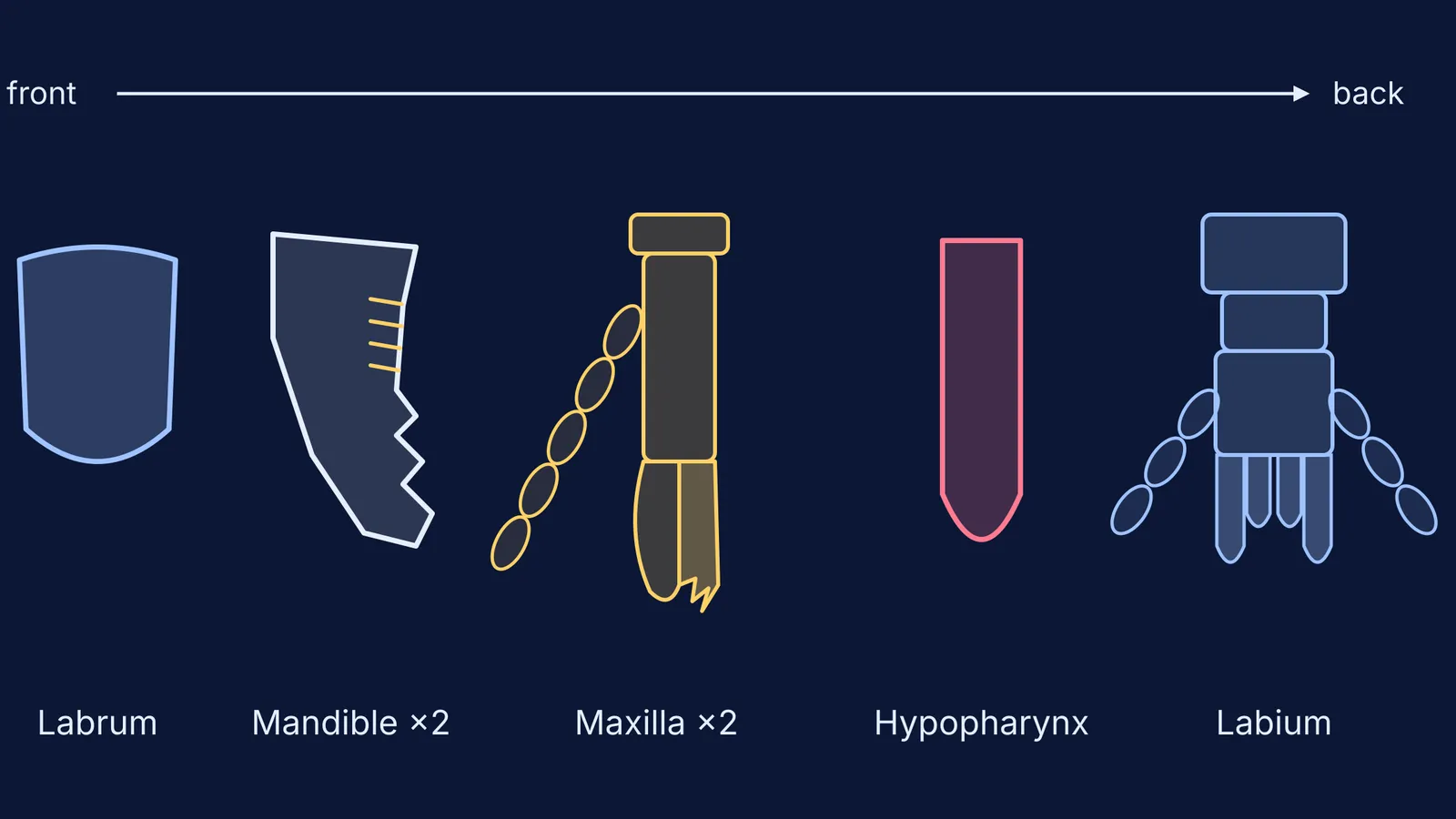
A cockroach has five kinds of mouthparts, listed here from front to back. The American cockroach, Periplaneta americana, has “typical orthopteroid mouthparts”, with 5-segmented maxillary palps and 3-segmented labial palps, according to a 2016 study of its head anatomy by Wipfler and colleagues.
Labrum: a single flap at the front that works as the upper lip.
Mandibles: one pair of hard, toothed jaws.
Maxillae: one pair of smaller jaws, each with a long feeler called a palp.
Hypopharynx: a tongue-like lobe on the floor of the mouth.
Labium: a single plate at the back that works as the lower lip.
The labium “represents the fused pair of ancestral second maxillae”, according to the Amateur Entomologists’ Society, which helps explain why it carries palps, as a maxilla does.
What does each mouthpart do while the cockroach eats?
Follow one crumb of chapati into the mouth and every part has a job.
The labrum holds the food in front. North Carolina State University’s entomology notes describe it as “a simple plate-like sclerite that serves as a front lip to help contain the food” (NC State, Bug Bytes).
The mandibles cut and crush. They move from side to side, not up and down, and in cockroaches they have “toothed inner surfaces for grinding or crushing food” (NC State, Bug Bytes). A 2015 PLOS ONE study measured a maximum bite force of 0.36 N in the American cockroach, at a mandible opening angle of about 61 degrees. The same paper found the grinding (molar) region small compared with plant-eating insects, and the authors suggest the cockroach mostly takes in small particles and soft food.
The maxillae hold, steer and taste. Their two tip lobes, the galea and the lacinia, “act as fork and spoon to manipulate the food” (NC State, Bug Bytes). The palps sense the food: the same notes say the five-segmented maxillary palps and three-segmented labial palps of a grasshopper, which match the cockroach’s, “serve primarily as touch and taste receptors”. X-ray video of feeding cockroaches showed the maxillae moving in antiphase with the mandibles, and each opening-and-closing cycle took about 450 to 500 milliseconds on average (Schmitt, Rack and Betz, 2014).
The hypopharynx brings in saliva. It is “a tongue-like structure in the floor of the mouth”, and “the salivary glands discharge saliva through it” (Amateur Entomologists’ Society).
The labium closes the mouth from behind. It is the lower lip, and its palps also sense the food. In the same X-ray study, the labium made regular forward-and-back movements during feeding (Schmitt, Rack and Betz, 2014).
How do you remember labrum vs labium?
Use one hook for each word:
labRum: R for Roof. The labrum is the upper lip, the roof at the front of the mouth.
labIUM ends like podIUM. A podium is what you stand on, at the bottom, and the labium is the lower lip.
Then fix the order with one sentence that follows a meal: lips open, mandibles bite, maxillae hold, hypopharynx wets, lips close. The R word opens the list and the IUM word closes it.
Hooks tied to a meaning (a roof, a podium) tend to hold better than a random string of letters. For more on building them, read our piece on mnemonics that work, from the method of loci to the keyword method.
How can you test yourself in three minutes?
Cover the answers in brackets and say each one aloud:
Which mouthpart is the upper lip? (Labrum)
Which part bites, and which way does it move? (Mandibles, side to side)
Name the two tip lobes of the maxilla. (Galea and lacinia)
How many segments are in the maxillary palp, and in the labial palp? (5 and 3)
Which part delivers saliva? (Hypopharynx)
Which part comes from fused second maxillae? (Labium)
Which parts are paired? (Mandibles and maxillae)
For any miss, draw and label the five parts from memory, front to back. If the gap is a word rather than a fact, such as what a palp or a sclerite is, the Fermi Concept Library gives every biology concept its own lesson and its place in the map. If you would rather be asked than read, Fermi’s AI tutor works out what you already know and checks understanding as it goes.
For the rest of the cockroach, see the cockroach organ numbers that NCERT questions ask about and how its exoskeleton and jointed legs let it move.