On this page
Jellyfish and comb jellies look alike in a photo and in a textbook sketch, and exam questions use that. The NCERT Class 11 Biology chapter on Animal Kingdom places Coelenterata (Cnidaria) and Ctenophora side by side: both are radially symmetrical, diploblastic animals with tissue-level organisation. The real differences come down to how they catch food, what body forms they take, and how they reproduce.
How do cnidoblasts differ from colloblasts?
Cnidoblasts sting. NCERT says the name cnidaria comes from cnidoblasts or cnidocytes, cells on the tentacles and body that contain stinging capsules called nematocysts (NCERT, Animal Kingdom). Cnidarians use them for anchorage, defence and catching prey.
Colloblasts stick. Comb jellies have no stinging cells of their own. A 2018 study in Molecular Biology and Evolution by Leslie Babonis and colleagues says ctenophores are unified by a novel cell type, the colloblast, "an adhesive cell found only in the tentacles" (Babonis et al., 2018). The team found no evidence that colloblasts and cnidocytes share an origin and suggested that the two cell types arose independently in each lineage.
To remember it: a cnidoblast fires a harpoon, a colloblast is a dab of glue.
Source for that exception: the Animal Diversity Web entry on Ctenophora.
Do ctenophores have polyp and medusa forms?
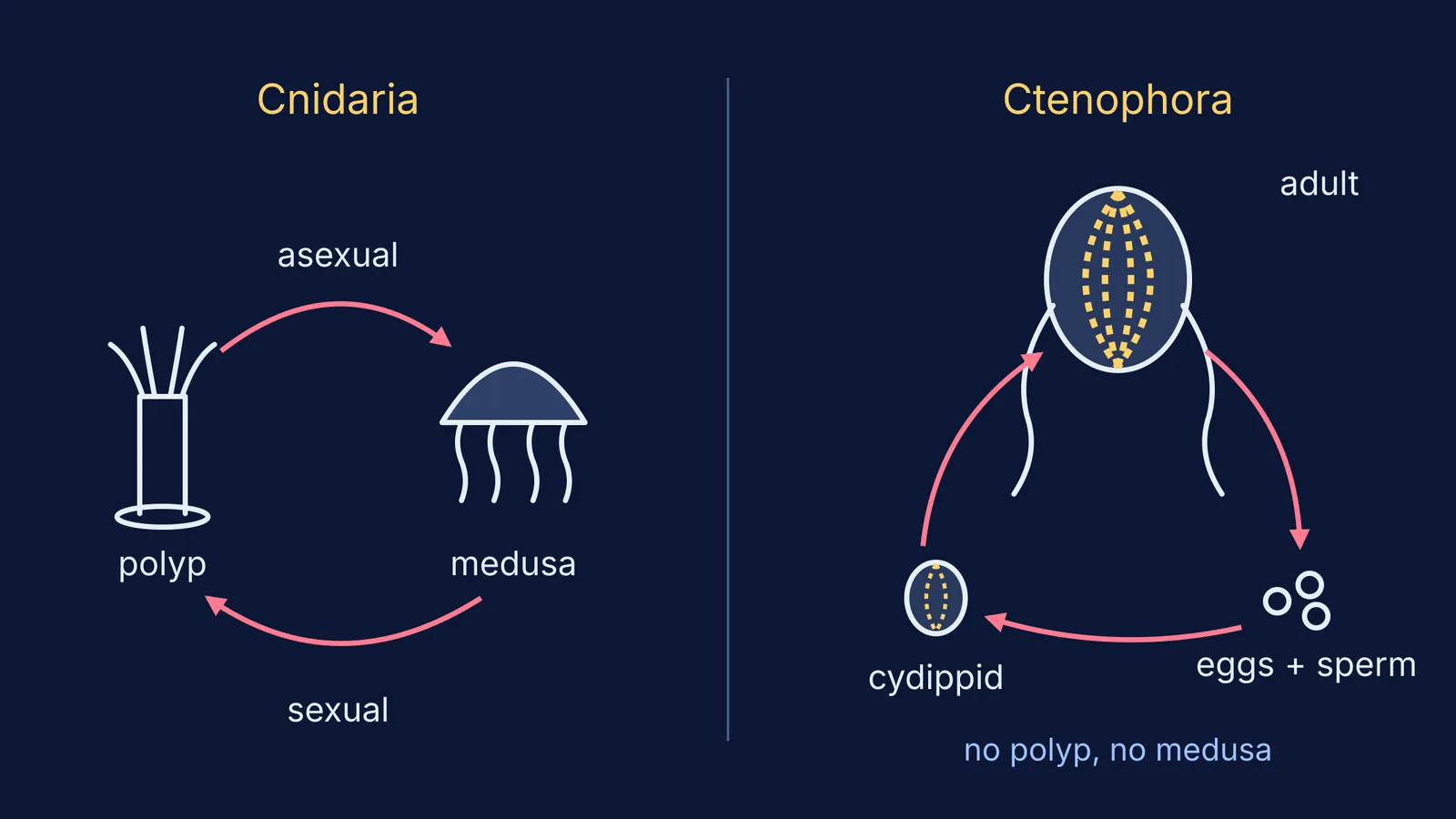
No, and this is the second big difference. According to NCERT, cnidarians show two basic body forms. The polyp is sessile and cylindrical, like Hydra and Adamsia. The medusa is umbrella-shaped and free-swimming, like Aurelia. Cnidarians that exist in both forms show alternation of generations (metagenesis): polyps produce medusae asexually, and medusae form polyps sexually, as in Obelia.
NCERT's description of Ctenophora lists neither form. Instead, the body bears eight external rows of ciliated comb plates that help in locomotion, and bioluminescence is well marked. The Animal Diversity Web says fertilised eggs of most species grow into ciliated cydippids, which gradually reach adult size and shape. There is no polyp stage and no medusa stage.
How do cnidarians and ctenophores reproduce?
Cnidarians with both body forms use both kinds of reproduction in one life cycle: asexual in the polyp, sexual in the medusa (NCERT).
For ctenophores, NCERT says sexes are not separate, reproduction takes place only by sexual means, and fertilisation is external with indirect development. A 2016 PeerJ paper by Daniel Sasson and Joseph Ryan reports that the sea walnut Mnemiopsis leidyi, like most ctenophores, is a simultaneous hermaphrodite that can self-fertilise, and typically develops into a juvenile cydippid within 24 hours of fertilisation at 18 to 20 °C (Sasson and Ryan, 2016).
That study is Edgar, Ponciano and Martindale, 2022. The Animal Diversity Web also notes that members of the order Platyctenida can reproduce asexually from small fragments, and that most, not all, ctenophores are simultaneous hermaphrodites: the genus Ocyropsis has separate sexes. "Only sexual" and "sexes not separate" are textbook rules with exceptions.
Cnidaria vs Ctenophora: a compact comparison
Each row comes from the NCERT chapter unless marked.
Prey capture: Cnidaria use cnidoblasts with stinging nematocysts; Ctenophora use adhesive colloblasts (Babonis et al., 2018)
Body forms: Cnidaria have polyp and/or medusa; Ctenophora have neither
Movement: medusae swim and polyps are mostly sessile; ctenophores swim with eight rows of comb plates
Reproduction: Cnidaria are asexual and sexual, with metagenesis in Obelia; Ctenophora are sexual only, hermaphrodite, with external fertilisation
Habitat: Cnidaria are aquatic and mostly marine; Ctenophora are exclusively marine
Special feature: some cnidarians, such as corals, have a calcium carbonate skeleton; ctenophores show well-marked bioluminescence
Examples: Physalia, Adamsia, Aurelia, Obelia, Meandrina; Pleurobrachia and Ctenoplana
Shared: radial symmetry, diploblastic, tissue level, extracellular and intracellular digestion
How do you answer a difference question in the exam?
Use three checks, in this order.
Cross out shared features. If an option says radial symmetry, diploblastic or tissue level, it fits both phyla and cannot separate them.
Check the capture cell. Stinging cells mean Cnidaria; comb plates or sticky tentacles mean Ctenophora.
Check the life cycle. Polyp, medusa or metagenesis means Cnidaria; hermaphrodite with only sexual reproduction means Ctenophora (in NCERT terms).
Worked example: "Which feature is found in Pleurobrachia but not in Aurelia? (a) radial symmetry (b) diploblastic body (c) comb plates (d) tissue-level organisation." Step 1 removes (a), (b) and (d). Pleurobrachia is a ctenophore, so the answer is (c).
Practise with these Animal Kingdom odd-one-out questions built on NCERT exceptions, revise the vocabulary with Animal Kingdom Class 11 key terms, or see the whole phylum map in Animal Kingdom Class 11: phyla, coelom and chordate classes.
If the phyla still blur together, the Fermi Concept Library gives every concept in biology its own lesson and its place in the map. When an MCQ trips you up, the Fermi Problem Library has worked problems with a step-by-step solver that explains the reasoning rather than printing an answer.