On this page
This set follows our Ecology NEET practice questions with solutions (set 1), which leaned on Ecosystem and Biodiversity, so six of these nine questions come from Organisms and Populations.
Which Ecology topics does set 2 cover?
The NEET (UG)-2026 syllabus puts all three chapters in Biology Unit 10, Ecology and Environment. Q1 to Q5 and Q8 come from NCERT Organisms and Populations (Class 12, Chapter 11, Reprint 2026-27); Q6, Q7 and Q9 from NCERT Biodiversity and Conservation (Chapter 13). Ecosystem is skipped; set 1 covered it.
For the core rules, see our guide to ecology questions for NEET.
How should you use this practice set?
Give yourself nine minutes for Q1 to Q8, then two more for Q9.
Before checking, note the NCERT section behind each answer.
For the NOT question (Q3), say why the three other options are true.
Redo misses in four days.
Easy: can you recall NCERT's key lines?
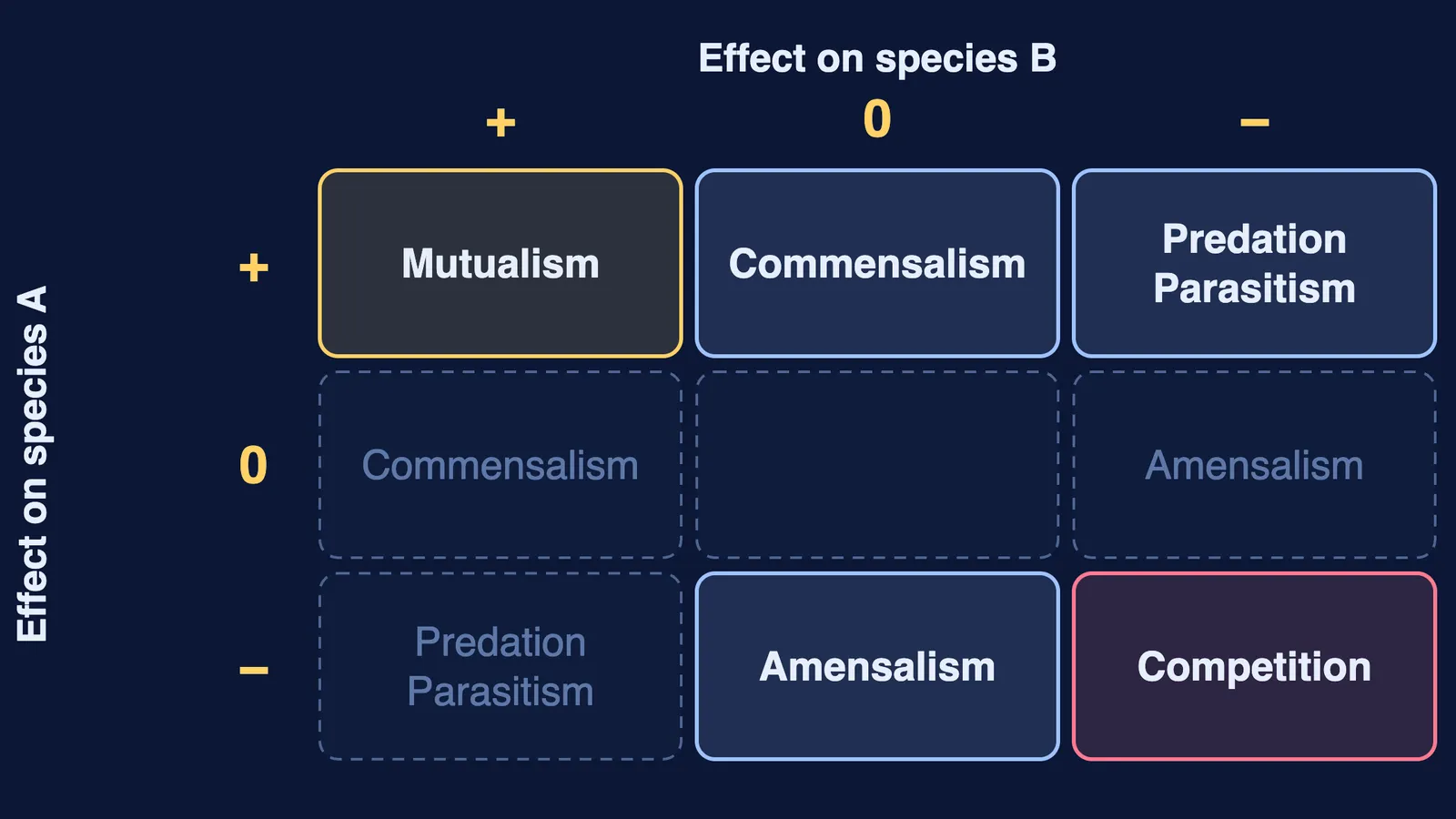
Q1 (easy). Which characteristic does NCERT say predation, parasitism and commensalism share?
(1) The interacting species live closely together (2) The interaction ends with the death of one partner (3) Both partners belong to the same kingdom (4) Each pair is a strict one-to-one, co-evolved partnership
Answer: (1). Section 11.1.4 makes this point just after Table 11.1.
Why the tempting wrong option fails: (2) fits a tiger and a deer, but a commensal harms nobody.
Q2 (easy). Why does NCERT call herbivory a particularly severe problem for plants?
(1) Unlike animals, plants cannot run away from their predators (2) Most insect species feed on plants (3) Plants have no chemical defences (4) Herbivores do not count as predators
Answer: (1). Section 11.1.4 (i): about a quarter of insect species are phytophagous, and plants cannot escape them.
Why the tempting wrong option fails: (2) overstates the share; NCERT's figure is about one insect in four.
Q3 (easy). Which is NOT one of the effects NCERT lists for the chemicals plants store against herbivores?
(1) Making the herbivore sick (2) Inhibiting its feeding or digestion (3) Disrupting its reproduction (4) Speeding up the plant's own growth after grazing
Answer: (4). Section 11.1.4 (i) lists the other three, plus death.
Why the tempting wrong option fails: (3) sounds too indirect to be a defence, but NCERT names it.
Medium: can you apply the ideas?
Q4 (medium). You test a new pesticide on a mite population. Which parameter does NCERT call very important for assessing how any biotic or abiotic factor affects population growth?
(1) The intrinsic rate of natural increase, r (2) The carrying capacity, K (3) The sex ratio (4) The shape of the age pyramid
Answer: (1). Section 11.1.2 names r; 11.1.1 adds that a pesticide's effect shows up as a change in population size.
Why the tempting wrong option fails: (2) is the habitat's ceiling, not the growth measure NCERT names.
Q5 (medium). An annual weed in a disturbed field sets thousands of tiny seeds once and dies. A forest tree fruits for decades. How does NCERT's section on life history variation explain such differences?
(1) Each strategy evolved under the abiotic and biotic constraints of its habitat, as populations evolve to maximise reproductive fitness (2) One strategy is best everywhere, so the other species is less evolved (3) Life history is fixed by body size alone (4) Plants pick a strategy each season
Answer: (1). Section 11.1.3 ties each strategy to the selection pressures of the habitat.
Why the tempting wrong option fails: (2) assumes a single best answer; NCERT links the best strategy to the habitat.
Q6 (medium). Why do NCERT's global species estimates give no figures for prokaryotes?
(1) Conventional taxonomic methods do not suit microbial species, and many cannot be cultured in the laboratory (2) Prokaryotes are too few to change the totals (3) Prokaryotes are counted along with fungi (4) Prokaryotes live only in habitats that cannot be sampled
Answer: (1). Section 13.1.1; by molecular criteria, prokaryotes alone might run into millions of species.
Why the tempting wrong option fails: (2) gets the scale backwards; the gap is in counting, not in numbers.
Q7 (medium). NCERT says human colonisation of tropical Pacific Islands is thought to have caused the loss of more than 2,000 species of which group?
(1) Native birds (2) Native mammals (3) Freshwater fishes (4) Flowering plants
Answer: (1). Section 13.1.4 uses it to show human activities driving biodiversity loss.
Why the tempting wrong option fails: (2) sounds plausible, but NCERT's figure is for birds.
Hard: can you reason past the obvious?
Q8 (hard). A bee bites a hole at the base of a flower and drinks the nectar without touching anthers or stigma. In NCERT's account of plant-animal mutualism, this bee is:
(1) a cheater; the need to guard against such animals helps explain why flower and pollinator co-evolve (2) a commensal, since the plant is unaffected (3) a pollinator, since it visits the flower (4) a brood parasite
Answer: (1). Section 11.1.4 (v) treats nectar and pollen as fees for pollination. Taking the fee without pollinating is cheating, and guarding against cheaters is one reason partners co-evolve.
Why the tempting wrong option fails: (2) ignores that the plant loses its fee and gets no pollination.
Q9 (hard). Per NCERT, tropical rain forests have shrunk from more than 14 per cent of Earth's land to 6 per cent or less. Taking the figures as exactly 14 and 6 per cent, what share of the original rain forest cover has been lost?
(1) About 57 per cent (2) 8 per cent (3) About 43 per cent (4) About 133 per cent
Answer: (1). Section 13.1.4 gives these figures under habitat loss and fragmentation, NCERT's most important cause of extinction. The loss is 14 − 6 = 8 percentage points of land, and 8 ÷ 14 ≈ 0.57, so about 57 per cent of the original forest is gone.
Why the tempting wrong option fails: (2) is the drop in Earth's land share, not the share of the forest lost; (3) is what remains.
What should you do after this set?
Rewrite the NCERT line behind each miss in your own words, then work through our statement and match-the-list set on Organisms and Populations, with its growth sums.
Not sure which Ecology chapter to revise first? Fermi's AI tutor works out what you already know and builds a plan for the session.