

On this page
This is the second set of eight original questions. If you have not done the first, start with set 1 of sets, relations and functions questions, easy to hard. This set is harder and mixes sub-topics inside one question. All eight are single-correct.
Which topics does set 2 cover?
NTA's Syllabus for JEE (Main) 2027 puts sets, relations and functions in Mathematics Unit 1: sets, union, intersection and complement, power sets, types of relations, equivalence relations, one-one, into and onto functions, and composition. Q4 and Q5 also use logarithmic and rational functions from Unit 7, and Q7 borrows counting from Unit 4.
Medium: Venn bounds, subset pairs, relations and domains
Q1 (medium). Of 100 students, 65 like maths and 55 like physics. If x students like both, the possible values of x are
(A) 20 ≤ x ≤ 55
(B) 0 ≤ x ≤ 55
(C) 20 ≤ x ≤ 65
(D) 10 ≤ x ≤ 55
Answer: (A). n(M ∪ P) = 120 − x cannot exceed 100, so x ≥ 20, and the overlap cannot exceed the smaller set, so x ≤ 55. Trap: (B) forgets that 120 likes among 100 students force an overlap. Check: at x = 20 nobody likes neither; at x = 55 every physics fan likes maths.
Q2 (medium). A = {1, 2, 3, 4, 5}. The number of ordered pairs (X, Y) of subsets of A with X ∩ Y = ∅ is
(A) 243
(B) 1024
(C) 32
(D) 242
Answer: (A). Each element goes into X only, Y only, or neither, so there are 3⁵ = 243 pairs. Trap: (B) is 2⁵ × 2⁵, every pair of subsets with no condition. Check with A = {1}: (∅, ∅), (∅, {1}) and ({1}, ∅) make 3¹.
Q3 (medium). On {1, 2, 3, 4}, R = {(1, 1), (2, 2), (3, 3), (4, 4), (1, 2), (2, 3)}. The least number of ordered pairs to add so that R becomes an equivalence relation is
(A) 2
(B) 3
(C) 4
(D) 6
Answer: (C). Symmetry needs (2, 1) and (3, 2). Then 1 R 2 and 2 R 3 force (1, 3) by transitivity, and symmetry adds (3, 1). Trap: (A) stops at symmetry. Check: the classes {1, 2, 3} and {4} need 3² + 1² = 10 pairs; R has 6.
Q4 (medium). The domain of f(x) = √(log₂((5x − x²)/4)) is
(A) [1, 4]
(B) (0, 5)
(C) (1, 4)
(D) [0, 5]
Answer: (A). The root needs log₂((5x − x²)/4) ≥ 0, so (5x − x²)/4 ≥ 1, x² − 5x + 4 ≤ 0 and 1 ≤ x ≤ 4. That also keeps the log's argument positive. Trap: (B) only asks for the log to exist. Check: at x = 1 the argument is 1, so f(1) = 0 is defined.
Hard: range, composition, one-one counts and a tricky relation
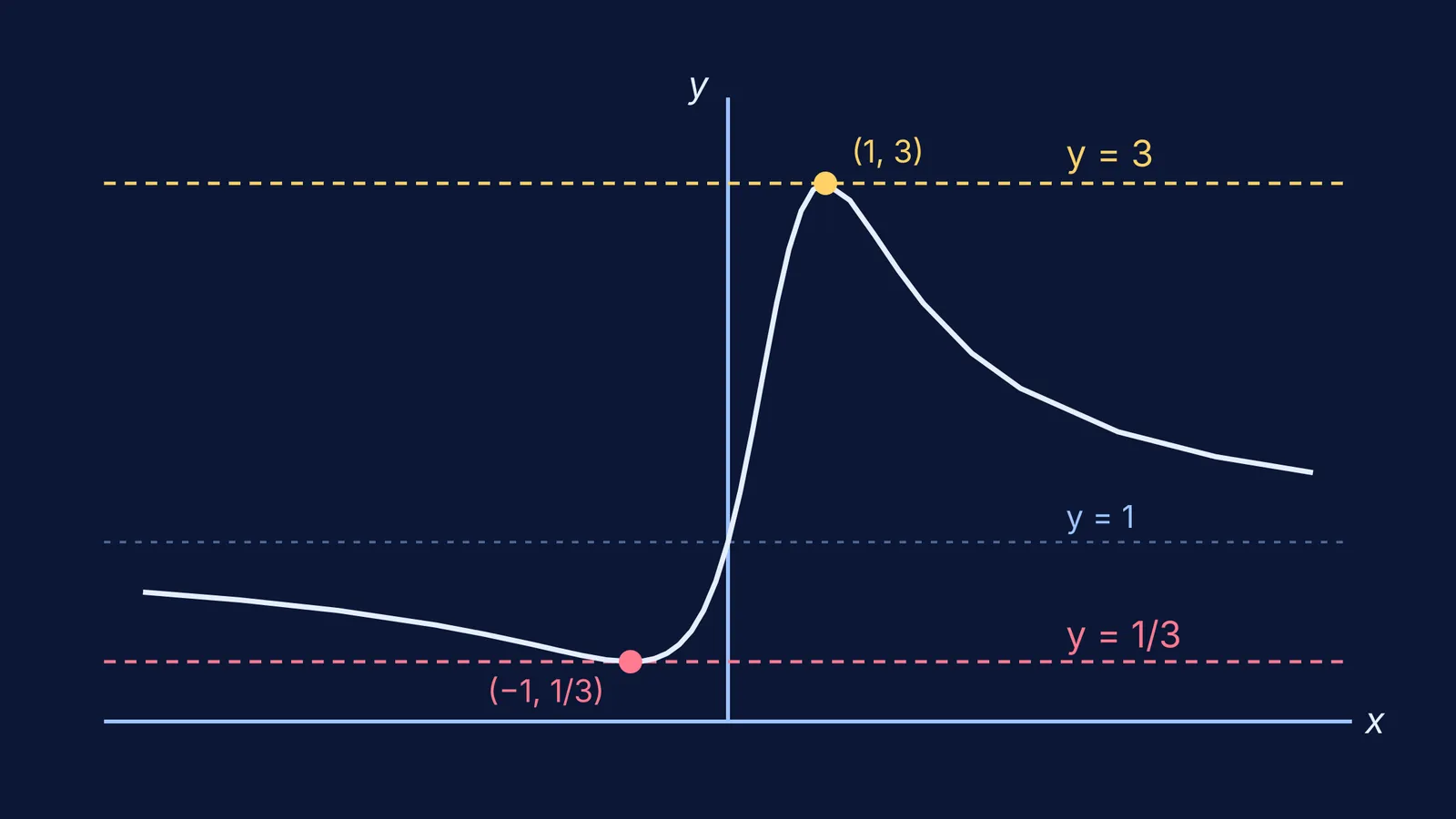
Q5 (hard). The range of f(x) = (x² + x + 1)/(x² − x + 1), x real, is
(A) [1/3, 3]
(B) (1/3, 3)
(C) [1, 3]
(D) all real numbers
Answer: (A). Put y = f(x): (y − 1)x² − (y + 1)x + (y − 1) = 0. For real x the discriminant (y + 1)² − 4(y − 1)² = (3 − y)(3y − 1) must be ≥ 0, so 1/3 ≤ y ≤ 3 (y = 1 comes from x = 0). Trap: (B) drops endpoints that are reached. Check: f(1) = 3 and f(−1) = 1/3, as the diagram at the top shows.
Q6 (hard). f(x) = x² − 2x. The number of real solutions of f(f(x)) = 0 is
(A) 2
(B) 3
(C) 4
(D) 6
Answer: (C). f(t) = 0 at t = 0 or 2, so you need f(x) = 0 or f(x) = 2. The first gives x = 0, 2; the second, x² − 2x − 2 = 0, gives x = 1 ± √3. Trap: (A) solves only f(x) = 0. Check: f(1 + √3) = (1 + √3)(√3 − 1) = 2.
Q7 (hard). The number of one-one functions f from {1, 2, 3, 4} to itself with f(i) ≠ i for every i is
(A) 8
(B) 9
(C) 23
(D) 24
Answer: (B). Inclusion-exclusion on fixed points: 4! − 4 × 3! + 6 × 2! − 4 × 1! + 1 = 24 − 24 + 12 − 4 + 1 = 9. Trap: (C) removes only the identity, though many functions fix one or two points. Check by listing: three swap-pairs such as (1 2)(3 4), plus 3! = 6 four-cycles, make 9.
Q8 (hard). On the real numbers, a R b means a − b + √3 is irrational. Then R is
(A) an equivalence relation
(B) reflexive and symmetric, not transitive
(C) reflexive, but neither symmetric nor transitive
(D) not reflexive
Answer: (C). Reflexive: a − a + √3 = √3 is irrational. Not symmetric: √3 R 0, since 2√3 is irrational, but 0 − √3 + √3 = 0. Not transitive: 0 R √2 and √2 R √3, yet 0 − √3 + √3 = 0 is rational. Trap: (A) sees reflexivity work and assumes the rest. Check: one counterexample is enough to rule out a property.
How should you review your mistakes from set 2?
Name each miss: a condition dropped (Q1, Q2, Q4, Q5), a case missed (Q3, Q6, Q7) or a property assumed (Q8).
Test every relation property on a small counterexample before you choose.
Two days later, redo the misses from a blank page.
Then switch format with these sets, relations and functions numerical value questions, where there are no options to work back from. For a plan for the whole chapter, see our guide to preparing sets, relations and functions for JEE Main.
If a step still does not make sense, the Fermi Problem Library has worked problems with a step-by-step solver that explains the reasoning rather than printing an answer. For JEE Main and Advanced preparation, see Fermi Test Prep.


